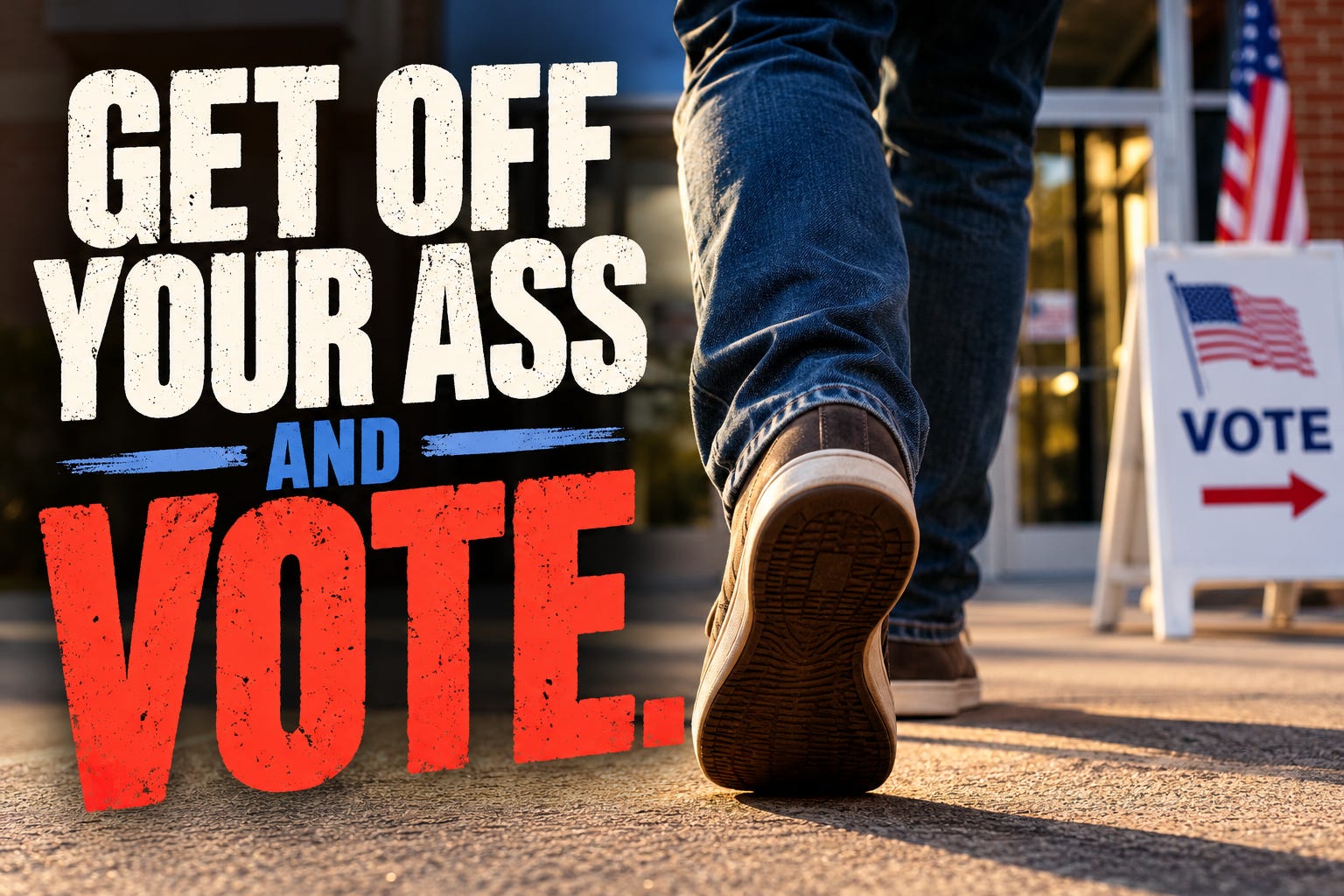
There comes a point when complaining about the state of our nation becomes an exercise in futility if we are unwilling to do anything about it.
We complain about Congress. We complain about the economy. We complain about the cost of groceries, the price of housing, the condition of our schools, and the seemingly endless parade of political theater masquerading as governance.
The Table with Timothy Hundley is a reader-supported publication. To receive new posts and support my work, consider becoming a free or paid subscriber.
We complain over dinner. We complain on social media. We complain to our friends, our coworkers, and anyone unfortunate enough to be standing within earshot.
And then Election Day comes.
And some of us stay home.
I have a rather straightforward message for those of us who have made political outrage a recreational activity:
Get off your ass and vote.
Your Outrage Is Not a Ballot
We have become exceptionally talented at expressing dissatisfaction.
We can compose a scathing Facebook post, dismantle a politician’s argument in a comment section, and spend hours debating the failures of our government.
But none of those activities casts a ballot.
There is a peculiar contradiction in demanding accountability from elected officials while declining to participate in the process by which those officials are elected.
Voting does not guarantee that our preferred candidates will win. It does not guarantee that legislation will pass, that campaign promises will be honored, or that the machinery of government will suddenly function as we believe it should.
But it establishes something foundational: participation.
Democracy is not a promise that we will always get our way. It is a system through which we exercise a measure of collective authority over the people who govern us.
And that authority requires us to show up.
The Midterms Are Not a Dress Rehearsal
On Tuesday, November 3, Americans will head to the polls for the 2026 midterm elections.
Every seat in the United States House of Representatives is up for election, along with approximately one-third of the Senate. Depending on where you live, additional state and local contests and ballot measures may also appear.
These are not inconsequential elections tucked between presidential campaigns.
Congress writes laws, appropriates funds, conducts oversight, and exercises powers that shape the direction of the nation.
Meanwhile, state and local governments make decisions whose consequences we encounter in our schools, neighborhoods, workplaces, and everyday lives.
The presidency may command the greatest share of national attention, but governing does not happen exclusively at 1600 Pennsylvania Avenue.
If we only pay attention to democracy once every four years, we are ignoring much of the government that affects our daily lives.
Faith Without Participation?
For those of us who approach public life through the lens of faith, I believe there is an additional question worth considering.
What does it mean to pray for justice while refusing opportunities to participate in the public decisions that affect our neighbors?
The prophet Micah asks what the Lord requires of humanity and answers with a familiar charge: to do justice, love kindness, and walk humbly with God.
Notice that justice is something we are called to do.
Not merely admire.
Not simply discuss.
Not endlessly lament its absence.
Do.
I am not suggesting that casting a ballot fulfills the whole of our moral responsibility. Far from it.
And I certainly reject the notion that any political party enjoys exclusive ownership of God’s will.
Faithful people can examine the same issues and arrive at different political conclusions. Conscience deserves more respect than partisan conformity.
But we cannot reasonably claim that our neighbors’ well-being matters to us while treating every opportunity for civic involvement as someone else’s responsibility.
Prayer and participation are not mutually exclusive.
We can do both.
The Privilege of Having a Choice
We should also be honest about the fact that voting is not equally easy for everyone.
Some people face transportation problems, inflexible work schedules, disabilities, caregiving responsibilities, complicated registration requirements, or other genuine barriers.
Those realities deserve attention, not condemnation.
A person prevented from voting by circumstances beyond their control is not the same as a person who simply cannot be bothered.
That distinction matters.
But for those of us who are eligible, have access to the polls, and possess the means to participate, habitual indifference deserves examination.
We live in a country where generations struggled to expand access to the ballot.
The history of American democracy includes extraordinary movements to secure voting rights for people who were deliberately excluded from political participation.
That history does not mean our electoral system is perfect. It certainly does not mean our work toward a more representative democracy is finished.
It does mean the right to vote should never be treated as something too insignificant to exercise.
Stop Waiting for the Perfect Candidate
I often hear people explain their absence from the polls by declaring that they dislike every available candidate.
I understand the frustration.
Political campaigns can be exhausting. Candidates can disappoint us. The distance between political promises and governing realities can make even attentive citizens cynical.
But the ballot is not a marriage proposal.
We are not being asked to find a candidate who embodies everything we believe, thinks precisely as we think, or satisfies every moral and political expectation we possess.
We are being asked to exercise judgment.
That judgment may lead different voters to different conclusions. It may also lead someone to leave a particular contest blank while participating in others.
The important thing is to approach the decision thoughtfully rather than surrendering the whole exercise to apathy.
Read the ballot. Examine the candidates’ records and proposals. Understand the questions being presented. Decide what your conscience permits.
Then act accordingly.
November 3 Is Coming
There is still time to make a plan.
Find out where you vote. Check your registration and the voting requirements in your state. Review the candidates and ballot questions before you enter the polling place.
If early voting is available to you, consider using it.
If you have already voted, wonderful. If you know someone struggling to navigate the process, help them locate reliable election information.
And if you have spent the last two years complaining about the people making decisions in Washington, your state capital, or your city hall, consider whether you are willing to spend a little time participating in the process that puts them there.
The future of this country is not determined by a single election. Our democracy requires far more than ballots, and citizenship demands far more than occasional participation.
But elections are among the most direct opportunities we possess to exercise our civic voice.
So exercise it.
Not because I told you which candidate deserves your support.
Not because a political party expects your loyalty.
Not because a preacher, commentator, celebrity, or social media personality has declared what your conscience must believe.
Vote because your citizenship carries both a voice and a responsibility.
Vote thoughtfully. Vote according to your convictions. Vote with an understanding that your neighbors have just as much right to reach a different conclusion.
And whatever the outcome, remain engaged afterward.
Because democracy is not something we observe from the comfort of our couches while complaining that everyone else is doing it wrong.
It is something we participate in.
So, with all the love and exasperation I can muster:
Get off your ass and vote.
And as always, there’s room for another chair at the table.
— Timothy Hundley
Voting resources
Election Day: Tuesday, November 3, 2026.
* National voter information…