“Some folks are too heavenly minded to be any earthly good.”
It’s an old saying, whispered in pews and passed through generations.Usually it’s said with a sigh — meant to humble those who float so high above the dust of life that they forget what it feels like to have feet on the ground.
But maybe the opposite has become true in our time.Maybe we’ve become so spiritually theoretical that we’ve forgotten how to be spiritually embodied.We speak of saving souls but neglect the body that houses them.We chase transcendence while ignoring the temple through which heaven meets the dirt.
We’ve mistaken holiness for disembodiment — as though our flesh were a distraction instead of a declaration;a problem to escape rather than a place God has chosen to dwell.
The Body as Sacred Architecture
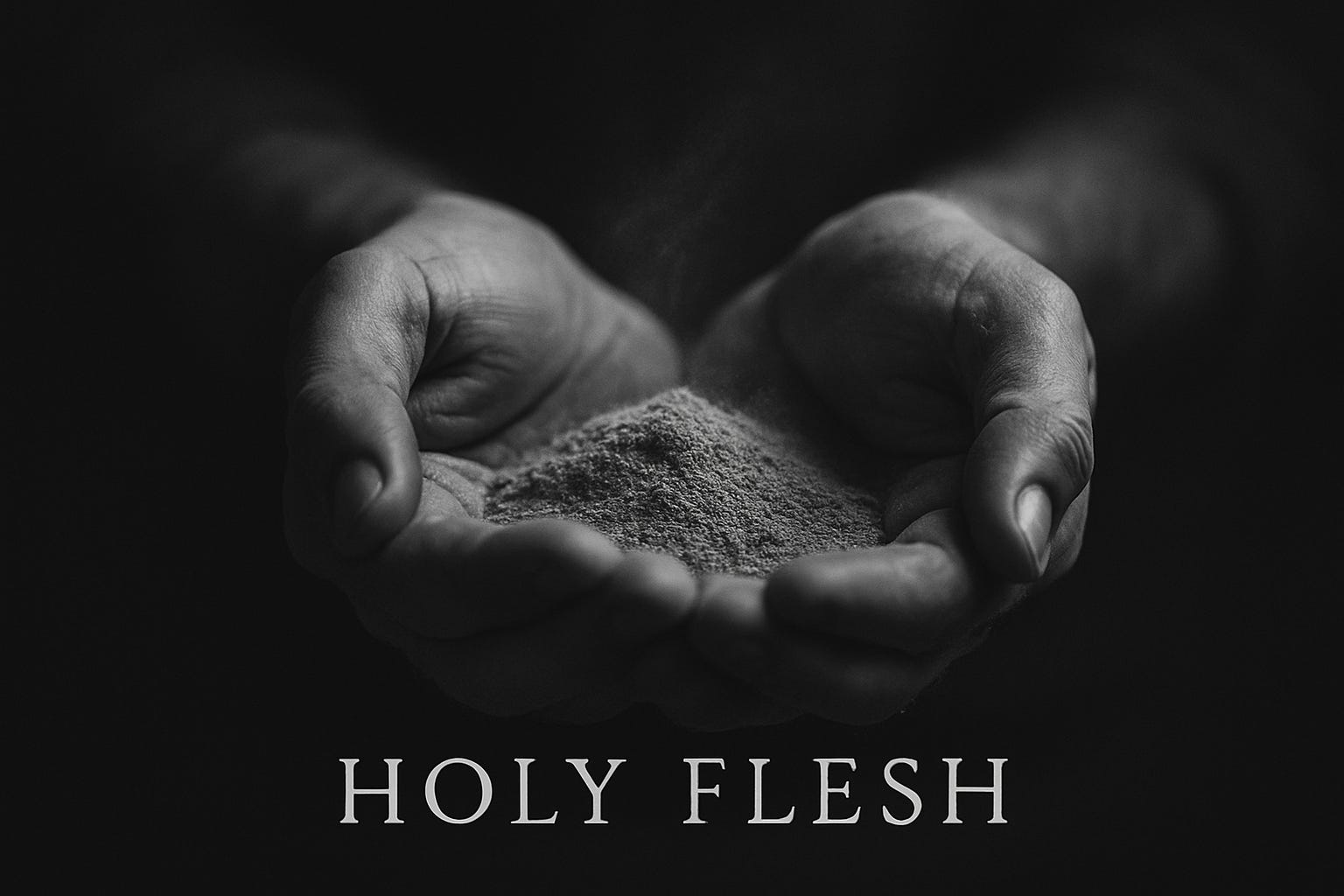
From the very beginning, God tied spirit to substance.“Then the Lord God formed man from the dust of the ground and breathed into his nostrils the breath of life.” — Genesis 2:7
Dust and breath. Matter and mystery. Neither whole without the other.
Our bodies are sacred architecture — designed to host the divine.They are not rental property for the soul, but dwelling places of presence.The body is the throne of our will, the frame through which God’s image becomes visible.
Even our senses are sermons: the taste of bread, the sound of singing, the feeling of touch — each one is an invitation to experience grace in physical form.We were never meant to ascend away from our bodies; we were meant to inhabit them with reverence.
The Incarnation: Divine Embodiment
And then — as if to silence every notion that flesh is inferior — the Word became flesh.God did not redeem us from a distance. He wrapped Himself in skin and nerve and muscle. He took on hunger, exhaustion, and pain. He touched lepers. He washed feet. He wept.
Every act of redemption was physical: birth, breath, blood, cross.Why a physical sacrifice for a spiritual condition?Because the condition was never just spiritual — it was total, embodied.And so was the cure.
The Incarnation tells us something essential:God does not despise flesh.He enters it.He sanctifies it.He calls it holy ground.
Reverent Stewardship: Caring for the Whole Temple
Reverent stewardship encompasses all the parts of us.Scripture calls us to “love the Lord your God with all your heart, all your soul, and all your mind.”But implicit in that command is another truth: if the body is the temple, then the whole of us is sacred space.
To love God fully means to honor the design He gave us.
* The mind must be tended through reflection and renewal — through the humility of therapy and the courage of self-examination. Thought can be an altar or a battleground; we decide which by what we invite to dwell there.
* The soul is nourished through community and worship — through the table of belonging and the song of shared faith. No soul can thrive in isolation; our inner life needs the sound of others praying beside us.
* The heart finds strength in relationship with the Almighty — the pulse of prayer aligning us to the rhythm of divine love.
* And the body — the often-forgotten vessel — houses them all. Our physiology is not incidental; it is the sacred scaffolding that holds spirit and mind and heart together.
To care for it is not vanity; it is obedience.Eating can be worship when done with gratitude and restraint — a recognition that maintenance, not indulgence, sustains the temple.Exercise becomes devotion, the stewardship of strength.
Without movement, the body atrophies;without Eucharist and worship, the soul does the same.Both need participation. Both require rhythm. Both are forms of reverence.
Our flesh is not the enemy of our faith — it is the means through which faith breathes, serves, embraces, and heals.The body, properly cared for, becomes the sermon — a living testimony that grace does not just dwell in heaven; it inhabits us.
The Living Sacrifice
“Offer your bodies as a living sacrifice, holy and pleasing to God — this is your true and proper worship.” — Romans 12:1
Notice the phrasing: not your prayers, not your songs, not your intentions — your bodies.The totality of you.
Worship is not an hour in a sanctuary; it is every breath, every motion, every meal, every rest offered with awareness that this life is borrowed breath wrapped in holy dust.
To honor your body is to proclaim resurrection in real time —to live as though the tomb is still empty and flesh still sacred.
Your heartbeat is not separate from your holiness.Your health is not detached from your discipleship.Your care for yourself is not self-centered — it is God-centered when done in reverence.
A Benediction for the Embodied
To follow Christ is not to escape the flesh but to sanctify it.To breathe deeply, eat gratefully, rest without guilt, and move with mercy — this is worship incarnate.
So this Sunday, may you love God not only with your mind and soul,but with your pulse, your breath, your stride, your appetite, your very skin.
May your body become prayer.May your care become liturgy.And may every beat of your heart preach this truth:God still dwells in flesh — and calls it good.