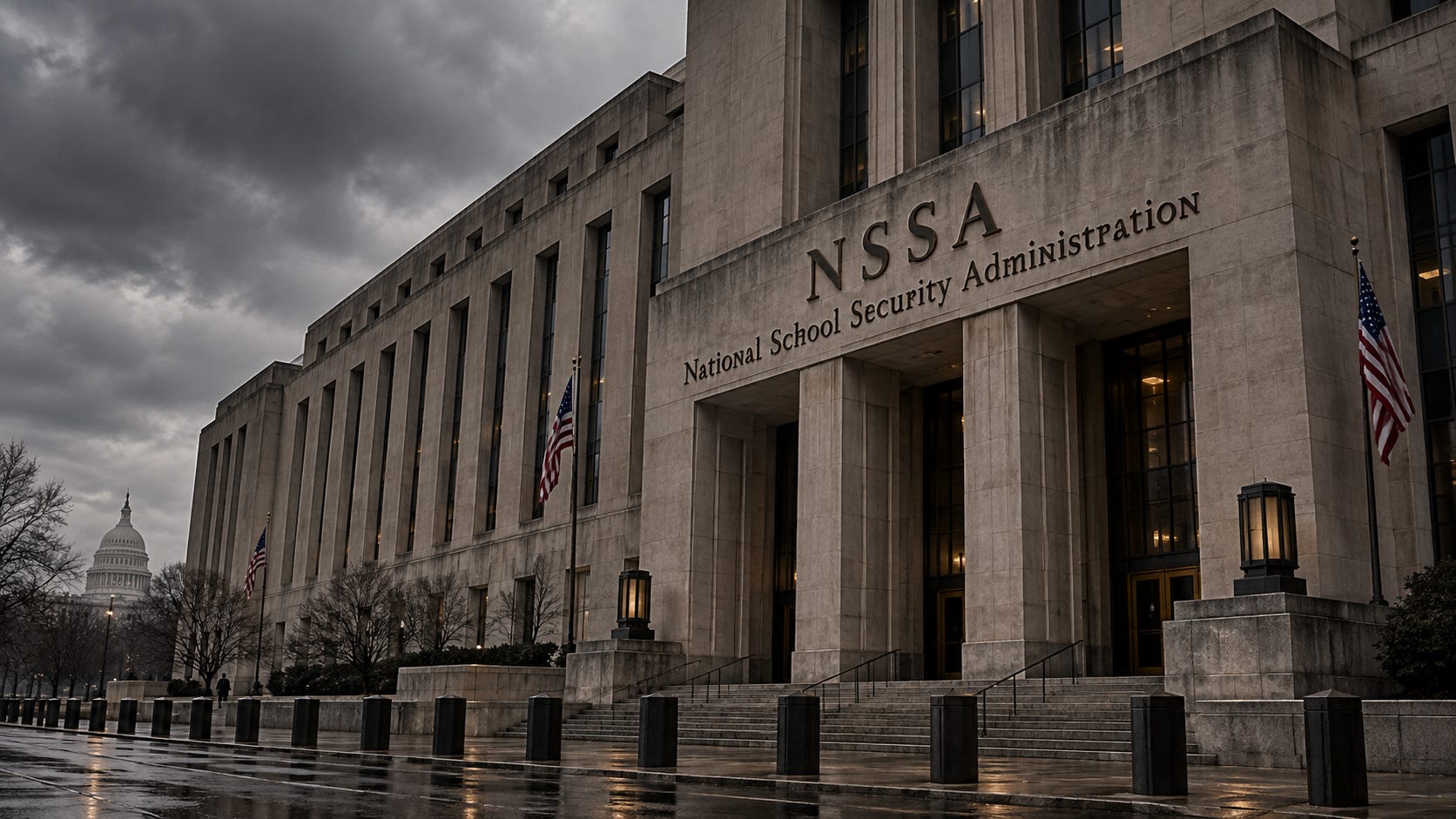
A five-year-old child went to elementary school in Bend, Oregon, on Thursday. That child did not come home. Neither did an eight-year-old. Neither did an eleven-year-old. Neither did one of their teachers.
On October 15, 2026, a 16-year-old armed with a pump-action shotgun arrived at Silver Rail Elementary School and opened fire. Another seven-year-old child and another teacher were critically wounded.
The doors were locked. I want you to sit with that sentence. The doors were locked. The shooter shot through them.
Because somewhere along the way, America decided that “lock the doors” constituted a serious national security strategy for elementary school children facing firearms powerful enough to make the lock irrelevant.
And now we will do what we always do. We will lower flags. We will send thoughts. We will offer prayers. Parents will receive emails assuring them that their own child’s school takes safety very seriously. Teachers will review procedures. Children will practice where to hide. Politicians will call what happened “unimaginable,” even though American children have been required to imagine precisely this scenario during lockdown drills for years.
Spare me the word unimaginable. We have imagined it. We have rehearsed it. We have rehearsed it with kindergarteners. What we have refused to do is treat it like a national emergency.
After September 11, 2001, the United States did not respond to the murder of nearly 3,000 people by telling airline passengers to become more situationally aware. We did not hand pilots a pamphlet. We did not leave airport security entirely to a collection of municipalities and hope that each one found enough room in next year’s budget.
Congress passed the Aviation and Transportation Security Act in November 2001. It created the Transportation Security Administration. Federal law required the deployment of enough federal screeners, security managers, security personnel, and law-enforcement officers to perform required screening at American airports within one year.
One year.
By 2022, TSA described an operation spanning roughly 430 federalized airports with approximately 60,000 employees.
We changed the experience of air travel for an entire nation because we decided something very simple: Certain catastrophic risks are unacceptable even when they are statistically rare.
You take off your shoes because one man once tried to detonate explosives hidden in his. Your bag goes through a machine. Your body goes through a machine. Your shampoo bottle can be confiscated. There are federally established rules determining what you may carry through a checkpoint before boarding an airplane.
We accepted inconvenience, bureaucracy, billions of dollars in spending, federal employees, new technology and permanently altered public behavior because Americans agreed that preventing another catastrophic aviation attack was worth it.
Now consider where we send our children.
The United States operates 99,073 public elementary and secondary schools serving 49.3 million students. In the most recent nationwide federal school-security statistics, 97.1 percent of public schools controlled access to their buildings. Only 2.4 percent conducted daily metal-detector checks on students. Among elementary schools, it was approximately 0.5 percent.
And today in Bend, the locked door did exactly what a locked door can do against a shotgun. Almost nothing.
Donald Trump loves executive orders. He has used presidential authority again and again to reorganize federal priorities, reshape immigration enforcement, change government policy, restructure agencies and push the machinery of the executive branch toward whatever he believes deserves immediate attention.
Fine.
Here is another order for the Resolute Desk. Protect America’s children.
Tomorrow morning, direct the Department of Justice, Department of Education, Department of Homeland Security and every other relevant federal agency to develop a national standard for school security. Inventory every federal program already available. Coordinate them. Prioritize school protection. Identify every authority the executive branch already possesses.
Then walk to a microphone and tell Congress that America needs a permanent institution devoted to this problem: The National School Security Administration.
The NSSA.
TSA exists because we decided that the safety of Americans traveling through our transportation system was a matter of national importance. Why isn’t the safety of children attending a legally compulsory public institution treated the same way?
Give the NSSA one mission: No child’s physical safety at school should depend upon the ZIP code in which that child happens to live.
Let it establish national minimum standards. Let it fund hardened entrances. Let it fund modern access control. Let it help schools install appropriate weapons-detection technology where evidence and risk assessments justify it. Let it fund emergency communications. Let it establish national threat-assessment standards. Let it integrate anonymous reporting systems. Let it help districts hire the security professionals they cannot afford. Let it inspect. Let it certify. Let it collect data. Let it study failures. Let it research what works. And when something fails, let it change the standard.
Most importantly, let Washington pay for it instead of sending another grant application to an exhausted superintendent and calling that a national policy.
Yes, Congress would have to create and permanently fund such an agency. Then send Congress the bill. Make them vote on it. Make every senator and every representative put their name next to an answer to one simple question: Do you believe every American child deserves a minimum national standard of physical safety at school, or don’t you?
And if the answer is yes, fund it.
Not someday. Not after another commission. Not after another study. Not after another massacre. Now.
If this administration can discover urgency when it wants urgency, then surely murdered elementary school children qualify. If executive power can be used aggressively to pursue immigration priorities, economic priorities, regulatory priorities and political priorities, then use that same urgency to make schoolchildren a national priority.
Do not tell me Washington is powerless. Washington is almost never powerless. Washington is selective.
And if Washington says we cannot afford it, then perhaps it is finally time for a national conversation about the things America apparently can afford.
We live in one of the wealthiest societies in human history. We live in a country where individual human beings control fortunes measured in hundreds of billions of dollars.
Perhaps Elon Musk could part with some infinitesimal fraction of that extraordinary wealth. Perhaps the billionaires who have benefited enormously from American infrastructure, American research, American universities, American workers, American courts, American financial markets, American government contracts and American technological development could help finance the civilization that made fortunes of that scale possible.
Perhaps the President of the United States, who so readily speaks of national greatness, could decide that national greatness includes children surviving elementary school. Perhaps Congress could discover that protecting classrooms deserves the same urgency routinely summoned for tax policy, defense programs, border infrastructure, corporate incentives and every other priority Washington suddenly knows how to finance when powerful people decide it matters.
I am tired of being told what America cannot afford immediately after watching America produce money for the things it actually values.
Show me the federal budget and I will show you a moral document. Budgets tell us what matters. And if nearly 50 million public-school children can be sent into buildings with radically different levels of protection depending on the wealth of their district, then the federal budget is tel…