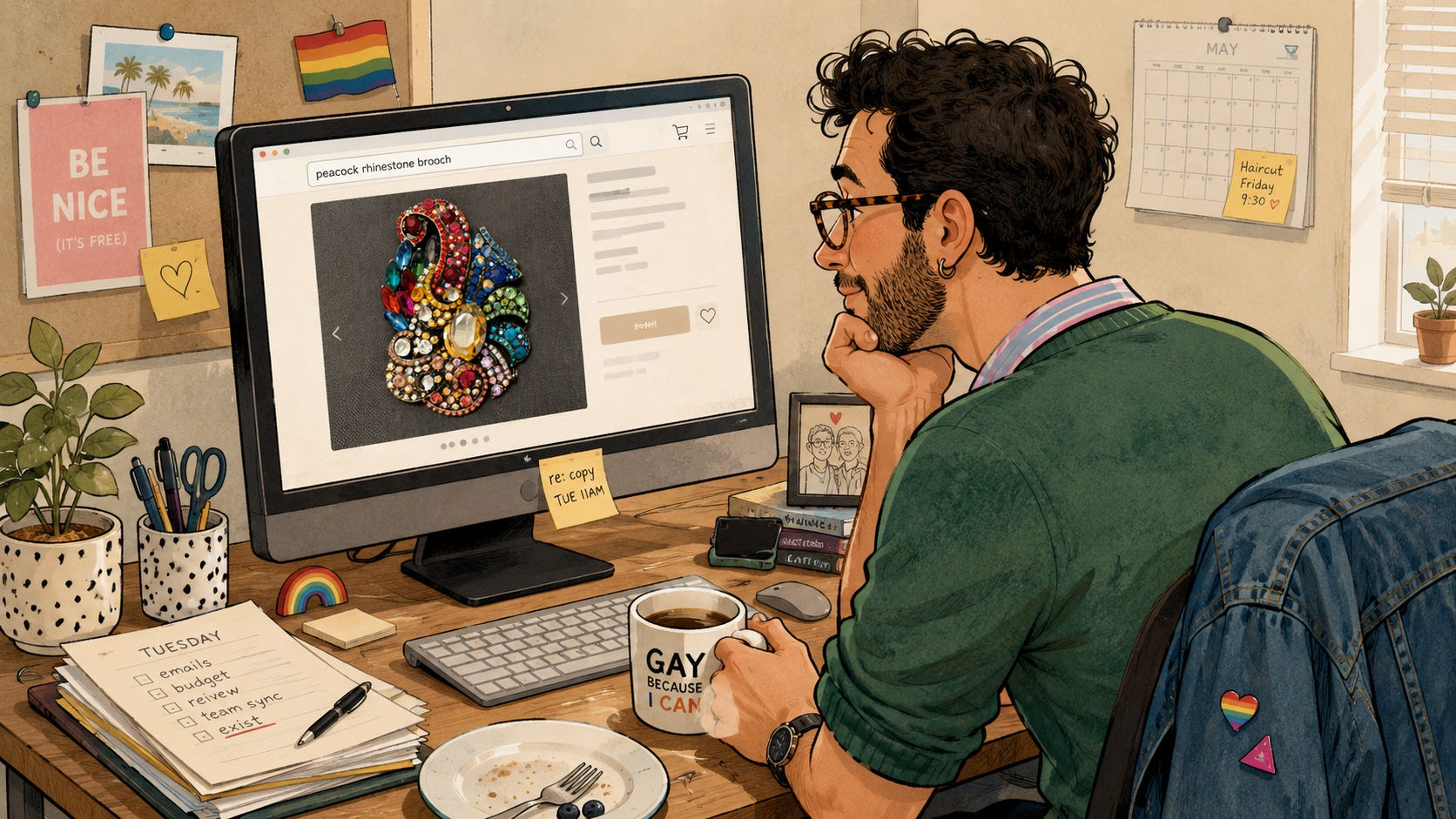
I got up. Made coffee. Cooked eggs. Got on the treadmill. Showered, got dressed, started work, checked email. Nothing cinematic happened. It was the kind of morning most of us live thousands of times without remembering any particular one of them.
Somewhere in the middle of that ordinary machinery, I found myself scrolling through things I absolutely did not need and discovered three spectacularly unnecessary rhinestone brooches for fifteen dollars.
Naturally, I wanted them.
Then I saw a set of children’s lunchboxes, and my first thought came before I had time to examine it: I should get these for the kids.
For half a second, the thought felt completely normal. Then I remembered that the children I already imagine packing lunches for are still part of the life I am waiting and praying for. They are not here yet.
And then I went back to Tuesday.
A little later, another email arrived.
“GOP reps lob outing threats, MI ends conversion therapy ban & Dem apologizes for anti-trans stance.”
And there it was. That familiar internal alarm:
Pay attention. They’re talking about us again.
Put down whatever you were doing. Look up. Someone with power is discussing queer people again.
Again, being gay is apparently shameful enough that the possibility of exposing someone can still be wielded as political ammunition.
Again, conversion therapy—a practice built on the premise that there is something defective about queer people that should be corrected—is back in the news because protections against it are being stripped away or rendered unenforceable.
Again, transgender people are being discussed as a political liability, a campaign calculation, a position to apologize for, revise, defend, abandon, or rediscover depending on which electorate someone hopes to persuade this week.
Again.
That word may be the most exhausting part of all.
Because none of this happens in some separate political universe where queer people exist only as constitutional questions, campaign talking points, and cable-news segments. We are at work. We are grocery shopping. We are deciding what to make for dinner. We are taking children to school, or dreaming about the family we hope will someday fill the house. We are going to church. We are getting married and getting divorced. We are caring for aging parents. We are trying to build lives, save money, make plans, keep appointments, fall in love, heal from heartbreak, and occasionally decide whether three rhinestone brooches for fifteen dollars constitutes a sound financial decision.
We are trying to live.
And then the notification arrives.
Pay attention. They’re talking about us again.
Our marriages again. Our children again. Our bodies again. Our healthcare again. Our books again. Our privacy again. Whether children should be permitted to know that people like us exist again. Whether someone should be allowed to convince a frightened queer teenager that God would love them better if they could become somebody else again. Whether being suspected of homosexuality remains sufficiently humiliating to function as a threat against another grown adult again.
And somewhere in all of this, we are expected to formulate another argument. Another defense. Another theological response. Another explanation of why queer people are human beings worthy of the same dignity, privacy, safety, family, faith, and ordinary existence everyone else assumes belongs to them without debate.
I am tired of answering that question.
There is something uniquely exhausting about carrying all the ordinary burdens of human existence while periodically being required to defend your eligibility for ordinary human existence.
I already have enough to do. I have work. I have disappointments. I have grief. I have unanswered prayers. I have people I love and people I miss. I have a future I am trying to build, a body that gets tired, and apparently a ridiculous jeweled peacock I have decided would improve my quality of life.
That is plenty.
So, with all the Christian charity I can presently muster, I have one small request for the people who remain fascinated by governing queer lives:
F**k off, kindly.
Mind your own business.
Let people marry. Let people raise their families. Let people receive healthcare with their doctors. Let children grow up without adults teaching them to hate themselves. Let people read books. Let people worship. Let people decide what names belong to them, what clothes belong on their bodies, whom they love, whom they come home to, and what kind of life they want to build.
You do not have to understand every life in order to leave it alone. You do not have to approve of everybody in order to protect their dignity. And Christianity certainly does not require you to make somebody else’s existence your personal legislative project.
If your politics, your theology, or your moral vision requires another human being to live perpetually beneath your inspection, perhaps the problem is not that they have failed your standard.
Perhaps you have forgotten Jesus.
So please.
For once, let us get on with the ordinary business of being alive. Let us pay the bills and make dinner. Let us buy the lunchboxes when the children finally come. Let us occasionally waste fifteen dollars on something gloriously unnecessary. Let us love our husbands and wives. Let us raise our families. Let us pray. Let us grow old.
Let us have entire stretches of our lives in which nobody requires us to look up from a perfectly ordinary Tuesday because someone powerful has decided our humanity requires another public discussion.
I do not want to spend the rest of my life proving that I am human. I would very much like to get on with being one.