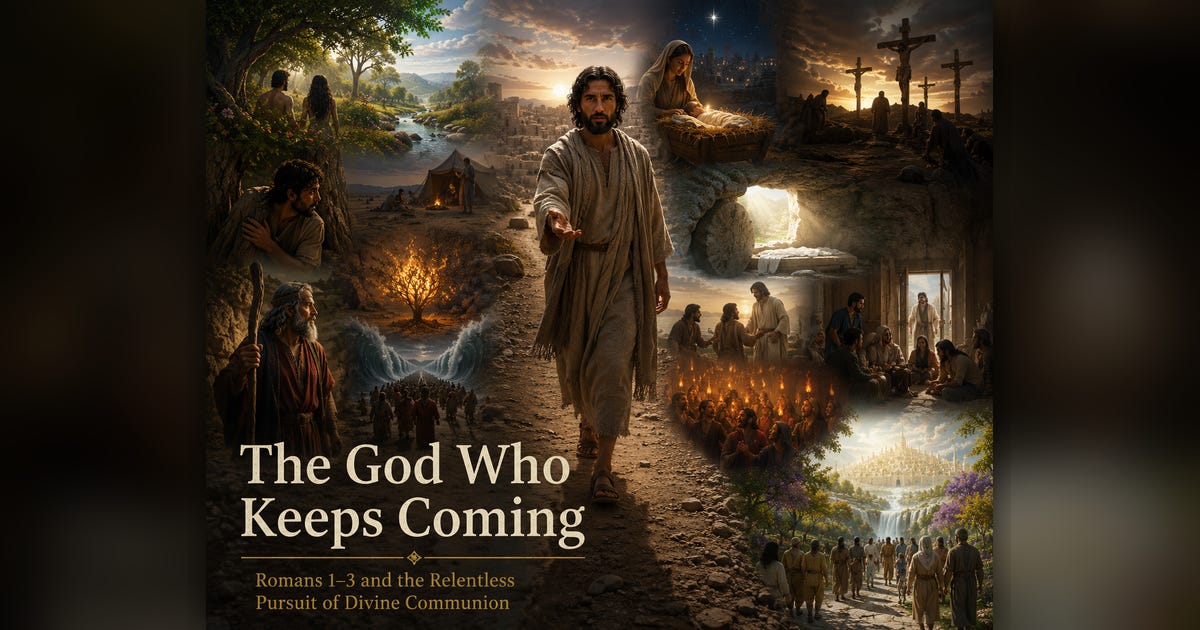
The Gospel Is God’s Relentless Desire for Communion
“For I am not ashamed of the gospel, because it is the power of God for salvation to everyone who believes.” — Romans chapter one verse sixteen
There may not be a more familiar verse in Paul’s letter to the Romans. Most Christians can quote at least part of it from memory: “For I am not ashamed of the gospel.” Yet I wonder how often we stop long enough to ask the question Paul assumes we understand.
What is the Gospel?
For many Christians, the answer begins with heaven. For others, it begins with forgiveness. For still others, it begins with the cross. None of those answers is wrong, but none of them, by itself, is complete. The Gospel is the good news that the God who spoke humanity into existence has never abandoned his desire to dwell with his creation.
The Gospel is God’s relentless desire for communion with humanity.
That story did not begin in Bethlehem. It began in a garden.
Genesis does not begin with humanity searching for God. It begins with God walking among his creation. The Garden of Eden is a place of beauty, abundance, nourishment, and peace, but the garden is not paradise merely because of its rivers, its trees, or the absence of death. The treasure of Eden is that God is there. Humanity lives in uninterrupted communion with its Creator.
Then comes rebellion, and the first consequence of sin is not merely guilt. It is separation. Adam and Eve hide, and God comes looking.
“Where are you?”
That question echoes through the rest of Scripture. Humanity hides, and God comes. Cain murders, and God comes. Abraham wanders, and God comes. Moses flees, and God comes. Israel rebels, and God comes through the prophets. Humanity crucifies Christ, and God comes out of the grave. The disciples hide behind locked doors, and God comes. The Spirit descends, and God comes.
The Bible ends where it began: with God dwelling among humanity. Not merely with golden streets, walls of jasper, and gates of pearl, but with the great proclamation that “the dwelling of God is with humanity.”
The story of Scripture is not primarily about humanity finding its way to heaven. It is about God refusing to stop making his way toward humanity.
That is why Romans matters. Paul is not inventing the Gospel. He is explaining why restored communion with God required nothing less than the self-giving love of Christ. Before Paul announces what grace accomplishes, he dismantles every illusion that humanity can restore communion on its own.
That dismantling does not stop at the end of Romans 1. It continues through Romans 2 and into Romans 3. In fact, Romans chapter one verse eighteen throughRomans chapter three verse twenty is one sustained argument. It is the diagnosis before the cure, the courtroom before the declaration of grace, the universal need before the universal invitation.
Our chapter and verse divisions often hide this from us. We read a verse as though it contains a complete thought. We read a chapter as though it contains a complete story. Paul wrote neither. He wrote a letter, and he did not stop writing where we so often stop reading.
Romans 2 begins with a single word.
Therefore.
That word changes everything because Paul has not changed subjects. He is continuing his argument. After describing humanity’s rebellion, idolatry, corruption, and disorder, Paul turns toward the person who has been listening and agreeing.
“Therefore you have no excuse, whoever you are, when you judge another.”
Imagine hearing Romans read aloud for the first time. As chapter 1 unfolds, heads begin to nod. Yes, Paul. That is exactly what is wrong with the world. Those people have abandoned God.
Then Paul says, “Therefore.”
The room becomes quiet. The spotlight turns. The listeners discover that they have not merely been watching someone else’s trial. They have been sitting in the defendant’s chair all along.
Romans 1 is the indictment. Romans 2 is the mirror. Romans 3 is the verdict: “There is no distinction, for all have sinned and fall short of the glory of God.”
Only then does grace become good news.
This also reveals the difference between judgment and discernment. Judgment assumes a seat that belongs to Christ. Judgment says, “I have decided that you are not worthy.” Discernment asks a different question: Does this look like Jesus?
That has become the foundational question of The Table. Not, “Does this person deserve Jesus?” but, “Does this teaching resemble Jesus? Does this movement resemble Jesus? Does this policy resemble Jesus? Does this fruit resemble Jesus?”
Jesus taught that we would know people by their fruit. Fruit can be examined. Actions can be named. Teachings can be tested. Movements can be discerned. But another person’s final standing before God belongs to Christ.
Discernment evaluates fruit. Judgment declares worth.
The Church is called to the first. The second belongs to God.
That is why Acts 10 remains one of the most revolutionary passages in the New Testament. Peter is not rebelling against God. He believes he is defending holiness. He believes he understands what is clean and what is unclean. He believes he knows where the boundaries have been drawn.
Then God interrupts his certainty.
“What God has made clean, you must not call profane.”
Peter enters the home of Cornelius. The Spirit falls upon the Gentiles. Peter then asks one of the most beautiful questions in Scripture: “Who was I to hinder God?”
Peter did not become less faithful. He became less certain that his understanding of God’s boundaries was complete. That is repentance.
Sometimes the hardest thing we surrender is not our appetite, our ambition, or even our fear. Sometimes the hardest thing to surrender is our certainty: the certainty that we know exactly where God is allowed to move, whom God may receive, and where grace must stop.
The Church’s greatest moments have rarely come when it led God somewhere new. They came when it finally realized that God was already there.
When Jesus taught his disciples to pray, he said, “Your kingdom come. Your will be done, on earth as it is in heaven.”
What does that Kingdom look like?
We could begin with Revelation. We could speak of gates of pearl, streets of gold, walls of jasper, and the throne of God. But perhaps we should begin where Scripture begins.
In the garden.
The garden is beauty. The garden is abundance. The garden is sustenance. The garden is creation at peace. Most of all, the garden is communion. It is humanity walking with God.
Then we move to Matthew 25. The hungry are fed. The thirsty receive something to drink. The stranger is welcomed. The naked are clothed. The sick are cared for. The prisoner is visited. This is not merely charity. It is the character of the Kingdom becoming visible on earth.
Then we arrive at Revelation, and once again the greatest promise is not wealth. It is presence.
“The dwelling of God is with humanity.”
The Kingdom is not first defined by geography. It is defined by communion. The streets of gold are not the treasure. God is.
Perhaps gold covers the streets because, in the Kingdom, the thing humanity has killed for, hoarded, worshiped, and gone to war over has finally been reduced to pavement. The treasure is not what lies beneath our feet. The treasure is the God who walks among us.
So what is the Gospel?
The Gospel is not simply that sinners may escape judgment. It is not merely that heaven awaits us after death. It is not merely a prescription for becoming morally respectable. The Gospel is the good news that the God who created us has never surrendered his desire for communion with us.
Humanity chose separation. God chose incarnation. Humanity chose violence. God chose self-giving love. Humanity raised a cross. God turned it into a doorway.
Through Jesus Christ, God entered our suffering, bore the weight of sin and death, and made restored communion possible. Romans 1 through 3 does not exist so that we may identify which sinners deserve condemnation. It exists to dismantle every illusion that any of us stand ou…