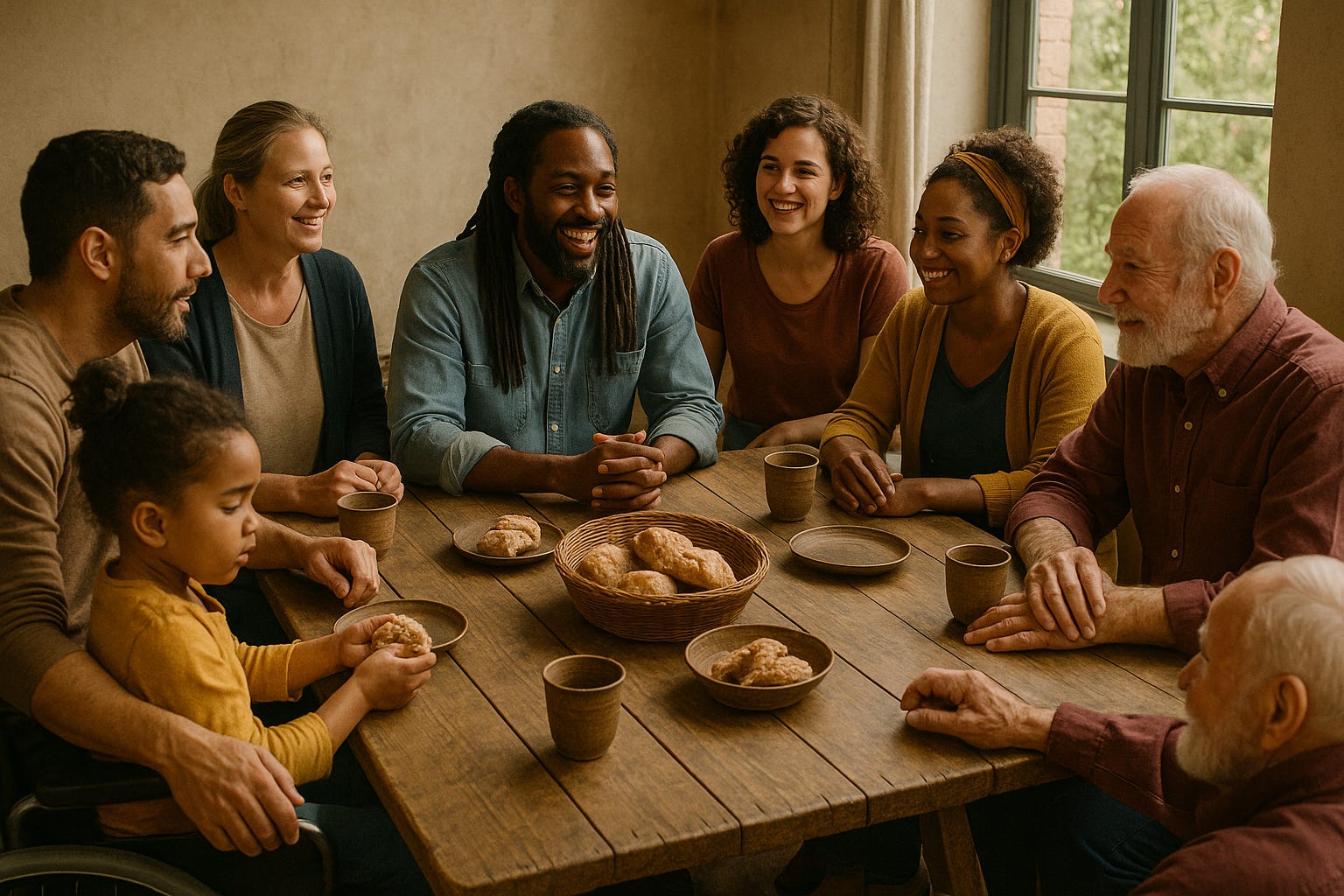
There is a reason Jesus didn’t build a movement around a pulpit, a creed, or a weekly agenda. He built it around a table.
He built it around people—fishermen, tax collectors, doubters, prophets, siblings, wanderers, the wounded, the curious, the bold, and the unsure. He built it around shared bread, shared stories, shared sorrow, and shared hope. He built it around presence.
Community wasn’t a ministry strategy for Jesus.It was the ministry.
And when we step into community today—real community, not performative gatherings or surface-level church smiles—we step into the same pattern He handed us. We touch the same rhythm. We inherit the same belonging. We find ourselves mirrored in the people who gather with us, reminding us that we were never designed to navigate life alone.
The Community Jesus Formed
When Jesus gathered His followers, He wasn’t forming an institution. He was forming a human ecosystem—one where love was the oxygen and grace was the gravity. His community was the space where the human spirit could breathe again.
These people didn’t come from the same backgrounds. They didn’t all believe the same way. They didn’t agree on everything; in fact, many came with agendas, fears, and competing visions of what they wanted Jesus to be.
But community gave them a place to wrestle, to grow, and to learn how to be human together.
Think about it:
* Peter found accountability.
* Mary found voice.
* Thomas found safety to doubt.
* Matthew found redemption.
* Martha found worth beyond her work.
* The outcasts found a home.
* The righteous found humility.
* The broken found healing.
This is how Jesus forms people—through other people.Grace is never meant to be a solo project.
Community as the Mirror of the Human Spirit
When we gather with others in vulnerability and authenticity, something sacred happens: we see ourselves reflected back. Not the polished version we present to the world, but the real one—the one God already knows.
Community becomes a mirror:
* It shows us our growth.
* It reveals our fears.
* It amplifies our joy.
* It gently exposes the places we try to hide.
* It reminds us we are not alone in our ache or our becoming.
The early church called this koinonia—a fellowship so deep it touches the soul. It is not simply friendship. It is not shared interests. It is the intertwining of stories, burdens, and hopes in a way that strengthens everyone involved.
When we open ourselves to community, we allow others to speak truth into the places we’ve muted. We let people carry us when our own legs give out. We let ourselves be loved in ways we never imagined possible.
We begin to see ourselves the way Jesus sees us.
Finding Your “Tribe”—And the Holy Caution It Requires
Many of us spend years longing for the moment when we find our people—the ones who understand us, welcome us, make room for us, and reflect our values.
In modern language, we call this finding our tribe.
And that is a beautiful thing.Life becomes lighter when you find the people who “get” you.
But it’s important to hold that word gently.
Because in Jesus-shaped community, a “tribe” is never meant to become a fortress.It cannot become us versus them.It cannot become a wall that separates or elevates.
So when we speak of tribe, we speak in a way that honors the belonging we’ve found while remembering the expansive love we are called to offer.
A Jesus-shaped tribe is open-armed, outward-facing, and rooted not in sameness, but in love.
What Community Gives Us
When we find community—healthy, vibrant, grace-driven community—it becomes one of the most transformative forces of the human soul.
1. Community Grounds Us
In a world that spins with anxiety, division, and noise, community becomes an anchor.It gives us a place where our feet can touch the floor again.It whispers, “You are steady. You are held. You are here.”
2. Community Gives Us Something to Lean On
Life will break all of us in different ways.No one makes it through unscarred.But when grief hits, when loss shakes us, when exhaustion steals our breath—community stands with us.
People become shelter.Presence becomes medicine.
3. Community Uplifts Us
There are days when we cannot summon hope within ourselves.But hope borrowed from others still counts.
Community speaks life into our dry places until we can breathe again.It reminds us that joy is still worth reaching for.
4. Community Strengthens Our Resolve
Standing for justice, compassion, and truth can be wearying.Doing it alone can feel impossible.
But community strengthens our hands.It reminds us that resistance is shared work, that faith is collective, and that love becomes stronger when practiced together.
5. Community Makes Us More Human
We learn patience in community.We learn empathy.We learn forgiveness.We learn how to hold space for difference, how to welcome stories not like our own, how to see the divine in every face.
Community doesn’t shape us into better churchgoers.It shapes us into better people.
The Table We Carry Forward
At the heart of the gospel is a simple truth:Jesus gathers.
He gathers the lonely.He gathers the hurting.He gathers the overlooked.He gathers the ones who feel out of place everywhere else.
And then He gives them to one another.
That is the community we are called to create.Not just a place to worship, but a place to belong.Not just a place to sit, but a place to be seen.Not just a place to learn, but a place to become.
The table Jesus set is not a relic.It is a blueprint.
It tells us that grace looks like shared bread, shared burdens, shared presence, and shared life.
And when we gather that way—when we form communities that heal rather than divide, that uplift rather than judge, that widen rather than gatekeep—we become part of something holy.
We become the reflection of the Kingdom Jesus said was already here among us.