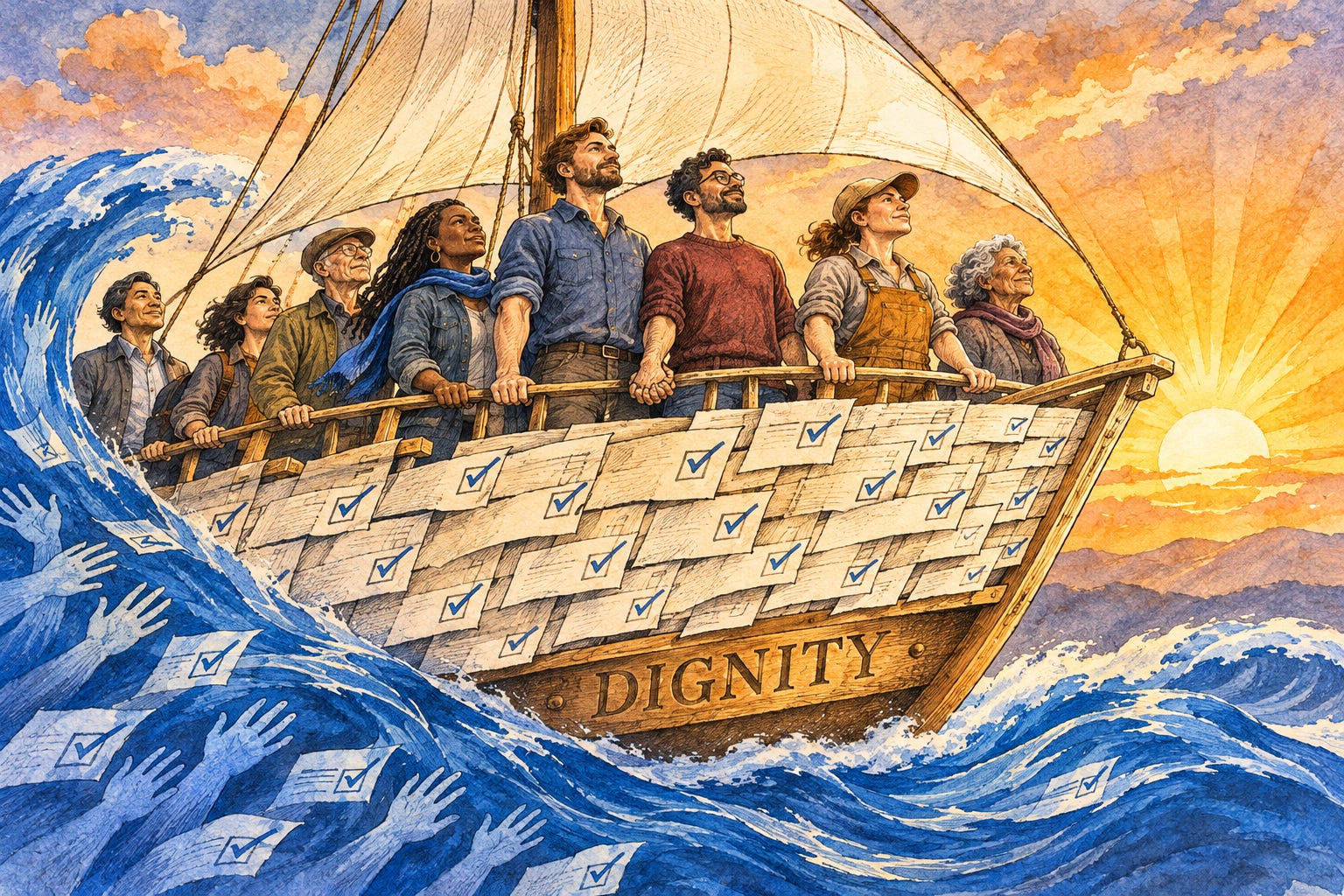
I am proud of my vote.
I am proud to have a voice in what happens to this country, and I am proud to use that voice on behalf of people whose lives have been treated as acceptable collateral in somebody else’s pursuit of power. After this election, I have no intention of tempering that pride to make it more comfortable for the people who would have preferred our silence.
We have spent enough time being told to understand the anger of people who resent our freedom. I would like to spend a little time celebrating the people who voted to defend it.
Democrats won control of both chambers of Congress. Texas elected James Talarico to the Senate and Gina Hinojosa governor. Virginia voters approved all three constitutional amendments concerning reproductive freedom, marriage equality, and voting rights restoration. Certification remains ahead, but the reported outcomes give us substantial reason to celebrate.
Look at what people did with the power they were told was insufficient.
This is why we vote, baby.
Virginia, this is personal
I want to begin at home, because I refuse to let Virginia’s amendments disappear into a passing sentence about a good night for Democrats.
Our neighbors voted on questions that reach directly into our bodies, our families, and our standing as citizens. They were asked what protections belong in the foundational document of this Commonwealth. Their answers deserve to be understood for the commitments they represent.
Virginia voted to protect reproductive freedom. It voted to replace its constitutional prohibition on same-sex marriage with marriage equality protections. It voted to restore voting rights upon release from incarceration for people convicted of felonies.
I am a gay Virginian. I cannot read that second result with the emotional distance of someone reviewing a road appropriation.
I want to marry a man. I want to build a life with him. I want the ordinary privileges of loving someone openly and making promises we intend to keep. I want a home in which our commitment belongs to us, without a politician treating its legitimacy as an opportunity to excite his base.
And I am tired of having to make that desire sound small enough to be acceptable.
There is nothing small about the life I hope to build. There is nothing shameful about wanting it protected. My capacity for covenant does not become less sacred because the hand I hold belongs to another man.
When voters choose to replace exclusion with protection, I feel that. I feel it as a citizen whose future belongs in the law. I feel it as a Christian who has watched the language of marriage used to humiliate people capable of profound faithfulness.
That vote matters to me before there is a husband, before there is a wedding, before there is anyone standing beside me.
My equality does not have to wait for my love story.
And my concern for the other amendments does not end at the boundaries of my own experience. I do not have to become pregnant to insist that the person who does deserves authority over their own body. I do not have to serve a prison sentence to believe that a person returning to the community should have a voice in its government.
That is part of what citizenship requires: an imagination large enough to recognize someone else’s freedom as worth defending.
Virginia gave me something to be proud of this week. I intend to say so without embarrassment.
The religious right does not own my faith
Then there is Texas.
James Talarico, a Presbyterian seminarian, won election to the United States Senate. As a Christian who has spent years challenging the political captivity of our faith, I take particular satisfaction in that victory.
I know the religious world in which voting Republican was treated as evidence of obedience to God. I know how easily a pulpit can become a place where political loyalties are baptized and then presented as obligations of conscience. I know what it costs to question that arrangement when your family, your community, and your understanding of belonging have been formed inside it.
I also know that I did not surrender Jesus when I refused the arrangement.
The Gospel still asks something of me when I enter a voting booth. It asks whether I have considered the hungry person, the stranger, the prisoner, the person whose suffering is easy to overlook because attending to it would cost me something. It asks whether my professed love of neighbor has acquired any substance beyond the sentiment.
I cannot reconcile that obligation with a politics that needs somebody to despise.
My faith gives me reasons to defend people whose beliefs differ from mine. It gives me reasons to care whether a family can afford food, whether a patient can receive care, whether a gay child can imagine a future without learning to hate himself first.
Those are convictions I bring into public life with my head held high.
Talarico’s victory does not make a political party the kingdom of God. No party deserves that allegiance. But I welcome the challenge his election presents to people who have confused their ownership of a religious microphone with ownership of Christianity itself.
They do not speak for all of us.
They never did.
A tsunami is made of people
I understand political exhaustion. I understand watching another promise collapse while the rent remains due and the grocery bill keeps climbing. People have legitimate reasons to distrust institutions that ask for their loyalty and deliver so little relief.
What I reject is the insistence that this disappointment obligates us to abandon the power we still possess.
There is nothing especially wise about announcing that nothing can change. Pessimism can become its own shelter from responsibility. If every effort is declared pointless in advance, we never have to risk the vulnerability of trying.
But somebody has to try. Somebody has to organize the meeting, knock on the door, help a neighbor register, arrange the ride, and cast the ballot. Someone has to keep working before the result makes the work look sensible.
We call this election a blue tsunami, and I understand the language. I feel the force of it. But I want us to remember that people produced this outcome through choices and labor.
The victory was assembled one voter at a time.
Your vote does not become meaningless because millions of people voted alongside you. Those millions are the reason it can exercise power. Insisting that a ballot only matters if it single-handedly decides an election misunderstands the entire undertaking.
We act together because none of us can do this alone.
And when that collective action produces a victory, we are entitled to recognize what we accomplished. We do not owe cynicism the last word merely because it speaks with confidence.
I expect something from the people we elected
My pride in this result comes with demands.
I expect Democrats to remember who gave them this opportunity. I expect them to remember the people who stood in line while worrying about bills, who organized while afraid for their families, who voted despite years of disappointment.
Those voters are owed serious governing.
I want civil rights defended with conviction. I want the cost of living addressed with urgency. I want public officials willing to investigate wrongdoing, explain their decisions, and accept scrutiny of their own conduct. I want campaign promises to remain recognizable after the campaign signs come down.
And I will not excuse failure simply because I celebrated the winner.
A vote entrusts power to someone. It does not relieve us of the responsibility to question how they use it. The people elected this week should understand our joy as a measure of the hope placed in them—and of the obligation they have assumed.
We worked for an opportunity to make people’s lives better. Now I expect that opportunity to be used.
Let us have this joy
There will be another fight. I know that. The people whose rights become campaign material rarely have the luxury of forgetting it.
But I refuse to live as though vigila…