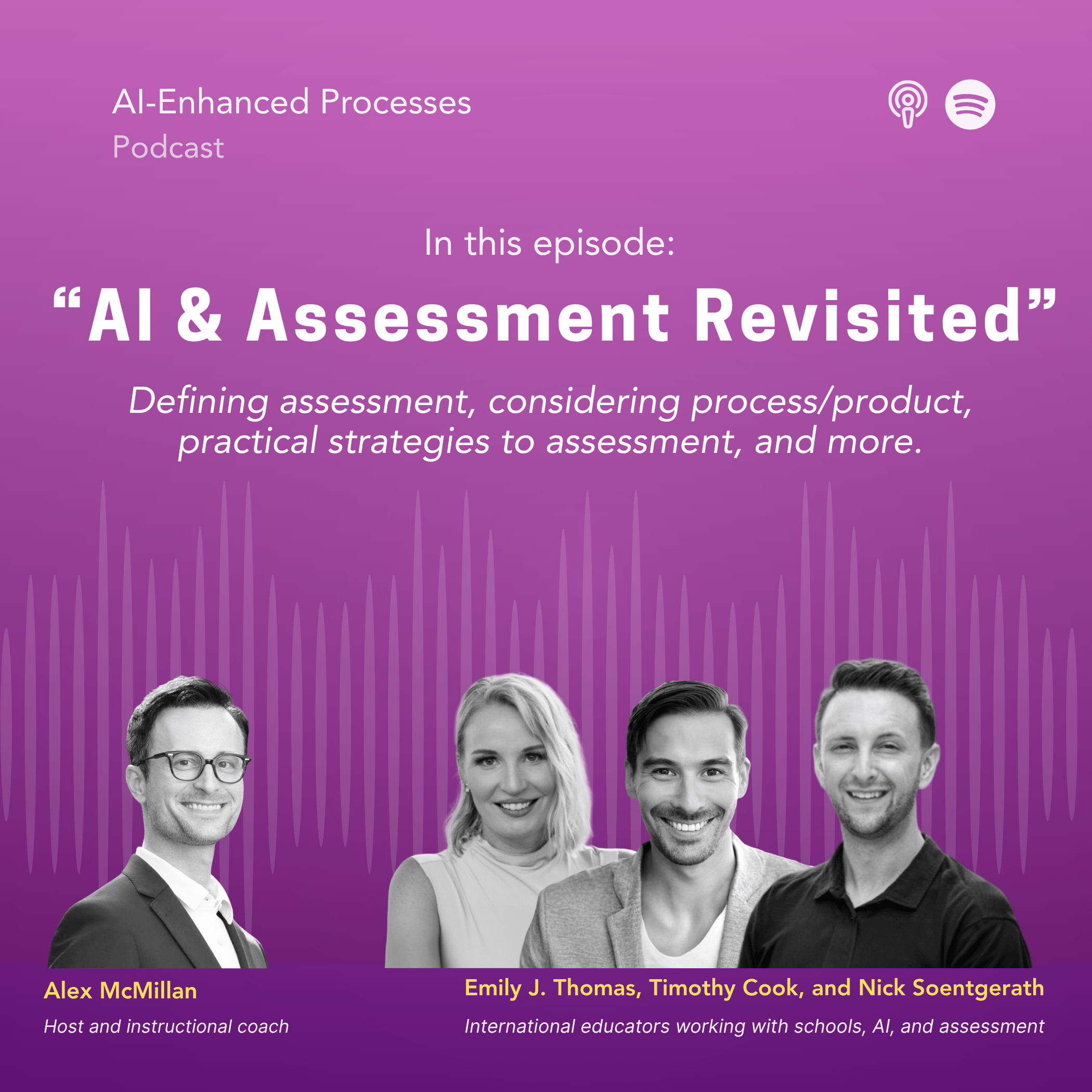
In this episode, I have three chats with different international educators who are working with AI and assessment in different contexts. My previous episode on assessment was one of my more popular, so I thought it was time to come back and see where we were at in terms of thinking that might be developing or getting more refined. It’s been a year since we recorded the last episode. Wow, time flies!
Let’s take a look at the details of what you can expect and the folks joining me in order of appearance in the show.
Emily J. Thomas is an educator, educational consultant, and entrepreneur who supports international schools in strengthening curricular development, coherence, and a clear vision for teaching and learning. She has spent over a decade in IB international schools as an MYP/DP English language and literature teacher and, most recently, served as an MYP Coordinator; she’s also an IB Educator Network workshop leader and a DP Literature examiner, and works as a literacy strategist with Erin Kent Consulting (EKC). Alongside her work in schools, Emily founded Playground Pedagogy (“playful minds, serious learning”) and leads yoga-focused work through Teaching Matters Yoga and Drift Yoga in Bangkok, and she writes the weekly Substack Elsewhere, Examined.
In this conversation, Emily reframes assessment as an opportunity to extend learning; a way to “tune in” to what learners have actually acquired, not a checkbox to end a unit. She unpacks why formative vs. summative terminology can create anxiety and mixed signals for students and argues for schoolwide clarity, including shared definitions, consistent language, and policies that treat formative evidence as meaningful rather than “worthless.” Turning to AI, Emily’s message is “process first”: the best response is doing the fundamentals well with simple, standardized task sheets and clear expectations (including what AI use is appropriate) that teachers and students see consistently across classes. She closes with empathy for educators navigating this moment and a call for leaders to “steer the ship” with clarity so teachers can feel calm and supported.
Timothy Cook is an educator and the founder of Connected Classroom, exploring how AI shapes student cognition and learning. He currently teaches third grade at the American Community School in Amman and writes Psychology Today’s “Algorithmic Mind” column, where he examines the intersection of education, AI, and human cognition, especially the risks of dependency and what schools can do to protect critical thinking, creativity, and moral development.
In this conversation, Tim argues that writing still matters more than ever because it’s fundamentally a process of thinking: the focus, word choice, revision, and self-argument that helps students clarify what they actually believe (and that AI can’t authentically replicate). He introduces the idea of “jagged edges” that include the human, lived, imperfect uniqueness that gets flattened when AI produces the same “academically average” response to predictable prompts. From there, he makes a practical case for “AI-proofing” assessment by redesigning tasks around community, identity, and design: prompts where students must apply content in locally grounded ways (and where AI can still be used as a tool without replacing the thinking).
Nick Soentgerath is a Technology Learning Coach at Yokohama International School (Japan), where he supports teachers and students in designing practical, future-focused learning with a strong emphasis on ethical, responsible, and safe use of AI.
In our conversation, Nick brings a practical, classroom-grounded lens to what assessment can be when it’s less about “gotcha” grading and more about clarity, feedback, and growth. Helping schools move from measuring learning to actually improving it. He also presents at international conferences and works with educators on assessment practices that are more authentic, equitable, and aligned with the skills students need beyond school. In the episode, Nick and I discuss the upcoming conference at his school. Find out more here: www.AIFE.community.