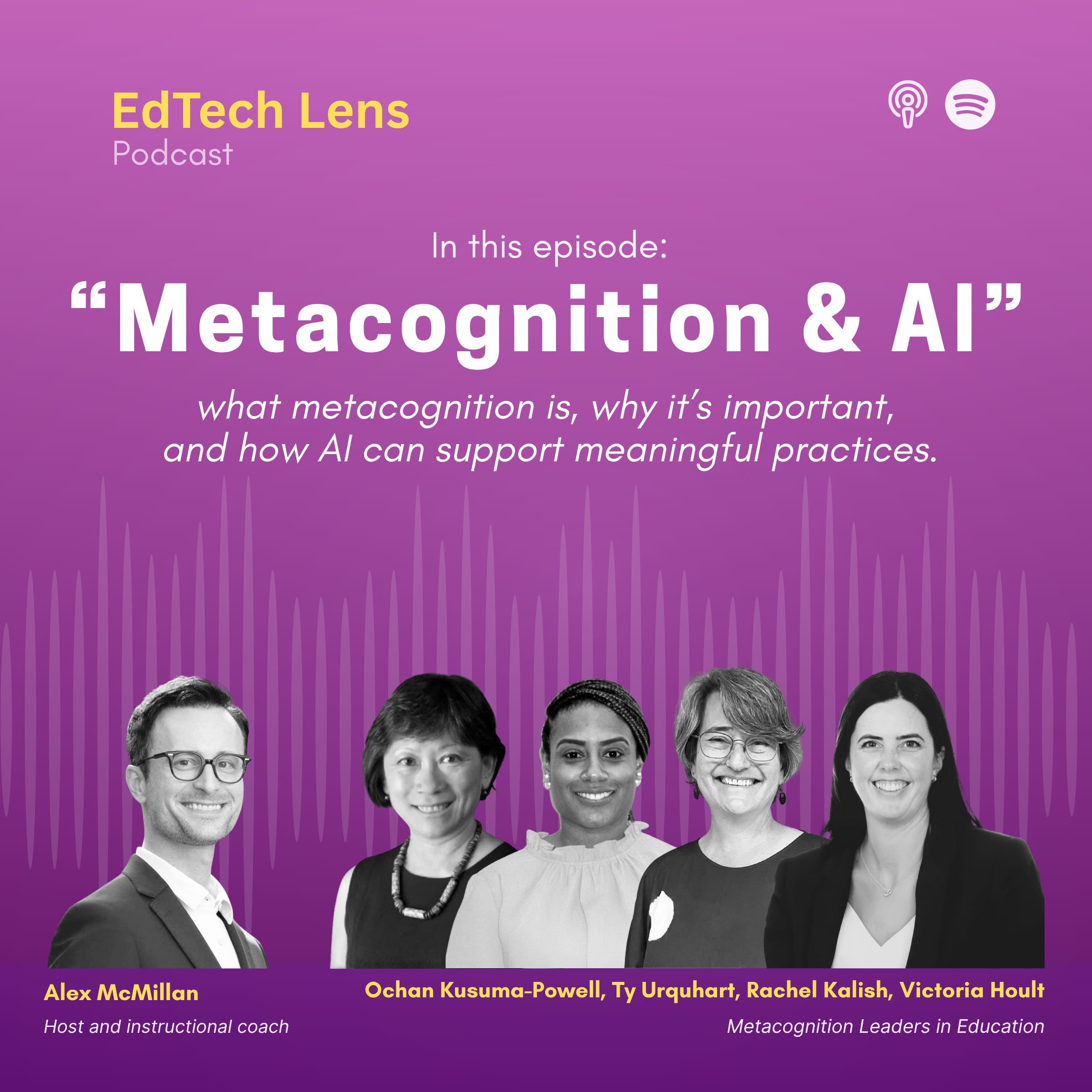
In this episode of The EdTech Lens, Alex explores one of the most powerful ideas in learning: metacognition. Inspired by Amelia King’s recent book, Thinking with AI, and the rising need to understand how AI intersects with thinking, this episode looks closely at how learners plan, monitor, and make sense of their thinking before, during, and after learning. To do that, Alex speaks with four educators whose combined experience stretches across continents, disciplines, and decades.
The conversation begins with Ochan Kusuma-Powell, an internationally respected educator, consultant, Cognitive Coaching trainer, and author whose career has helped shape how schools understand learning, thinking, and inclusion. With experience in the United States, Saudi Arabia, Tanzania, Indonesia, and Malaysia, she brings a global perspective to how students learn and how teachers can help them think about their own thinking. A founding member of the original Design Team behind Next Frontier Inclusion and co-founder of Education Across Frontiers, Ochan has influenced schools worldwide through her books and her ability to blend research, storytelling, and practical strategy. In this episode, she shares a crystalline view of metacognition as holding your thinking in the palm of your hand and examining it from many angles, and she describes how she uses AI as a thought partner while writing a new book.
Next, Alex is joined by Ty Urquhart, Middle School counselor at Shanghai American School Puxi. Ty brings a social emotional lens to the conversation, offering insight into how teens develop self-awareness, self-management, and decision-making skills during a time of rapid cognitive change. He discusses why teens crave independence, why pausing before acting is so challenging, and why shifting from right versus wrong to helpful versus harmful leads to more productive conversations about AI, digital behavior, and wellbeing. Ty also describes AI as the mirror rather than the villain, reminding us that the goal for students is not avoidance of technology but conscious, intentional use of it.
The episode closes with Victoria Hoult and Rachel Kalish from Korea International School, Jeju. Victoria is an experienced instructional coach, curriculum coordinator, and educational leader whose career includes New Zealand, the United Kingdom, Brazil, and Korea. Now serving as Director of Teaching and Learning, she leads with relationships, clarity, and an unwavering commitment to building a school culture where all voices feel valued.
Rachel, who holds an MA in Educational Leadership, is the school’s Curriculum and Instruction Coach and has worked in Guatemala, California, Dubai, and Korea. As an innovative and collaborative educational leader, she is dedicated to enhancing student learning by prioritizing relevance and engagement. Her expertise includes implementing effective instructional strategies, aligning curriculum with educational standards, and fostering teamwork among educators. By leveraging data driven insights in collaboration with all stakeholders, she works to improve student outcomes academically and socially, ensuring that every learner reaches their full potential. Together, Victoria and Rachel share practical insights from coaching teachers, guiding schoolwide reflection, and helping students develop the habits needed for sustained, independent learning. Their reflections on how metacognition shows up in teacher practice and how AI might support deeper thinking bring the conversation to a thoughtful and grounded close.