“Lauck has constructed a riveting narrative from the awful mess of her life.That she has managed to do so fills me with an admiration for which I cannot find words. The best I can do is to suggest that you read this book.”
~ The London Times
Welcome into Flight School:
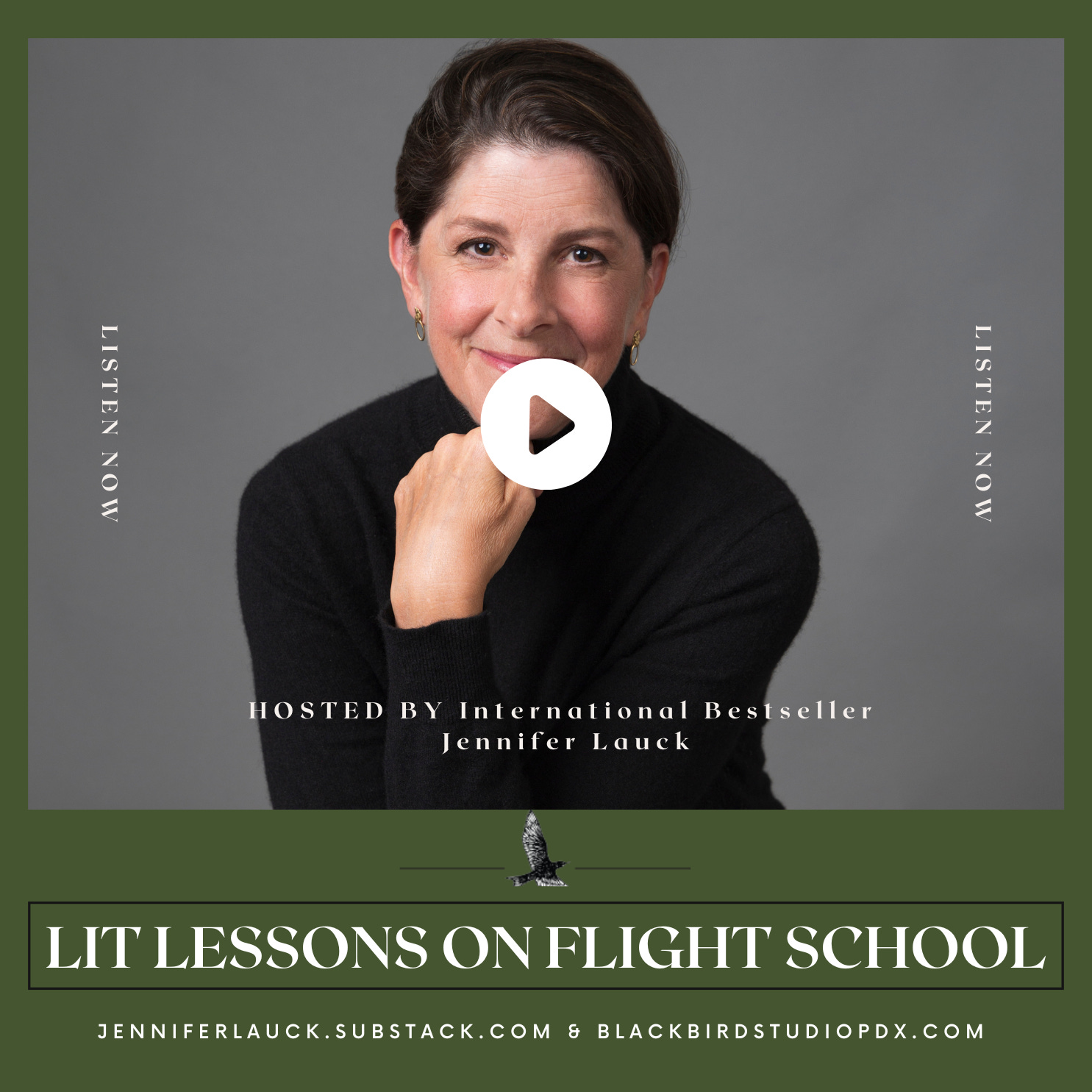
The video is a conversation with an advanced Studio at The Blackbird Studio for Writers on this topic and the questions below. I hope you’ll dig into those questions too, and share your perspectives.
The Creation of Blackbird: 1995-1999
Thirty or so years ago, I unearthed the astonishing story of my adoptive mother’s illness and death, and then my adoptive father’s sudden death from a heart attack eighteen months later. With a background as a journalist, I knew the events were remarkable enough that they wouldn’t need much analysis or embellishment but how to do it as something creative vs. reported? Could I merge my journalism background into what I was learning about story, literature and creative writing as applied to non-fiction?
How fortunate was I then to learn the art of writing scene in those early days of drafting and redrafting. My job was simple: Do a good job remembering and then reporting—moment by moment—and leave it to the reader to assign value and meaning.
With a single-minded focus, I worked hard and was careful to follow the particular rules of description that included location, people, dialogue and the forward flow of action with something at stake. The process was write, read aloud to myself, rewrite, read aloud to a ground, rewrite, move on. I did this through about eight drafts of the full manuscript.
The Power of Scene:
When I started Blackbird, I had the data: The dates, the timeline, the medical reports, the death certificates, and our different home addresses. I also had accounts from my surviving family. What I didn’t have was the “feeling” of those times. The full immersion in the moments gave me what I was after, which was to re-occupy the skin of Jenny and tell the story from her perspective alone. This wasn’t something I intended to do but rather discovered as I wrote scenes.
I wasn’t taught to write scenes with a method, with steps, but rather via example. “Stay present,” my teacher said, “move through time. Breath. Be. Go deeper here...” Only when I became a teacher did I develop the Scene Recipe Card to help others see and mark the components of a scene as found in most novels, short stories and many memoirs. What I’ve learned over these years is that, from the broadest perspective, the best part of writing scene is that it allows the writer (and later, the reader) into direct experience and bypasses the all-too-human tendency to explain, justify, twist, conceal, and even control the narrative. With scene, the moment is just the moment. Raw. True. Simple. But also complex. Like the painter uses canvas and pigment to create image, and interpretation is left to the viewer, the writer uses paper and words that shape moments-in-time and interpretation is left to the reader. No commentary. No rationalization. Just pure being.
25th Anniversary Edition:
Thanks to Peter Borland and his team at Atria, Blackbird re-releases in an anniversary edition on 2/10/26 (my adoptive father, Bud’s birthday). While the body of the book is the dame, it’s been updated with a new introduction I’ve written, new jacket copy and updates questions and answers in the readers guide. You’ll find those updates here.
What strikes me, in retrospect, is what I say every day in our workshop at The Blackbird Studio for Writers: Scene is simply amazing. While you don’t ALWAYS have to write in scene, it cannot be underestimated as a tool of profound discovery. the present moment is what it is, and that’s hard for us to accept but this book and all the writing I’ve done after, has proved the premise again and again.
My greatest suggestion to all creative writers is to devote at least a year if not more to learning, writing and perfecting your scene writing skills. You will not regret it. And you don’t have to come to the Studio to do this. You can take the video class now and get started on your own with my blessings.
🤔 Your Turn
* Grab a copy of Blackbird (see if you can get the 25th Anniversary edition) and find a scene that tracks the ingredients from the Scene Recipe Card (above). Tick them off, and then, standing back, think about what element of that “moment in time” impacted you? (IE: When Jenny is bringing the breakfast tray into her mother’s room, what about that moment impacted you? Or another scene?)
* Scene requires the writer to give up a great deal of control, or perceived control, because you are not telling the reader what to think, or explaining events. How does this lack of control hit you as an artist? Where do you see yourself resisting that release of control and tumbling into telling/explaining? When do you think you can give up the need for control and simply allow the story “to be” as it is.
I’m looking forward to your shares in the comments!
Thanks for being with me,
Jennifer
Blackbird's Flight School with Jennifer Lauck is a reader-supported publication. To receive new posts and support my work, consider becoming a free or paid subscriber.