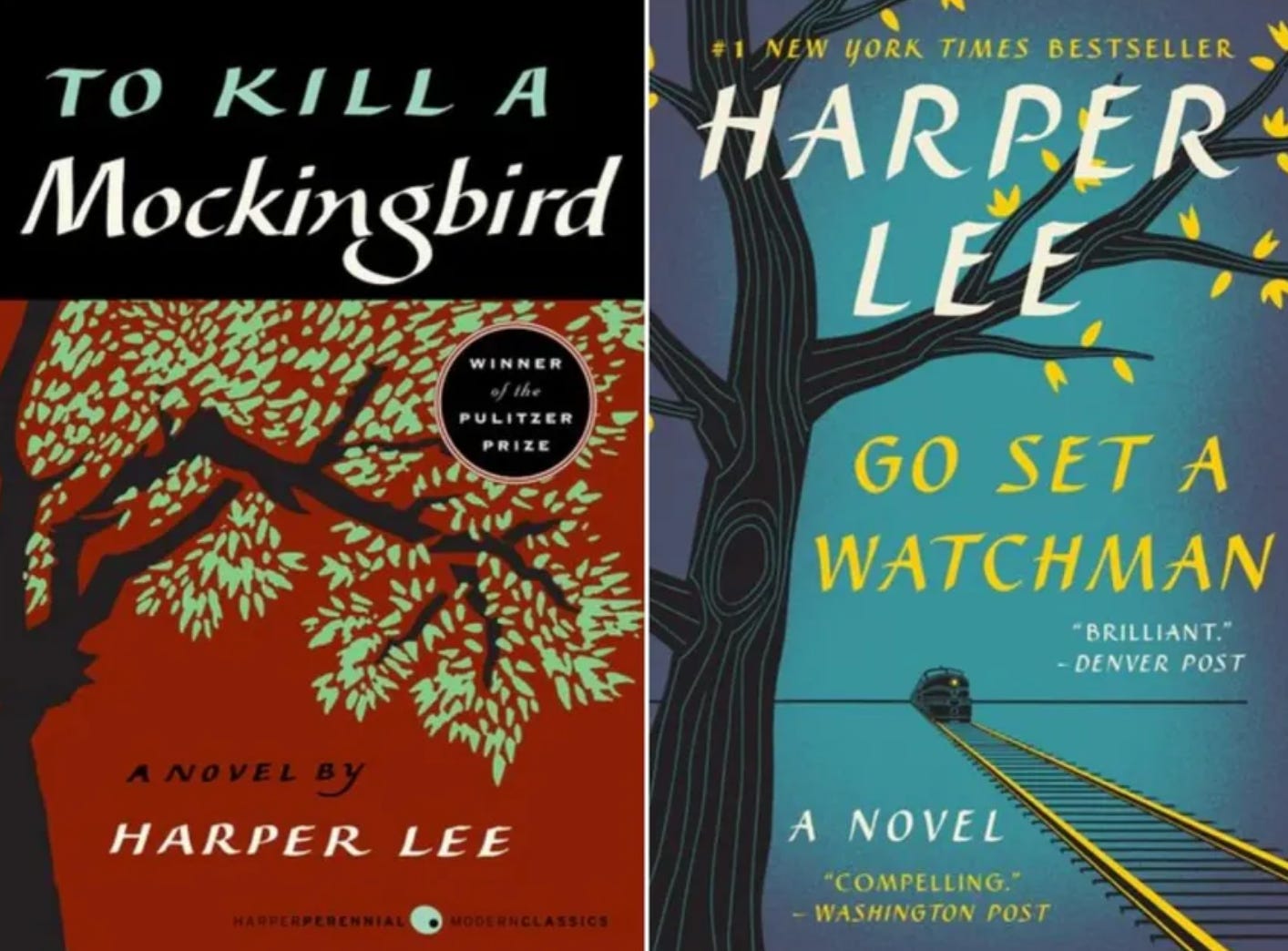
Welcome into Flight School for our Summer of the Finch:
We had a full house of writers signed up for this meeting and then, come Go Time, we only had two and then one and then two again. That’s summer for you so I’m delighted to bring you this follow up conversation from our launch.
I opened with an exercise. Close your eyes. Imagine your unfinished manuscript — the one that isn’t ready, the one in the drawer, the one you know needs more work. Now imagine you drop dead.
And someone publishes it anyway.
Jennifer from Oklahoma put it perfectly: It would be like someone just pushing you out of a plane.
That is exactly what happened to Harper Lee. Her first draft, raw, unrevised, the book she locked away and said would never see the light of day, was published fifty-five years later while she was deaf, nearly blind, and living in an assisted care facility. Her protector, her older sister Alice, had died months before.
Holding that context in your hands changes everything about how you read Go Set a Watchman. It is not just a difficult book. It is an exposed one. And as writers we feel that in our bones.
Who Formed Your Conscience?
That’s the question to hold. Not who taught you manners. Not who gave you rules. Who had a moral certainty so complete that you absorbed it as your own — a parent, a priest, a teacher, a tradition, a belief system — and trusted it so fully that you never had to build one yourself?
And NOW the harder question: What happened, or what would happen, if that person or institution turned out to be wrong? Not wrong about something small. Wrong about something that sits at the very center of what you both believed.
Jean Louise Finch built her entire moral life on Atticus. His certainty became hers. She called it her conscience when it was really his. And then she comes home to Maycomb and the floor drops.
That is not a story about race politics in 1950s Alabama, though that context matters enormously and we’ll sit with it. It is a story about any person — any writer — who has been living inside someone else’s certainties and suddenly has to find out what they actually believe.
Patricia (New Mexico):
She walked into Go Set a Watchman already knowing To Kill a Mockingbird by heart. And so she couldn’t help but see, the whole time she was reading the first draft, what was going to be lifted and transformed into the masterpiece. Jean Louise becoming Scout. The difficult, annoying, self-righteous adult becoming the child every reader fell in love with.
The transformation, she said, is just amazing.
That observation is the heart of where we’re headed. Lee didn’t abandon her first draft. She went back inside it and found the real story hiding in the margins. Her editor Tay Hohoff, a Quaker, a serious reader, pointed at the flashbacks, the childhood memories, the child’s clear eyes looking up at her father, and said: go there. Write that story.
Two and a half years of revision later, To Kill a Mockingbird emerged. One of the most perfectly constructed novels in the American canon. Built from the bones of the book everyone says is unreadable.
Nothing was wasted.
Jennifer (Oklahoma):
This is a writer who gets the Harper Lee Award of the day. She finished Watchman nine minutes before our Zoom. And her honest response? I didn’t think it was bad. I liked it. I went along with it.
That is the right response for a newer writer, and a genuinely important craft observation. When you haven’t yet spent years learning what makes a novel great, you don’t feel the weight of the telling, the exposition, the pages of interiority that exhaust the experienced reader. You just ride it. The audio helps too. When a book is being read to you, the telling washes over you the way a song on the radio does.
If you are listening, that’s great, but to capture the feeling I’m pointing to, that drag in this book, go back and read that first chapter on the page to feel how inside Jean Louise’s head we are rather than in a room with other people. That is the craft lesson. And it is exactly what Hohoff saw and why she sent Lee back to revise.
The Full Teaching: Lit Lesson 57
This lives on my Blackbird Studio site, where the advanced writers in the thirty week program go. You’re invited in now, too. This post lays the groundwork for our Summer of the Finch.
If you are just joining the challenge: Start Here with that teaching. Then go read Go Set a Watchman if you haven’t. And if you have started and stalled —> keep going. The gold is at the end. I promise.
Summer of the Finch Schedule:
6/27/26: Live Zoom Meeting 1: The Live Launch/Conscience (post 6/28) ✔️
6/29/26: Post Two Drops on our Deep Watchman Teaching (PAID ONLY)
7/7/26: Live Zoom Meeting 2: Debrief Watchman & Assign Mockingbird
7/14/26: Reaction Posts Drops: Our conversation from 7/7/26 + on editing and what Harper Lee took from Watchman and dropped into Mockingbird
Bonus: How this impacts you and your writing
7/21/26: While you’re reading Mockingbird in Review Post Drops (PAID ONLY)
7/25/26: Live Zoom Meeting 3: Debriefing your read of Mockingbird
8/3/26: Post Drops: Our edited 7/25/26 conversation + Mockingbird and Plot (PAID ONLY)
8/8/26: Live Zoom Meeting 4: Wrapping the Finch teachings
8/17/26: Final Post Drops: Our 8/8 edited conversation and last thoughts
🤔 Your Turn
Who formed your conscience? A parent, a teacher, a tradition, a belief system — whose moral certainty became yours before you ever had to build your own? Drop it in the comments. This is where the real conversation starts.
I’m looking forward to this terrific series. And your insights on a story about a Finch who touches the thorns and lives to sing about it,
Jennifer 🐦⬛