I. America Was Consecrated by Revolt
Every political order has a sacred beginning. America begins with inherited authority standing accused.
The American conservative enters every cultural dispute carrying a peculiar disadvantage. He reveres a country whose founding myth grants moral priority to the rebel. Then he tries to defend inherited authority within it.
He may appeal to custom. His opponent appeals to liberation.
He may invoke social order. His opponent accuses that order of tyranny.
The roles have already been assigned. One participant enters dressed as George Washington. The other is handed George III’s powdered wig and invited to explain himself.
The American Revolution created a constitutional settlement. It also supplied the nation with a permanent moral drama. Authority exceeds its rightful bounds. The subject discovers that obedience has become servitude. Resistance begins as conscience and ends in emancipation. Victory then proves the rebel was right.
This is America’s antiphany.
A theophany reveals God through His appearance. An antiphany reveals political legitimacy through opposition. America encounters the sacred through the spectacle of rebellion against inherited authority. The dissenter appears carrying a declaration. The old order appears carrying a tax bill. Heaven’s verdict seems curiously sensitive to casting.
This does not mean every American institution openly preaches revolt. The country possesses courts and prisons. It maintains military discipline. Yet its moral imagination remains governed by a founding that cannot be treated as divine writ. The regime needs authority for ordinary government while teaching that authority becomes legitimate through the consent of those it governs.
The contradiction is productive. It keeps the order moving.
Whenever inherited boundaries confront personal autonomy, the boundaries enter the dispute under suspicion. They must demonstrate that they are necessary. The individual needs only to demonstrate that they are restrictive.
Authority must submit a dissertation.
Desire needs a press release.
America did not invent rebellion. It made rebellion sacramental. The nation renews its founding whenever another claimant stands before an inherited order and declares independence from it.
II. Milton Taught Rebellion to Sound Magnificent
Before Americans rebelled against their king, Milton gave revolt the language of majesty.
The American Revolution did not reproduce Paradise Lost as conscious Satanic theater. The stronger claim concerns dramatic structure.
Milton taught the English-speaking world how rebellion against sovereignty could sound magnificent.
His Satan does not introduce himself as an enemy of goodness. He speaks of liberty. He casts obedience as degradation and hierarchy as arbitrary domination. His defeat becomes evidence of the ruler’s superior force rather than the ruler’s justice. Hell itself acquires a theatrical grandeur because the rebel prefers ruin under his own command to blessedness under another’s.
Milton intended Satan’s project to end in misery. That ending does little to erase the brilliance of the opening speech. Bad causes rarely suffer from poor copywriting.
The American revolutionaries knew Milton. Thomas Paine quoted Paradise Lost in Common Sense, while also describing monarchy as a form of idolatry. Paine placed government close to the Fall, calling it the badge of humanity’s lost innocence. Society might be a blessing. Government, even at its best, remained a necessary evil.
The conceptual resemblance matters more than any allegation of private devil worship among men in buckled shoes.
In both dramas, the rebel accuses the sovereign of tyranny. Dependence becomes slavery. Resistance becomes the recovery of a prior freedom that authority has violated. The rebel claims that he does not seek disorder. He seeks restoration.
The Revolution inherited this moral grammar. Its claims against royal power were constitutional and concrete, yet their cultural force came from the grander drama beneath them. A distant sovereign had violated a people who were free by nature. Independence therefore appeared as an act of recovery.
The American rebel did not need to think himself Satanic. He had entered a dramatic role that Milton had already furnished with thunder.
That role would survive the Revolution. Its language could migrate from colonial sovereignty to sexual autonomy without losing its emotional shape. Each rebel could claim a primordial liberty. Each boundary could be renamed a chain.
The costumes would change. The production would enjoy an unlimited renewal budget.
III. Liberalism Crowned the Sovereign Self
The king departed, and every individual inherited a miniature throne.
The Revolution left behind a political religion whose sacred object was the rights-bearing person.
This person does not exist merely as a member of a family or church. He stands conceptually prior to them. His obligations require his consent. His inherited identity may be examined, revised, or discarded. No authority may permanently claim him without answering before the tribunal of his autonomy.
Liberalism therefore places the individual at the center of public morality. The sacred self possesses rights. Those rights mark a protected territory around choice. When an inherited rule enters that territory, the rule bears the burden of proof.
This arrangement can protect people from genuine abuse. A ruler can become a tyrant. A father can become cruel. The Christian account of authority has never required pretending that every superior is righteous because he owns a larger chair.
Yet liberalism carries no stable internal principle for distinguishing freedom from appetite. Once autonomy becomes the ruling good, every durable boundary becomes vulnerable. Marriage must justify permanence. Sex must justify its moral structure. Religious doctrine must justify refusing affirmation.
The liberal self does not merely ask to be left alone. It eventually asks public authority to ratify its chosen identity.
As the religious structure of liberalism makes clear, this is a complete account of human nature. The person begins autonomous. Oppressive power alienates him from his authentic self. Emancipation restores him. Rights are the instruments of salvation.
Liberalism can therefore absorb continual moral change without surrendering its central creed. The object of liberation may change. The liberating structure remains.
A desire acquires public sanctity when it is translated into a right. Opposition then ceases to be a disagreement over the good. It becomes an offense against the person.
The self is enthroned ceremonially.
The state guards the throne.
This is the secret partnership between personal autonomy and political centralization. The sovereign individual appears to stand alone against power. Yet he requires a greater power to subdue every smaller authority that refuses recognition.
The miniature king needs a very large army.
IV. Tea Became America’s First Sacrament
The grievance may be narrow. The drama surrounding it has no such modesty.
The Boston Tea Party was not an argument about beverage prices conducted by men with an unusual commitment to eveningwear. It concerned Parliament’s power to tax the colonies. Beneath the damaged cargo stood a dispute over sovereignty.
Who possessed the right to command?
That question gave tea its sacramental character. The object mattered because it made authority visible. A modest tax could embody political subjection once it signified Parliament’s claim to govern without colonial representation.
The material grievance and its symbolic meaning must remain distinct. The Revolution arose from deeper conflicts involving imperial administration. Yet public memory compresses those conflicts into an image: ordinary goods cast into the harbor by men resisting tyranny.
America learned from this image that a small restriction can reveal a total structure of oppression.
Every later movement would inherit the lesson.
A boundary governing one form of conduct could be presented as evidence that the entire society denied a person’s humanity. A regulation could become a Stamp Act. A refused recognition could become taxation without representation. The scale of the original dispute would become irrelevant once the sacred drama had been activated.
This helps explain why American political arguments escalate so rapidly. A practical limitation seldom remains practical. It becomes a trial of sovereignty.
The customer denied a refund is several pamphlets away from Lexington.
The deeper error lies in believing that the Founding created neutral procedures from which later moral conflicts departed. The Constitutional order carried substantive assumptions about the person and legitimacy. Those assumptions did not remain frozen within eighteenth-century conditions. They continued working.
Tea became sacred because it revealed a disputed claim to command. Modern rights controversies operate through the same disclosure. A narrow conflict exposes an authority that claims power over the self. The claimant then transforms resistance to that authority into a reenactment of American independence.
The denied preference becomes the tea.
The inherited boundary becomes Parliament.
By the time anyone asks whether the preference is good, the harbor is already full.
V. Rebellion Became a Reproducible Liturgy
America does not suppress every rebellion. It processes the useful ones.
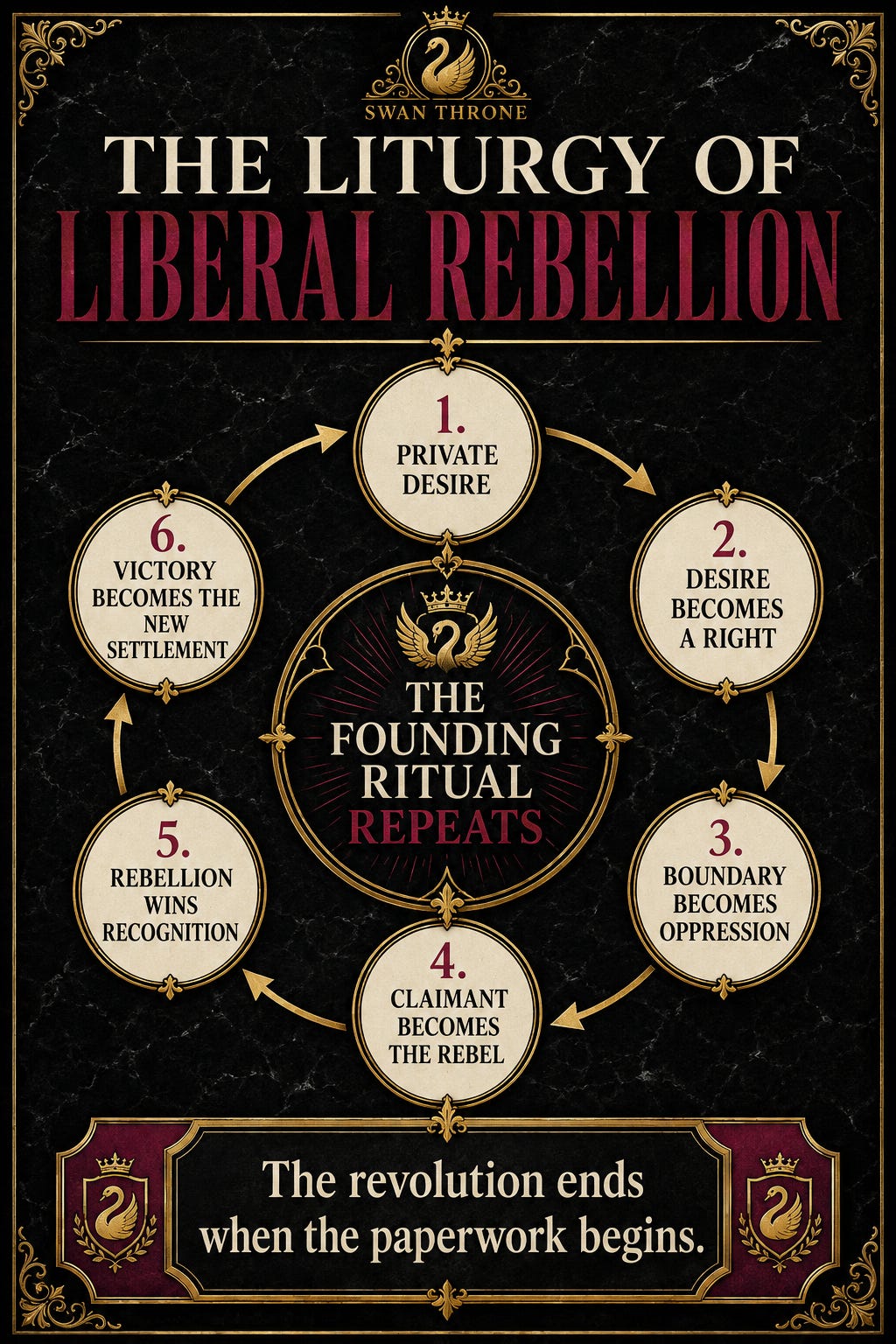
The American ritual begins with a private desire that encounters an established boundary.
The desire is then translated into the language of rights. This translation changes its moral standing. A preference may be questioned. A right demands recognition.
Once the right has been announced, the boundary becomes oppression. Its age counts against it because longevity can be presented as evidence of entrenched domination. The person challenging it assumes the role of the revolutionary. Defenders of the boundary inherit the role of the Crown.
The national myth supplies the expected ending.
The rebel must prevail.
Public debate still occurs, though much of it resembles a tribunal performing a sentence already written. Journalists locate the injured claimant. Lawyers produce the constitutional theory. The old custom is asked to explain why it should survive. Refusal to change becomes further evidence of its cruelty.
Then the right is recognized.
Yesterday’s rebellion enters the new settlement. Schools teach it as another chapter in the expansion of American freedom. Public agencies enforce it. Corporate policy carries it into the workplace. A movement born in defiance becomes an authority capable of punishing defiance.
The revolution ends when the paperwork begins.
This is why liberal politics exhibits unmistakably religious patterns. As a study of liberal ritual and purification observes, public confession is followed by reform. Institutions announce their former guilt, then display conformity with the newly clarified creed.
The process does not require a conspiracy. Participants may act with complete sincerity. Rituals derive their power from repetition rather than secret coordination.
Each campaign presents itself as unprecedented. Structurally, it is another performance of the same founding act. An oppressed person confronts inherited power. The public witnesses a declaration of independence. The regime proves its legitimacy by siding with the rebel.
Liberalism survives by canonizing selected attacks against itself.
It receives the stone thrown through its window, mounts the stone in a museum, then builds an office to regulate windows.
VI. Liberation Gives the State Another Key
The individual receives ceremonial sovereignty. The bureaucracy receives jurisdiction.
A newly recognized right cannot enforce itself.
It requires an authorized interpreter. Disputes must be adjudicated. Resistant officials must be compelled. Smaller associations must learn where their freedom ends and the claimant’s freedom begins.
Every liberation therefore produces a problem of administration.
The Supreme Court’s decision in Obergefell v. Hodges provides a clean example. The Court held that same-sex couples possessed a constitutional right to marry. State definitions of marriage could no longer stand because the Fourteenth Amendment protected personal choice concerning marriage.
The immediate dispute concerned marriage licenses. The ruling changed the legal meaning of marriage throughout the country.
That change reached the county clerk’s desk. Kim Davis refused to issue licenses that contradicted her religious convictions. The state could not treat her refusal as a private act of conscience because she occupied public office. The new right required her compliance.
The individual couple received recognition.
The federal settlement acquired command over the clerk.
This outcome does not arise from an accidental corruption of liberal freedom. It follows from the structure of rights. When two claims conflict, some authority must rank them. The sovereign self therefore summons the administrative sovereign.
Even the Court’s majority acknowledged that the ruling would generate disputes involving religious conviction. The dissenters anticipated sharper conflict. A later Congressional Research Service assessment examined consequences for religious bodies. The wedding ended. The jurisdictional arguments arrived before the caterer had packed the silverware.
A Christian account of political authority cannot accept the fiction that these settlements are morally neutral. Law teaches. Enforcement establishes which claim receives public honor and which must retreat into private life.
Liberal emancipation therefore centralizes authority while speaking the language of decentralizing the self. The citizen is told that no inherited institution may rule him. A remote court then determines what every local institution must recognize.
The rebel breaks the gate.
The compliance officer moves into the gatehouse.
VII. The Cultural Left Knows the American Liturgy
Those who despise America’s inheritance perform America’s founding ritual with perfect fidelity.
The cultural left often rejects traditional patriotism. Its activists may treat the flag with suspicion. They may regard the Founders as compromised men whose political settlement preserved grave injustices.
Yet they understand the American moral drama better than many people who cover their porches in patriotic bunting.
The successful activist identifies a person constrained by an inherited norm. That constraint is described as oppression. The claimant’s desire becomes an identity, then the identity becomes the bearer of a right.
Resistance confirms the accusation.
If a school refuses the claim, the school demonstrates exclusion. If a church refuses it, the church demonstrates intolerance. The strength of the boundary becomes evidence of the urgency required to destroy it.
The activist stands where the American imagination expects its hero to stand: before an old authority, declaring freedom.
Conservatives commonly answer by defending the existing settlement. This places them in the part traditionally reserved for villains. They speak of precedent when the national myth honors revolt. They speak of restraint when the myth honors emancipation.
Their opponent owns the better costume.
This pattern explains why the right’s attachment to the previous liberal settlement offers so little protection. As “Don’t Conserve the Rot” argues, conservatives frequently defend yesterday’s revolutionary victory against today’s revolutionary demand. They preserve a temporary stopping point inside a creed committed to further motion.
The left can then cite the older victory as precedent.
If autonomy justified one release from inherited authority, why should it stop before the next? The conservative has accepted the premise while disputing its newest application. He enters combat carrying his opponent’s ammunition and seems surprised by the noise.
The left may hate America’s historical substance. It remains deeply American in form.
It performs declarations of independence.
It constructs tyrants.
It asks the regime to prove its goodness through another emancipation.
The flag-bearing conservative guards the museum. The activist owns the script kept inside it.
VIII. Patriots Defend the Symbols While Losing the Regime
The American right loves the iconography of victory while inhabiting the structure of defeat.
Conservatives often appeal to the Founders as guardians of order. Yet the Founders were revolutionaries who justified resistance against an inherited sovereign.
That contradiction produces strange political theater. The same person who praises the Boston Tea Party may condemn every later movement for treating authority as provisional. He venerates rebellion at the nation’s beginning while demanding that rebellion cease at the precise settlement he inherited.
His chosen stopping point has no sacred authority within liberalism.
The activist can always appeal beyond it to the founding principle. Another group has been excluded. Another boundary restricts autonomy. Another declaration waits to be written.
The conservative answers with constitutional procedure. The activist answers with the moral meaning of the Constitution. Procedure eventually yields because the regime’s legitimacy depends upon appearing faithful to emancipation.
This is why liberalism’s internal arguments resemble theological disputes. Rival schools disagree over the meaning of freedom while retaining freedom as sacred language. The denominations of liberalism may accuse one another of heresy. None questions the altar beneath the quarrel.
The right participates in this religion when it describes every good through autonomy. It defends the family because families are freely chosen. It defends religion because religion is a private right. It defends speech because each person deserves personal expression.
These arguments may secure temporary protection. They also teach that the family possesses no authority beyond consent. They reduce faith to preference. They make truth depend upon a speaker’s entitlement to say it.
The defense hollows out the object being defended.
American patriotism then becomes loyalty to symbols detached from the governing creed. The conservative salutes the flag while liberalism decides what the flag means. He reveres the Constitution while authorized interpreters disclose new commands within it.
He owns the frame.
His opponent owns the painting.
IX. Christian Order Cannot Rest upon Permanent Revolt
No civilization can survive if every boundary must apologize for existing.
Christianity does not teach that authority becomes good through superior force. It teaches that authority answers to an order above itself.
This distinction separates rightful obedience from servility. A father may command because he bears responsibility for a household entrusted to him. His rule is bounded by duty. It exists for the good of those under his care.
The Christian father cannot worship his own will.
The Christian child cannot worship his own autonomy.
As “The Nursery and the Throne” explains, Christian authority begins in sacrifice. The ruler bears weight. He answers for those placed within his care. Authority receives dignity from service to the good, rather than from the consent of every appetite it restrains.
This gives Christianity a principle liberalism cannot supply. Rebellion must be judged by its object.
Some rulers become tyrants. Resistance may then be righteous. Yet opposition gains no sanctity merely because it opposes. Lucifer rebelled. So did the Maccabees. The outward act cannot settle the moral question.
The purpose of freedom must be considered.
Christian freedom is the capacity to live according to the good. It is release from bondage to sin. Liberal freedom increasingly means release from an authority the self did not choose. These accounts may briefly cooperate against a cruel ruler. They cannot construct the same civilization.
A Christian order must therefore recover the moral legitimacy of boundaries. Marriage has a form that desire does not create. The Church possesses doctrine that opinion cannot revise. The family makes claims upon its members before they can draft a contract.
None of this licenses arbitrary power. Authority that forgets sacrifice becomes predation wearing a ceremonial collar.
Yet fear of abuse cannot require the abolition of command. A society ashamed of authority eventually receives authority in its least human form: remote administration. The father disappears. The caseworker arrives with a laminated badge.
The choice is not between authority and freedom.
The real choice concerns which authority will form freedom toward which end.
X. Liberalism Sanctifies the Enemies Who Attack It
The regime survives because its enemies reenact its founding whenever they strike it.
Liberalism possesses a remarkable defensive power. It can absorb rebellion by interpreting rebellion as evidence of its own promise.
A dissenter accuses the country of betraying freedom. The regime recognizes a new right. That recognition becomes proof that the system can correct itself. Administrative power grows, while the rebel’s victory renews public faith in emancipation.
Attack becomes liturgy.
Defeat becomes expansion.
This is why liberalism often appears strongest after surrendering. It loses a traditional boundary and gains another field of jurisdiction. It relinquishes one inherited norm and strengthens the machinery that will adjudicate the next dispute.
The process resembles antifragility, though liberalism does not grow from every challenge. It grows from challenges it can translate into its sacred grammar. A rebel who demands autonomy can be canonized. A dissenter who rejects autonomy itself presents a deeper danger.
This explains liberalism’s insistence that it is neutral. If it admitted that it was one moral order among others, Christian political claims could confront it openly. By presenting itself as the fair referee, it forces rivals to speak in liberal terms before they may enter public argument. The denial of liberalism’s religious character protects its command of the courtroom.
A postliberal Christian politics must resist two temptations. It cannot conserve each previous liberal settlement as though decline became sacred after sufficient aging. It also cannot worship rebellion as a cleansing force.
Permanent revolt produces no throne worth occupying.
Christian order requires another account of legitimacy. Authority must be judged by its service to the good. Freedom must be ordered toward truth. Rights must remain subordinate to duties received from God and embodied within actual communities.
Such an order cannot emerge from another declaration of the sovereign self. That document has been issued many times. Its latest edition always arrives with a larger enforcement appendix.
America’s antiphany revealed freedom through revolt. Its descendants keep reenacting the scene, each convinced that the next fallen boundary will open the gates of paradise.
The gates open.
Another office stands behind them.