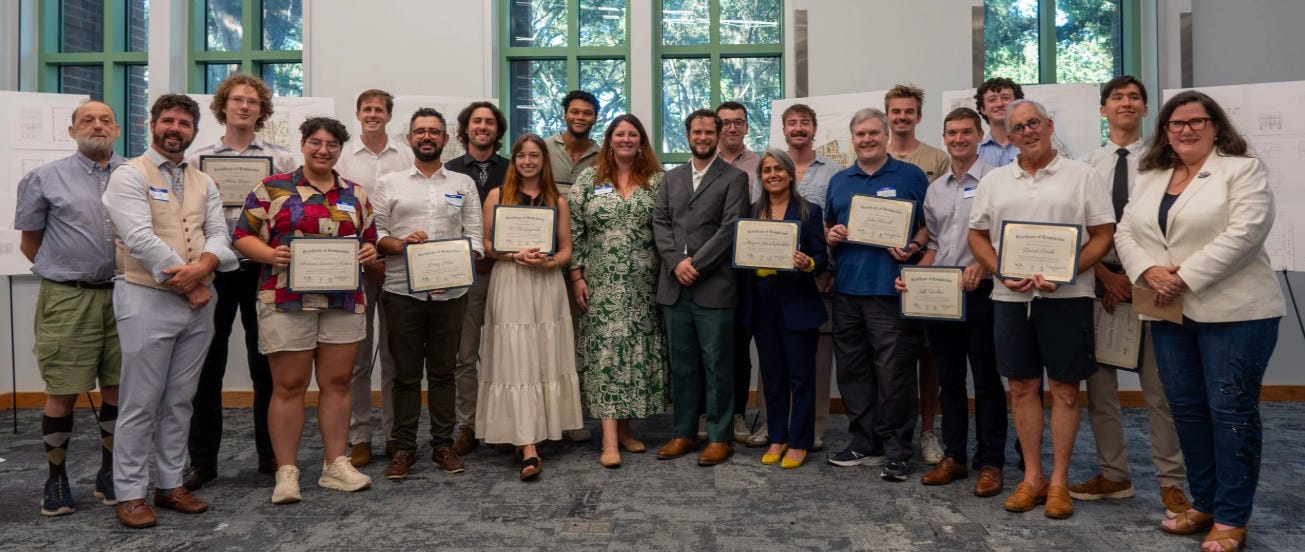
Thank you for joining me for the second installment of The New School for City Builders as I interview Sara Bega and Jack Duncan on Las Catalinas, studio education, building new architecture schools, and more. Please like and subscribe!
Build the Next Right Thing is a reader-supported publication. To receive new posts and support my work, consider becoming a free or paid subscriber.
The following transcript has been edited for clarity:
Seth Zeren (00:02) Hello and welcome to the New School for City Builders. I’m your host, Seth Zeren, a recovering city planner turned neighborhood developer in Providence, Rhode Island. This is a podcast about how we can transform the education of city builders. If we want to change how our cities and towns work, we need to change the people who run them. We need a new generation of city builders — architects, engineers, planners, developers, city managers, and civic leaders. We need a new school for city builders.
Joining me today is Sarah Bega, an architect, professor at Notre Dame Architecture School, and former town architect for Las Catalinas, Costa Rica. And for our first dual-guest podcast, Jack Duncan, also a Notre Dame architect, who helped launch an architecture program at the American College of Building Arts and is now at the College of Charleston. Together they are part of the founding team behind CityMakers Collective, a summer studio in Charleston, South Carolina, which is having its second summer starting this Sunday.
So it’s very exciting — you’re both about to get right back into the thick of it. In our conversation today, Jack, Sarah, and I are going to talk about building new towns, building new schools, and the ins and outs of the studio education experience. Sarah and Jack, welcome to the New School for City Builders.
Sara Bega (01:18) Thanks for having us.
Seth Zeren (01:21) Great. Sarah, I saw you about a week or two ago in Northwest Arkansas at CNU, which was a ton of fun. You had just gotten back from teaching a semester in Rome — which sounds like a pretty sweet deal. Now you’re teaching at Notre Dame, the same school where you studied architecture. Can you tell us what the architecture program is like there, and how it differs from other architecture schools?
Sara Bega (01:48) Sure. Notre Dame’s pedagogy in architecture and urbanism is founded on a classical philosophy and design process. That doesn’t necessarily mean it’s always expressed in the classical language, but it’s a design process based on analysis and the study of precedent — essentially learning from the successes of the past so you can do even better in the future. We treat architecture and urbanism as a living tradition. We should always be working to improve it, bringing it into the next generation, and thinking far beyond the moment so that we’re not pursuing trends that put an inherent expiration date on a project. Instead, we participate in a larger culture — multiple cultures — and understand how context-based design really matters, both as a process and as a character.
I studied at Notre Dame and was drawn to it because during my tour, I was told: “We teach you the rules so you can intelligently break them.” For someone who’s incapable of being obedient, that felt great. That philosophy has remained while the program constantly folds in new successes — it’s not stagnant. In Rome this past year, for example, we had even more emphasis on landscape than ever before. I just appreciate working with people who really care about the built environment, about contributing wonderful additions to our societies, and about always learning and doing better.
Seth Zeren (03:35) That’s fantastic. What’s the semester like in Rome as a teacher?
Sara Bega (03:41) Dreamlike. It’s a big ask for the students — it sounds cushy, but honestly, they have to balance a lot of travel, which is a good problem to have, along with the experience of simply being there. We all know how important it is to actually be in a place to understand it. They’re traveling all around Italy and constantly shifting in and out of their design headspace. It’s challenging — most of them are in an environment very different from where they grew up, learning as human beings to adapt, and simultaneously extracting design lessons. Not all of them are going to be doing work in Europe; it’s the precedent behind the precedent, so to speak. If you’re trying to engage American tradition and American classicism, you’re going to look at what those architects were looking at, which — given the history of the Grand Tour and the development of architectural language — has often been rooted in that region.
As a professor, it’s a joy because students are engaging more sophisticated ideas than ever before. They’re not just picking Corinthian because it’s their favorite — they understand when it’s appropriate to articulate a column at all, or simply use the proportional system, and if you are going to use a columnar order, what character is appropriate and where it fits within the broader culture of that expression. I had mostly taught second years before, which is the boot camp and the engine room of Notre Dame’s pedagogy. Getting to teach third years and expand on those conversations in a different context was a real joy. And outside of studio, you’re just kind of floating around in heaven.
Seth Zeren (05:48) Just hanging out in Italy. So Jack — you also attended Notre Dame. Sarah, you were an undergrad there, and Jack, you came as a graduate student. What was your arc? How did you end up there?
Jack Duncan (06:08) That’s a good question. I actually didn’t go to college right after high school. I ended up working for Procter & Gamble for almost five years. I wasn’t a great high school student, if I’m being honest. So it was definitely a transition.
When I was ready, I wanted to stay in-state and had always been interested in architecture, but in South Carolina we really only have Clemson, and the program didn’t quite fit my perspective on the built environment. I knew I wanted to come to Charleston — it’s a beautiful place, and a lot of us from the upstate, near the North Carolina line, would come south to the beaches. So I came here originally to study classics, and somewhat ironically realized after the first year that I didn’t want to teach. I couldn’t see another career path, so I started taking coursework that interested me: studio art, historic preservation, art history. A year later, my advisor Robert Russell said, “It looks like you could double-major in art history and historic preservation, and if you want to triple major or minor in studio art, you can do that.” So I said okay — I was a bit aimless, if I’m being real.
I fell in love with architecture through historic preservation, partly because of where I was. I’m sitting right now at 12 Wool Street, and you just walk out the door into a beautiful environment. Come senior year, I interned for two architects here — Christopher Liberatus and Jenny Bedden — for about a year. They asked if I was going to pursue architecture, and I said I honestly didn’t know. I took another year off and went to the ICAA Summer Studio — I think it was one of the first after they revamped it. I met great people there, came back, and thought: yes, I want to be a classical architect. So I applied to the master’s program at Notre Dame — the only program I applied to. I said, if I get in, great; if not, I’ll go join a fishing boat or something. I got in, finished the program, and it was honestly the most life-changing experience of my life.
Seth Zeren (09:36) This podcast is basically just an advertisement for Notre Dame — they should really be sponsoring us. So Sarah, after graduating you went back to Italy, and then someone told you to get on a plane?
Sara Bega (09:54) Yes. It was actually my last summer before my final year of school. I did a research project — mostly as an excuse to be back i…