The statue that would become one of the most famous in the world arrived in New York Harbor on the morning of June 17, 1885.
The ship that carried her, the French man-of-war Isère, had come to anchor in the Horseshoe, off Sandy Hook, twenty-seven days out from France, the early part of it through heavy seas. She lay quiet now in a fog so thick the harbor could not make her out. Only after she emerged from the fog and ran up her private signal was she recognized, and the word went to the city by telegraph at once: the Isère had arrived.
In her hold lay Liberty Enlightening the World. Liberty had been formally presented to the United States on the Fourth of July the year before, and in Paris, she had stood complete in a courtyard, rising over the rooftops of the neighborhood. To bring her across the ocean, the sculptor Frédéric-Auguste Bartholdi had taken his finished colossus apart. Her copper skin, hammered by hand over wooden molds and hung on an iron skeleton engineered by Gustave Eiffel, came down into some three hundred and fifty separate pieces and went into two hundred and fourteen wooden crates. Each fragment was sheathed in its own casing, numbered so the whole could later be read like a set of instructions. It was a monument shipped as a kit.
When the telegram reached General Charles P. Stone that morning, he was on his way to Bedloe’s Island, where the statue’s pedestal was being built. Stone was the pedestal’s chief engineer, a West Point man who had served in two wars. His job now was to receive this gift and stand her up.
Stone wired an enthusiastic welcome to the Isère‘s commander, Captain Gabriel Lespinasse de Saune, and went down the bay to the ship, where he was received with full courtesy. There, de Saune handed him the official transfer of the statue from the French committee to the American, a document engrossed on parchment, bearing the seal of the French Republic and, decorating its margins, the heads of Washington and Lafayette.
The statue had arrived. There was, however, nowhere to put her yet.
The French people had paid some two hundred and fifty thousand dollars, gathered across France, for the figure, on the understanding that Americans would build the base to set her on. But American fundraising had gone poorly for years. The committee was still a hundred thousand dollars short of what it needed, and there sat the completed gift of a nation, boxed in a ship’s hold off Sandy Hook.
Months before she sailed, the newspaperman Joseph Pulitzer had taken up her cause, turning the front of his New York World into a collection plate. The money for the statue had been raised by the ordinary people of France, he reminded his readers, and thus the fund for the pedestal ought to be raised by the ordinary people of America. “Let us not wait for the millionaires to give us this money,” he wrote.
Pulitzer printed the name of every donor, however small the gift. The donations came from roughly 120,000 people, most giving a dollar or less. By August 11, 1885, the World announced that $100,000 had been raised.
Still, she had to wait. She waited through the rest of that summer, the fall, and a long winter, until the pedestal was finished in April 1886. The pieces came up out of their boxes and were riveted back together over Eiffel’s iron frame throughout that summer.
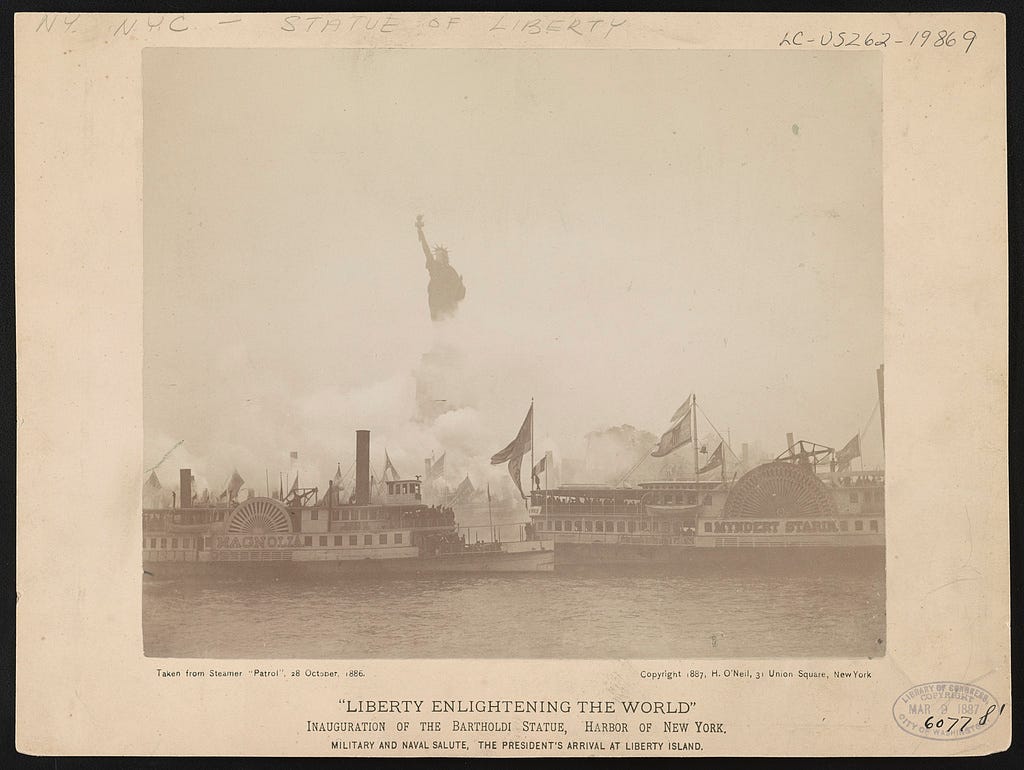
On October 28, 1886, amid fog and light rain, President Grover Cleveland dedicated the Statue of Liberty as crowds, estimated by some at close to a million, came out for the day’s celebrations. A little more than sixteen months after the Isère came in, Liberty finally stood above the harbor.
Note: the latest Historical Snapshots print magazine edition is now available. You can purchase it here.
Sources:
* “Arrival of the Statue of Liberty.” Scientific American, vol. 52, no. 26, 27 June 1885, p. 400. Scientific American, doi:10.1038/scientificamerican06271885-400. https://www.scientificamerican.com/article/arrival-of-the-statue-of-liberty/
* Boan, Devon. “Statue of Liberty Is Dedicated.” EBSCO Research Starters, EBSCO, 2023, www.ebsco.com/research-starters/history/statue-liberty-dedicated.
* Currier & Ives. The great Bartholdi statue, Liberty Enlightening the World: the gift of France to the American people. New York: Published by Currier & Ives. Photograph. Retrieved from the Library of Congress, <www.loc.gov/item/2001702147/>. / Wikimedia Commons, Wikimedia Foundation, https://en.wikipedia.org/wiki/File:Currier_and_Ives_Liberty2.jpg
* “Creating the Statue of Liberty.” Statue of Liberty National Monument, U.S. Department of the Interior, 25 Mar. 2025, www.nps.gov/stli/learn/historyculture/places_creating_statue.htm.
* Liberty Enlightening the World--Inauguration of the Bartholdi Statue, Harbor of New York--Military and naval salute, the President's arrival at Liberty Island. 1886 Oct. 28. Photograph. Retrieved from the Library of Congress, <www.loc.gov/item/97502746/>.
* “Overview + History.” Statue of Liberty, Statue of Liberty-Ellis Island Foundation, 2026, www.statueofliberty.org/statue-of-liberty/overview-history/.
* “Pulitzer—In Depth.” Statue of Liberty National Monument, U.S. Department of the Interior, 2 Sept. 2025, www.nps.gov/stli/learn/historyculture/pulitzer-in-depth.htm.