<
Title:
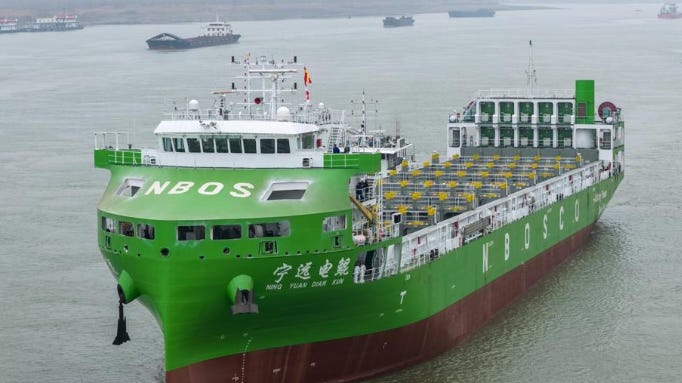
Electric Ships and the Future of Coastal Freight: Insights from China's Ning Yuan Dian Kun**Navigating the shift toward decarbonizing maritime freight, this episode explores China's groundbreaking electric container ship—the Ning Yuan Dian Kun—and what it signals for the industry. We delve into its operational significance, technological breakthroughs, and strategic implications for ports, shipowners, and investors.
Main points covered:
Introduction to the Ning Yuan Dian Kun, the world's largest all-electric container ship, and its role in decarbonization
Technical details: 10 battery-shaped units with 19 MWh capacity, powered by permanent magnet motors, and their operational deployment in Zhejiang
The ship's route: coastal corridors in Zhejiang, moving 740 TEUs efficiently while reducing fuel use by 580 tons and CO2 emissions by over 1,400 tons annually
Why right-sized electric ships for regional routes can be commercially viable, emphasizing the importance of infrastructure and predictable corridors
The potential for electrification to cut 34-73% of CO2 emissions in domestic trade by 2035 under high grid decarbonization scenarios
The role of software and autonomy: route planning, collision avoidance, and energy management—shifting operational decision-making
Crew experience improvements: quieter voyages, less machinery noise, and better working conditions
Investment opportunities: ports with reliable high-voltage shore power, standardized containerized batteries, and regional vessel design
The broader market context: incremental electrification of smaller vessels addressing up to 17% of global CO2 emissions in regional segments
Operational and training shifts needed for crews, emphasizing active energy management and route planning
Strategic lessons: the significance of corridors where economics, physics, and politics align for early technology adoption
The importance of early decarbonization plays, accelerated by falling battery costs, cleaner grids, and regulation
Timestamps:
00:00 - Introduction to the electric ship and its significance00:22 - Overview of the Ning Yuan Dian Kun's technical specs and deployment01:21 - Route details: coastal freight corridors in Zhejiang02:43 - Why this ship matters for decarbonization and commercial viability04:15 - Battery tech: 10 container-shaped units, recharging options, and propulsion05:26 - Estimated fuel savings and CO2 emission reductions06:26 - The broader implications for short regional trades and electrification possibilities07:27 - Economics of intra-regional routes at battery prices around $100/kWh08:20 - Software integration: autonomous navigation, energy management, and operational control09:08 - Crew experience improvements and operational discipline shifts10:00 - How to model and evaluate electrification investments with tools like Freight GPT11:44 - The strategic importance of port infrastructure and corridor design15:36 - Small vessel electrification's outsized emission benefits16:55 - Operational, crew training, and autonomous decision-making impacts18:59 - Final lessons: early corridors as the testing ground for decarbonization20:12 - Call to action: leveraging Freight FA tools to run scenario analyses
Resources & Links:
Freight GPT — AI-powered cost and scenario analysis for freight
Freight FA — Platform for freight market intelligence
China Daily — Coverage on electric ships
Marine Insight — Maritime tech insights
The Driven — Sustainable shipping developments
Nature Energy — Research on electrification economics
Connect with the host:
This episode underscores how regional, predictable corridors with supportive infrastructure are likely to be the initial frontier for electric shipping, making early adaptation a strategic move for stakeholders wanting to lead in decarbonization.