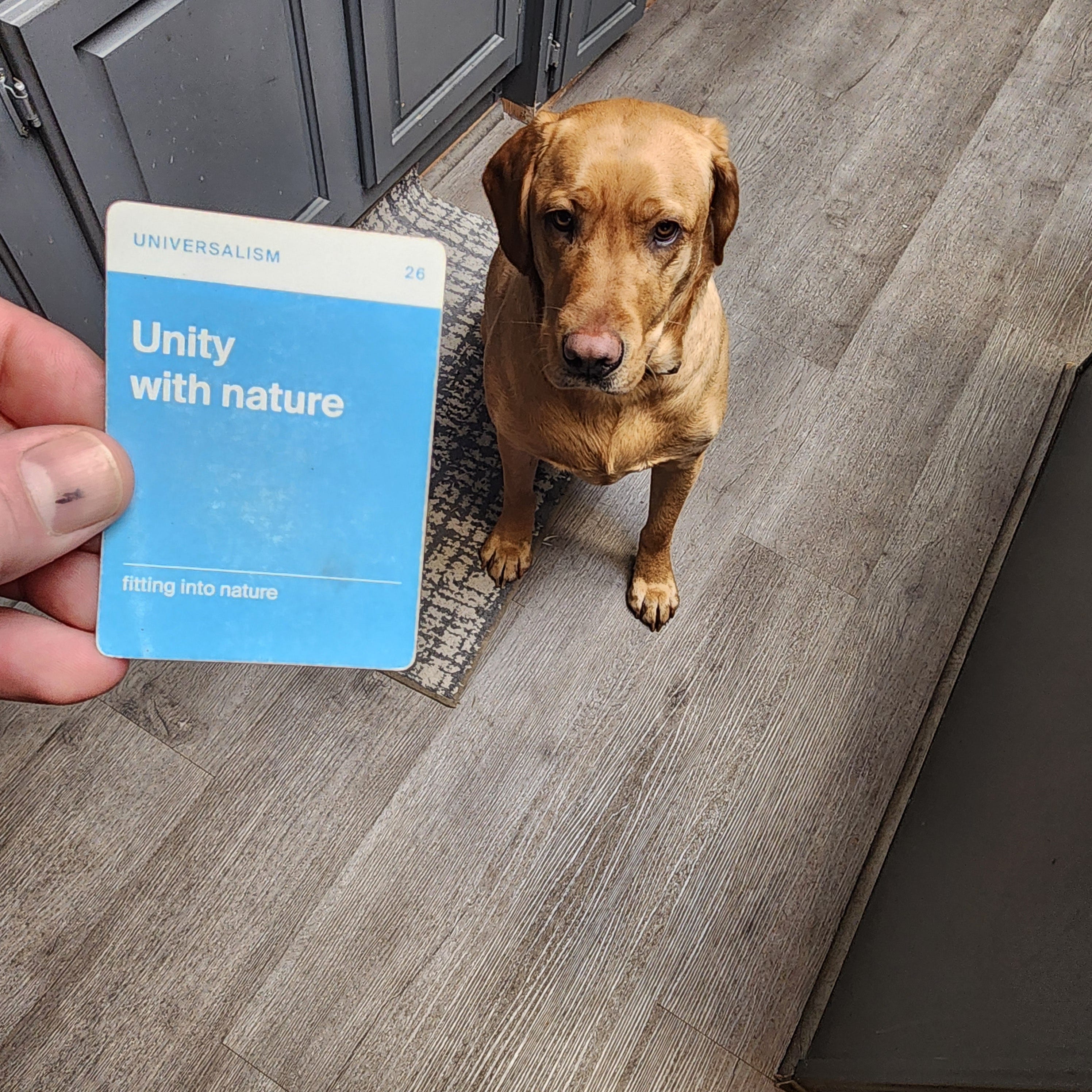
I do have a very high value for fitting into nature. It’s why I’m an avowed “environmentalist” now. To me, that means maintaining a value for our natural environment, as the name would suggest, but it feeds and bleeds—as these values tend to do—into other things. Like Conservation and Frugality. My love for the natural world informs my desire to not buy new things that require extractive and exploitative methods of production, here at home or abroad.
And it extends to plants and animals. This card was photographed with my best friend, Chuck. My love for him is informed by my belief that he has value and worth as a creature. I am not concerned about his level of consciousness. He is a part of the world and I am a part of the world and we fit together.
I grew up on a farm and I spent a lot of time in nature. Really a pretty idyllic place to grow up if you saw it. About 50 acres with a creek running along the west side of it. The creek was lined with Oregon Ash (Fraxinus latifolia), Bigleaf Maple (Acer macrophyllum), and some truly large Douglas Fir (Pseudotsuga menziesii).
When I was young, my uncle built us a treehouse that was so far from our regular people-house that we rarely even made it down there. It was in the most beautiful, magnificent maple tree you ever did see. The northwest corner of the property (I’d guess 15 acres or so) was almost entirely Oregon Ash and accompanying shrubbery, my favorites being the Nootka Rose (Rosa nutkana) and Cow Parsnip (Heracleum maximum)—both beautifully fragrant. I know those woods so well I could walk out there with my eyes closed.
(Yes, I went to forestry school. Learning the names of things is a form of intimacy, I think. You treat a “tree” differently than you treat an Acer macrophyllum that you know by name).
We heard coyotes, but I never saw one on the place in twenty years. Nutria and Himalayan blackberries were common invasives.
Once, we saw something black skimming along the top of the water and we shot it with bullets until it died. It turned out to be a mink. I regret that choice deeply. We killed it for no reason. It was fitting into nature and I wasn’t. It was unified with the greater whole, and we killed it.
But as I grew, the relationship changed. There was a maple tree in my woods that was five feet around at the base. It was a giant. A sentinel. When it finally fell, I didn’t see it as firewood. I wept. I cried for a tree because I had finally learned that we were part of the same community.
There was an island in our creek we called “Bugball Island.” I spent whole afternoons on Bugball Island, building forts and bridges that would be washed away in the inevitable wintertime floods.
We camped every year at Waldo Lake in Oregon. Remarkably clear water. Remarkably clear views of heaven. We would literally go up there for a month at a time sometimes. My mom would drive us up in one pickup truck, and my dad would stay home and go to work. On the weekends he’d come up in a separate pickup and we’d go adventuring to Taylor Burn or Wickiup Reservoir or Odell Lake.
But during the weeks we stayed close to Waldo Lake, canoeing, rock-hopping along the shore, or swimming either at the deep hole or the beach. My mom whittled old men out of bits of wood, prepared meals for hours, and we all did a great deal of reading.
There was a snow cabin at Waldo Lake. The door was padlocked, but it was meant to be accessible in the wintertime via a hatch built high up in a tower, above the snowline. That door was not padlocked. I do not know why. So we’d scale the building and sneak down inside to explore the tins of meat and firewood and old issues of Reader’s Digest contained therein.
I swam in rivers. I swam in lakes. I rode bicycles and crashed on red volcanic gravel at Camp Sherman.
Once, in Forestry School, I saw a raccoon that was as big as a small pig. It was the largest raccoon I’ve ever even heard of. I couldn’t believe my eyes. It looked like it was the size of a small bear. In fairness, I was across a small ravine. Google says the largest raccoons in the wild approach 70 pounds and up to 55 inches long. Which is much smaller than a bear. But Google wasn’t there. It was a portly, sizable raccoon. Nature!
Later, when I was a young married guy, we bought and remodeled a small home. Once, during the remodel, a woman came to the door and said she’d lived there as a girl, and could she have a look around? I happily showed her around and we talked awhile, and in return, she emailed me some photos of what the place looked like way back then.
The biggest difference I keyed into was that the backyards were all open to one another in those days. It was a great, well-kept orchard with grassy areas and garden plots throughout. Kids could go out the back of their homes and straight into the back of someone else’s, and they did. Community was more open to itself and more open to the natural world. I looked at my fence, I pondered the distance I felt from my neighbors, and I was sad.
After that, we moved to a beautiful place on three wooded acres that overlooked a sort of narrow creek bed that ran year-round. There were some small fishes in there, and many salamanders and all of the migratory birds in the whole world if you sat long enough to see them. I once, from my dining room, counted twelve egrets.
And now I live on a little farm of our own. We have a small gully that does not run year-round; it runs about half the time or better. We have no fishes, but we occasionally see ducks in season. It is a fairly developed property with defined fence rows and outbuildings. But I have plans. Plans for re-wilding, plans for multi-species development. I’ll bet you in a few more years we’ll see deer. A few years more and perhaps the nesting birds will come and stay.
A neighbor swears they saw a beaver on their land. A baby black bear ran across the road in front of my wife not three miles from the house. There is beauty in the world.
I am deeply affected by the coming of the Emerald Ash Borer Beetle. My wife is from a part of Canada that endured a beetle-kill. All of the spruce, just... gone. It took a dozen years or so, and it was gut-wrenching. The same is happening now, here, in our valley with our Ash trees. It won’t be long—they’ll be gone. I’m making plans for soil retention and species replacement. But the Ash trees will be gone and I am despondent when I think of it.
That is what this card means to me now. It means knowing the names of the roses. It means respecting the portly raccoons. It means looking at Chuck and seeing a peer, not a pet. It means being wise to invasive management and thinking about the future—not just today.
I have not always been an environmentalist. I have not always been kind to the wild things. But I have always been in love with the outdoors. And slowly, over forty years, I am learning how to stop conquering it and start fitting into it.
2026/01/30