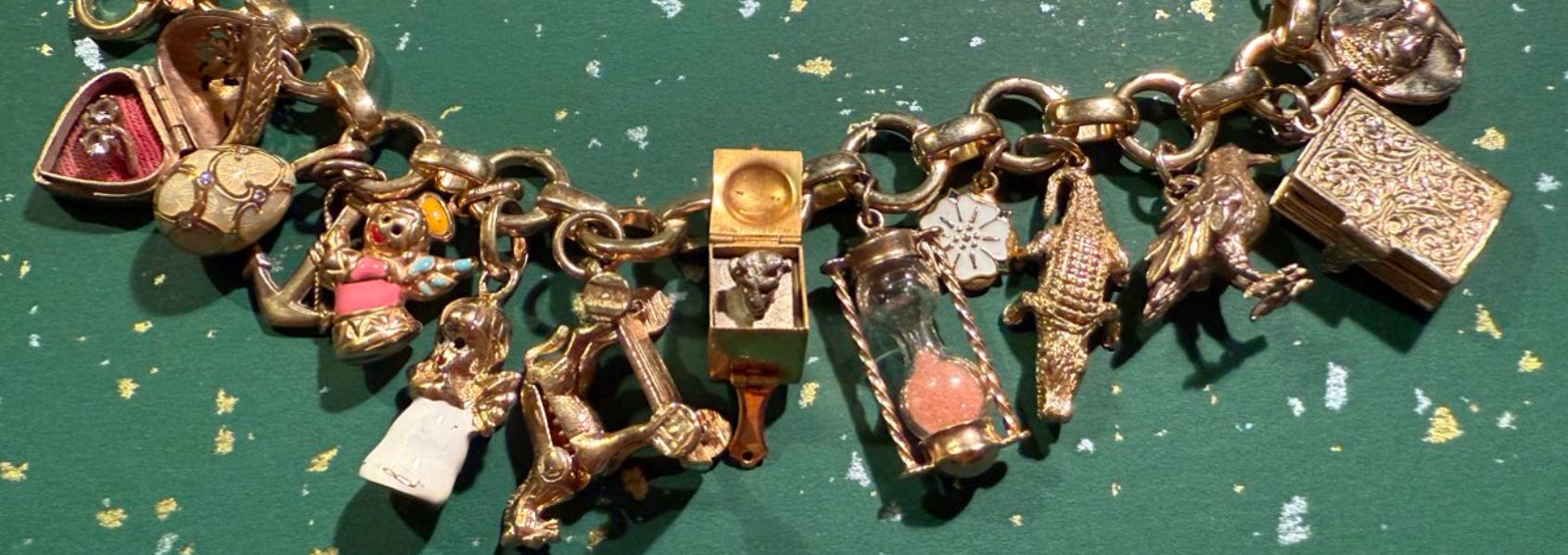
On 23 December last year, Rowling changed her Twixter home page header and cameo with this tweeted explanation:
The Charm Bracelet header features thirteen charms on nine links:
Rowling tweeted an addendum about the Psalter and Jack in the Box charms:
Nick Jeffery dropped an explanatory post two days later at the Hogwarts Professor weblog: J. K. Rowling Drops All the Strike 9 Clues for Christmas!It remains the only complete survey of the pieces and compendium of what Serious Strikers around the world have discovered about them.
Beatrice Groves, author of Literary Allusion in Harry Potter, wrote up her charm bracelet thoughts at ‘The Strike Ellacott Files’ a month later. In ‘Charms, Psalms & Golden Clues: A brace(let) of clues for Strike 9,’ Prof Groves discusses the magical quality of charms as talismans and even incantational song:
Rowling points out in this 2013 piece the link between the name given to charm bracelets and the magical world: ‘Why do we call those little masterpieces “charms” if not in allusion to their talismanic properties?… they are personal amulets.’ To charm someone is also to slightly to bewitch them, something Rowling plays with when Riddle exerts his charm on Ginny and literally possesses her: ‘If I say it myself, Harry, I’ve always been able to charm the people I needed.’ Witch Weekly’s Most-Charming-Smile Award is given to a smile that is both literally, as well as metaphorically, bewitching.
The word ‘charm’ comes, through French, from the Latin ‘carmen’ which means ‘song, verse, oracular response, incantation.’ Its first meaning in English, therefore, was the magical one: ‘the chanting or recitation of a verse supposed to possess magic power or occult influence; incantation, enchantment; hence, any action, process, verse, sentence, word, or material thing, credited with such properties; a magic spell; a talisman, etc.’ (Oxford English Dictionary). From the sixteenth century onwards, ‘charm’ meant ‘anything worn about the person to avert evil or ensure prosperity’ because such amulets might contain the text of such a charm. And thinking about this made me aware for the first time of how in the most important charms in Harry Potter – the Fidelius Charm and the Patronus Charm – the word is not simply a synonym for spell but encodes this original, protective meaning. These magical ‘Charms’ like the charms on charm bracelets encode what Rowling calls ‘talismanic properties.’
Nick and John invited Elizabeth Baird Hardy, Deputy Headmistress of Hogwarts Professor, the genius behind AppalachianInkling.com, Hunger Games expert, and author of Milton, Spenser and the Chronicles of Narnia: Literary Sources for the C.S. Lewis Novels to talk about these charms, especially about what she had written briefly on the subject.
The goals of this conversation?
* To introduce the subject to everyone not familiar with the Christmas tweets and bracelet-header,
* to discuss the ‘Why?’ of this present to Strike fans everywhere,
* to speculate about the meaning of the bracelet pieces individually and in a series, and
* to brainstorm their qualities as clues for Strike9, the penultimate novel in the decalogy.
Which is a lot! The good news is that the conversation never flagged and the revelations and possible meanings of the charms, thirteen in total on nine links, reward anyone listening in.
Nick starts off the conversation with a review of the six charm bracelets in Rowling’s life and writing, one of which was a long forgotten piece in the margins of a Rowling web site:
[You can read about those internet ‘Easter Eggs’ in ‘Hidden Photos at Rowling’s Website’ here, here, here, and here.]
Nick offered as a guiding idea for our conversation the likelihood that the nine links in the bracelet were meaningful, i.e., that they reflected the structure of the book for which the bracelet is meant to be a clue. There are thirteen charms, he noted, but certainly Rowling-Galbraith could have had a thirteen link chain made if she hadn’t thought the nine links more than sufficient, even a pointer to Strike 9 being a nine Part mystery. Since, as Nick noted, she has trouble even passing up a shop selling charms, it seems likely she has been collecting the pieces for this one for some time. Perhaps this bracelet is a “target” toward which she has been writing with these books. It is certainly not something she just threw together for a header photo shoot.
The trio elected to read the circular collection of charms, consequently, as pieces with individual meaning — as magical talismans of sorts per Prof Groves — and as a ring composition, with both aspects indicating the place and meaning of the piece in the book.
After a brief discussion of why Rowling, Inc., would release this set of clues now, with another Strike novel or Bronte Studios television adaptation in the distant future — John offered the possibility that this bit of fan servicing was meant as a touch of appeasement qua Christmas gift to the many fans disappointed with Hallmarked Man — Elizabeth, John, and Nick tackled the thirteen charms on nine links.
In Part One of their conversation, they talk about
* the heart shaped engagement ring box;
* the golden diamond-laden egg;
* the anchor;
* the two angels; and
* the Trojan horse.
Their preliminary conclusions at the half-way point?
Mrs. Murray in her Nativity gift to her readers offers them clues not only to the next Strike-Ellacott novel but to the meaning of human life. Each of these five charms is a symbol with obvious and not so obvious Christian meaning.
John reconsidered his answer to the ‘Why now?’ in light of this avalanche of symbolism; instead of it being fan servicing to rescue the brand, he thinks it may be Rowling’s attempt — on the most celebrated remnant Christian holiday in a post-Christian world — to reset her serious readers’ understanding of what she is about as a writer, what sort of transformation she is trying to create via story within her readers.
Part two of this interpretative deep dive into Rowling’s artistry in metallurgical symbolism, her “charm work” literary alchemy, will follow shortly. There are five links with seven charms to come — Jack in the Box, Hourglass, White Rose, Crocodile, Corvid, Psalter, and the Head of Persephone — all as rich in meaning as the first four links.
Below are links to subjects mentioned in this first conversation and additions not discussed but discovered after the fact, all shared for your consideration and comments!
Thank you as always from the Hogwarts Professor team for your joining us with special appreciation to our paid subscribers!
Subjects that Elizabeth, Nick, and John Discussed:
The Heart Shaped Engagement Ring Charm:
* The first, fourth, fifth, and ninth links are clasped objects with surprises inside,
* Ink Black Heart and Deathly Hallows: The Heart is Not About Emotions and Affection but the Human Spiritual Center(John, October 2022)
* Hallmarked Man, Part Five: The Center of Strike 8 is about “Inner Light” (Ed Shardlow)
* Gold as “solid light” and diamonds as “inner light,” both reflecting in nature the Light of God’s Word or Logos that is found with in every man (cf., John 1:9 and Rowling’s comments about Casual Vacancy being “all about” her belief that “the light of God shines in every soul”);
* The consequent symbolism of a golden wedding/engagement band with two diamonds;
* The human being as a ‘heart in a box’ either enlightened ‘gold and diamonds’ or a dark ‘jack in the box’ devil
* The two-stone ring, as Nick notes, is a “me and you” ring, alluding to a certain theme song. Also, Elizabeth notes, Robin is faced with a choice between two very different types of proposals, so the duality of the ring in the box connects to that conundrum, and since that is apparently where 9 will begin, it gives us a good idea that we are right in “reading” the bracelet starting with this one
The Gold Diamond-Laden Egg Charm:
* Assuming it is an ‘Easter Egg,’ the two meanings of that phrase;
* Again, ‘gold and diamonds,’ as above;
The custom of exchanging colored eggs entered the life of the Church. The symbolic meaning of the egg as the beginning of a new life was known even earlier. Christians saw in this symbol confirmation of their faith in the coming general resurrection. The Easter egg’s red color symbolized the all-conquering Divine Love, which alone could destroy hell!
The Foul-Anchor Charm:
* ‘Strike 9 to Heads to Portsmouth!’ (Nick, September 2025)
* Foul Anchor (Wikipedia);
* Eagle, Globe, and Anchor (Wikipedia);
* Meaning of ‘Hector’ in Homeric Greek is ‘Holding Fast,’ and, by interpretation, ‘anchor;’
* The Greek word for ‘Anchor’ found in the New Testament is ἄγκυρα, pronounced ‘ang-chor-a;’
* Hebrews 6:19:
13 For when God made promise to Abraham, because he could swear by no greater, he sware by himself,
14 Saying, Surely blessing I will bless thee, and multiplying I will multiply thee.
15 And so, after he had patiently endured, he obtained the promise.
16 For men verily swear by the greater: and an oath for confirmation is to them an end of all strife.
17 Wherein God, willing more abundantly to shew unto the heirs of promise the immutability of his counsel, confirmed it by an oath:
18 That by two immutable things, in which it was impossible for God to lie, we might have a strong consolation, who have fled for refuge to lay hold upon the hope set before us:
19 Which hope we have as an anchor of the soul, both sure and stedfast, and which entereth into that within the veil;
20 Whither the forerunner is for us entered, even Jesus, made an high priest for ever after the order of Melchisedec.
* Meaning of "Anchor of the Soul" in Hebrews 6:19?
The Immediate Context of Hebrews 6:13-20
The writer reassures wavering Jewish Christians by citing God’s oath to Abraham (Genesis 22:16-17). Two “unchangeable things” (God’s promise and His oath, v. 18) make it “impossible for God to lie.” The “hope set before us” (v. 18) functions as an anchor that has already “entered … behind the curtain” (v. 19), where Jesus, our High Priest, intercedes (v. 20; cf. 4:14-16).
Anchor as Hope: Theological Significance
1. Objective, not subjective: “hope” (ἐλπίς) is grounded in the historical, bodily resurrection of Jesus (1 Corinthians 15:17-20).
2. Already-but-not-yet: the anchor is cast forward into the heavenly holy of holies, securing believers’ future inheritance (1 Peter 1:3-4) while exerting a present stabilizing pull.
3. Firm and secure: βεβαία (reliable) and ἀσφαλής (incapable of slipping). The compound assures permanence beyond circumstantial change (Malachi 3:6).
Christ Our Forerunner Behind the Veil
The anchor “enters” (εἰσερχόμενον, pres. tense) the inner sanctuary “behind the curtain,” alluding to the Day of Atonement (Leviticus 16). Jesus is πρόδρομος (“forerunner,” v. 20), implying that others will follow where He has gone (John 14:2-3). The anchor-rope is His indestructible life (Hebrews 7:16), tethering the believer to God’s throne of grace.
* Hence its use as a symbol within Christianity: Christ having defeated death is an anchor to those members of His Mystical Body which anchors them to life after death, “beyond the veil;”
* The pairing of the anchor charm with the golden egg on the second link of the bracelet reinforces this Paschal symbolism;
* Charles Williams’ “Co-inherence” ideas: “Who Saved Draco’s Soul?” Co-Inherence in Harry Potter
The Two Angels Charms (paired on Link three)
* Cupid and Psyche? Maybe!
* Angels? Ghosts?
* Orlando drawings! A Silkworm flash-back to the Monkey-Bag with the essential clue inside…
The Trojan Horse Charm
* Trojan Horse (Wikipedia)
In Greek mythology, the Trojan Horse (Greek: δούρειος ίππος, romanized: doureios hippos, lit. ‘wooden horse’) was a wooden horse said to have been used by the Greeks during the Trojan War to enter the city of Troy and win the war. The Trojan Horse is not mentioned in Homer’s Iliad, with the poem ending before the war is concluded, and it is only briefly mentioned in the Odyssey. It is described at length in the Aeneid, in which Virgil recounts how, after a fruitless ten-year siege, the Greeks constructed a huge wooden horse at the behest of Odysseus, and hid a select force of men inside, including Odysseus himself. The Greeks pretended to sail away, and the Trojans pulled the horse into their city as a victory trophy. That night, the Greek force crept out of the horse and opened the gates for the rest of the Greek army, which had sailed back under the cover of darkness. The Greeks entered and destroyed the city, ending the war.
Metaphorically, a “Trojan horse” has come to mean any trick or stratagem that causes a target to invite a foe into a securely protected bastion or place. A malicious computer program that tricks users into willingly running it is also called a “Trojan horse“ or simply a “Trojan”.
* Could the Strike Series be a Re-telling of Virgil’s Aeneid? (John, July 2017)
If Cormoran Strike’s story is Rowling’s postmodern re-telling of the Aeneid, then the Fates theme is more than apt.
It is all about, after all, the hero’s destiny or fate to recreate Troy in Italy as Rome, a fate which it is pointless for Aeneas to resist. The refugee from Troy, son of the goddess of beauty, is forced ever onward, often over-riding his preferences and pledges, to his destiny to found Rome as the New Troy. A soldier in an eastern country ‘coming home,’ Aeneas is a wounded man, haunted by his divine mother, a man of destiny forced to leave a beautiful, powerful woman who curses him at his departure.
Sound familiar? The Aeneid is a reverse reflection and re-telling of Homer’s Iliad and Odyssey in that it’s first six books are about the Trojan’s travels and the last six relate his battles with the local tribes in Latium. It seems possible that Rowling might be trying to do with the Aeneid what she did with the Weird Sisters of Macbeth, namely, present what seems to be a tale of inevitability or fate, something prophesied or otherwise seemingly inescapable, as a function really of character choice.
In the Peg-Legged PI’s story that could mean Rowling’s revisiting fate vs choice vis a vis whether he is able to choose to take-or-leave an investigation of Leda’s death (and face the dangers inherent in threatening his biological father, Jonny Rokeby) or whether he feels doomed to follow it to its end, whatever the costs to him and to those he loves.
* The Trojan Horse is the wisdom of Athene as given to Odysseus, her favorite.