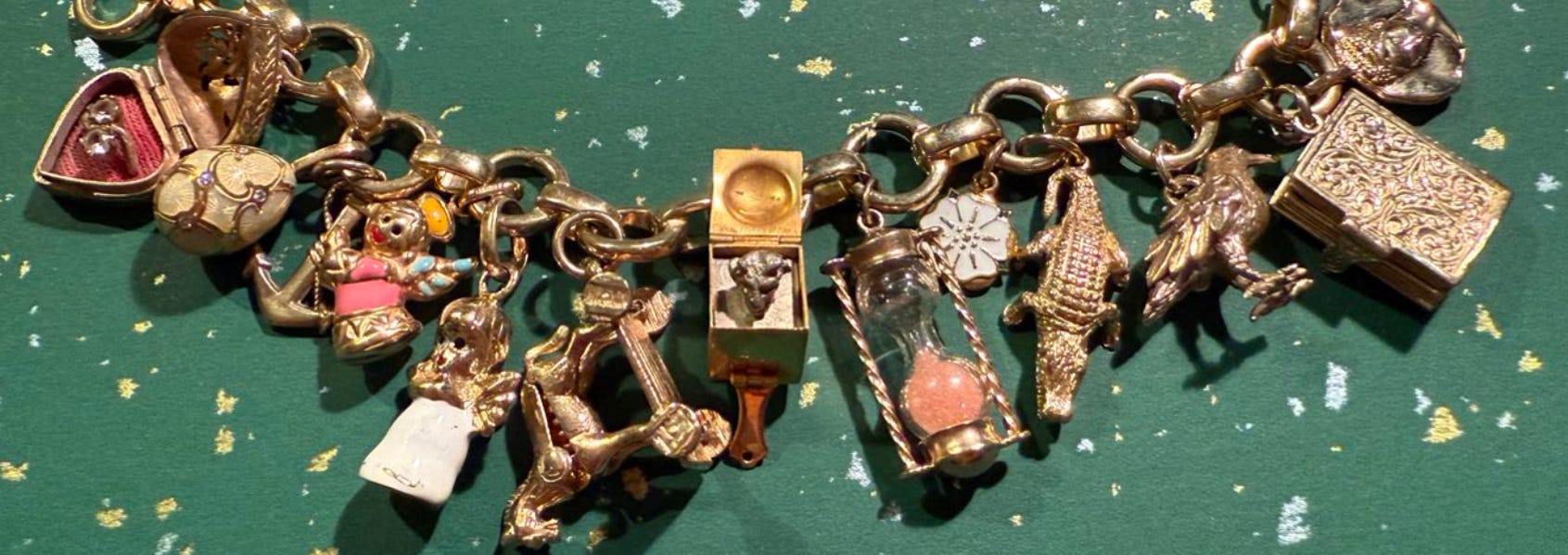
Elizabeth Baird Hardy, Deputy Headmistress of Hogwarts Professor, the genius behind AppalachianInkling.com, Hunger Games expert, and author of Milton, Spenser and the Chronicles of Narnia: Literary Sources for the C.S. Lewis Novels, joined Nick and John to discuss the Charm Bracelet that J. K. Rowling posted on her Twixter home page as a Christmas gift to her readers. She said that that the thirteen charms on nine links were a set of clues about the next Strike novel, the ninth in a ten book series.
In the first Part of Elizabeth, Nick, and John’s conversation, they discussed Rowling’s charm bracelet history, speculated about why she posted this picture when she did, decided to look at each charm on the bracelet for its stand-alone meaning and its place in the nine link set, and to read the whole series as if it were a ring composition, one reflecting a nine Part structure in Strike 9. They then made deep dives into the details of each charm: the heart shaped box containing a ‘You and Me’ engagement ring, a golden diamond-laden egg, a foul anchor, two angels, and a Trojan horse.
In this second Part of that conversation, the trio of Serious Strikers continue with the remaining charms on the bracelet, namely, a Jack-in-the-box, an Hourglass, a White Rose and Crocodile, a Corvid head, and a Psalter paired on the last link with the Head of Persephone. They share their thoughts, too, about the bracelet as a symbolic integer and its ring meaning.
The notes below are in support of references they make mid-flight and to other resources of interest to Magic Charm Decoders! Enjoy.
Thank you to all our subscribers with special gratitude and appreciations for our paid subscribers; you are the wind in our sails, the heat from our vents…
Serious Strikers are reading Browning’s The Ring and the Book, charting Hallmarked Man Part Six, and reviewing the Myth of Cupid and Psyche to look for parallels in the Strike-Ellacott series. See you soon!
Jack-in-the-Box Charm
* Rowling claims this as her favorite charm (Nick and John in the conversation mistakenly attribute this preference to the Psalter charm):
* Is it a devil — or a Racoon?
* The jack in the box toy, the 'Jack' being a devil, was invented in Germany in the 16th century as a mockery of the Roman Catholic doctrine of the Real Presence of Christ in the Eucharist.
* The shape of this charm, the golden circular center in the inside of the open box top, represents the transcendent spiritual realm and the square bottom with its four directions, the fallen world. The ‘jack’ devil lives in the latter but is from the former.
* The charm is the third latched object in the chain, the heart box and Trojan horse preceding it and the psalter at chain’s end following it — which means the ring latch and center are latched objects with surprises inside. The two interior objects at center have deadly surprises and the beginning and end eternal life interiors. The symbolism here is of the human being and its capacity via choice for either spiritual perfection in sacrificial love (anteros) or consumption by individual desires (eros). The thing hidden inside, man’s spiritual capacity or heart, is either light or darkness, the inside bigger than the outside. (John)
* What is the Strike 9 connection, the analogue to the demonic Jack in the box? Is it RFM? Uncle Ted? Ilsa’s husband Nick? Polworth?
* The Jack’s position is at the center of the bracelet and between the hourglass and the Trojan horse. So it’s placed between cleverness and craftiness and things that we can control and bad surprises, but also time, because we can’t control time. (Elizabeth)
Hourglass Charm
* tempus fugit ‘like sand in an hourglass’
* infinite symbol
* The Strike series may be a collection of mystery-story genres, each one illustrating a unique type of story, different from all the others while keeping the same core of characters and overarching narrative (cf., Rowling’s note in The Running Grave acknowledgements that that book was her “cult” book). The hourglass, then, may be Rowling’s pointer to Strike9 being a suspense drama in which the good guys not only have a challenging mission (find and rescue the missing Robin, Strike, Lucy, Pat, whomever) but have to do it before a literal deadline arrives. The Ticking Clock plot device.
* If the Jack at link five is the center of the bracelet ring of nine links, how does the hourglass mirror the Trojan horse? It’s two parts? The deadline aspect? “Reveal the crazies inside before the hourglass empties”?
White Rose Charm
* The interior of the flower charm is a literal Turtleback or ring composition diagram.
* White Rose of Dante: Paradiso Cantos XXXI and XXXII
The true home of all the blessed is with God in the Empyrean, a heaven of pure light beyond time and space. Dante sees the blessed systematically arranged in an immense white rose: like a hologram, a three-dimensional image, the rose is formed from a ray of light reflected off the outer surface of the Primum Mobile (30.106-17). The queen of this white rose is the Virgin Mary, traditionally represented as a rose herself (see Par. 23.73-4). This celestial rose recalls large rose windows of Gothic cathedrals, many of which are dedicated to Mary. The image of the rose, often red, is also used to represent Christ or, in other contexts, earthly love. The white rose is symmetrically structured according to various criteria, including belief, age, and gender. One half of the rose, already full, holds those who, according to Christian tradition, believed in Christ to come (the blessed of the Hebrew Bible); the other half, with only a few seats still unoccupied, contains those who believed in Christ already come (saved Christians). Two gendered rows mark this division of the rose in two halves. In the row below Mary appear women of the Hebrew Bible (Eve, Rachel, Sarah, Rebecca, Judith, Ruth, and unnamed others); Beatrice is seated next to Rachel, on the third row from the top. Opposite Mary, John the Baptist heads a row of men containing Francis, Benedict, Augustine, and other Christian fathers. Mary is flanked by Adam (first man) and Moses on one side, and Peter (first pope) and John the Evangelist on the other. John the Baptist is flanked by Lucy on one side and Anna, the mother of Mary, on the other. While only adults are seated in the upper section of the rose, below a certain line the rose contains souls of blessed children, their precise location based not on their own merits (since they lacked the power of free will) but on predestination. As physical laws do not apply in the Empyrean, Dante's ability to see these figures is not diminished by distance (30.118-23; 31.76-8).
* White Rose of Mockingjay (Hunger Games finale)
The prevailing symbol of Catching Fire and the most meaningful token the Christ figure of the series gives Katniss is a pearl, the solid-light symbolism of which we’ve discussed before. I think Commander Paylor’s name may be our last Madge-Pearl-Mags name reference in being a “pale orb.” That gold and pearls have a similar translucency and metaphysical correspondence with the ‘Light of the World’ make the twin possibilities that much more rich — and Commander Paylor’s ascending to Panem’s Presidency that much more meaningful and appropriate.
Katniss steps into the Garden with the Pearl’s blessing (“on my authority”) and discovers roses of every possible color. There are red, of course, and “lush pink, sunset orange, and even pale blue.” She knows what she wants, though; the rose colored like light, the white rose, Dante’s symbolic prelude to the beatific vision and transcendence. Just as she cuts the “magnificent white bud just about to open” “from the top of a slender bush” (ibid, p. 355), the manacled, “pale, sickly green” President Snow, our snake in the Garden, speaks.
“The colors, are lovely, of course, but nothing says perfection like white.”
Our story Satan, you recall, left her a white rose in District 12 in chapter 1 and dropped roses with the bunker buster bombs in Part 1 to terrify Katniss. Now we know why. He was taunting her with her end, that as a seeker’s soul he knew her goal was perfection in Christ and taunted her with it, especially when he held Peeta-Christ and understood the cartharsis and chrysalis she would have to pass through to claim it herself. Now that she is in the inner sanctuary, the High Place, he tells her the truth she could not hear anywhere else, the final, ugly truth about the cause for which Katniss had sacrificed everything. Snow reveals, just as Peeta had told her at the story’s start, that she was deceived by those she trusted. President Coin killed Primrose with a weapon designed by Gale.
Having been to the Absolute center, the world navel, and taken away the beatific vision as a white rose, Katniss is no longer a seeker but the resolution of contraries, an androgyn of justice and mercy. She is above right and wrong now as the phoenix-mockingjay and hears the voice of the “murderer” on the Hanging Tree at last. She deceives President Coin at the Victors Meeting as something of an avenging angel; she becomes a murderer herself by assassinating President Coin. Peeta-Christ comes down from the tree as her savior once again and prevents her suicide via Nightlock by his out-of-nowhere intervention.
* Why does the White Rose share the seventh bracelet link with a crocodile? Faerie Queene!
Crocodile Charm
* The Crocodile in Shed, crocodile skin handbags (Hallmarked Man)
“Maybe the4 crocodile or whatever they’re keeping in the shed’s chewed its way out,” said Strike. “ (Chapter 22, p 176; center chapter of Part 2)
* Crocodile entry, Cirlot’s Dictionary of Symbolism
Crocodile Two basically different aspects of the crocodile are blended in its symbolic meaning, representing the influence upon the animal of two of the four Elements. In the first place, because of it viciousness and destructive power, the crocodile came to signify fury and evil in Egyptian hieroglyphics (19); in the second place, since it inhabits a realm intermediate between earth and water, and is associated with mud and vegetation, it came to be thought of as an emblem of fecundity and power (50). In the opinion of Mertens Stienon there is a third aspct, deriving from its resemblance to the dragon and the serpent, as a symbol of knowledge. In Egypt, the dead used to be portrayed transformed into crocodiles of knowledge, an idea which is linked with that of the zodiacal sign of Capricorn. Blavatsky compares the crocodile with the Kumara of India (40). Then, finally, come the symbols of Inversion proper and of rebirth. (67)
* Lyndy Abraham’s Dictionary of Alchemical Imagery entry for ‘Crocodile:’
Crocodile The mercurial *serpent or transforming arcanum in its initial chthonic aspect during the dark, destructive opening of the opus alchymicum. Like the *bee, the crocodile was classified as a serpent in te bestiaries of the sixteenth and seventeenth centuries. The amphibious nature of the crocodile made it an apt symbol for the dual-natured *Mercurius. When Lepidus in Shakespeare’s Antony and Cleopatra says, ‘Your serpent of Egypt is bred of your mud by the operation of your sun; so is your crocodile’ (2.7.26-7), he is referring to the generation of gold in the earth, and the generation of the mercurial serpent through the heat of the secret *fire or ‘sun’. With the phrase ‘operation of your sun’ Lepidus also alludes to the final law of the alchemical Emerald Table: ‘That which I had to say about the operation of the Sun is completed’ (48)
* Sandy Hope on Crocodile symbolism
Isis Church crocodile in Faerie Queene: Book 5, Canto VII
Book V Canto vii. The speaker praises the virtue of justice and cites Osyris as an example of the just man. His wife, Isis, represented equity and to the Temple of Isis Britomart and Talus come to spend the night. Talus, however, is not allowed into the temple. Britomart enters and sees a statue of Isis with her foot on a crocodile. The temple is also full of the priests of Isis who are not allowed to drink wine as it leads to rebellion. Britomart sleeps under the statue of Isis and dreams that the crocodile comes alive and threatens the Goddess. The Goddess subdues the crocodile and it becomes meek and then impregnates the Goddess. She gives birth to a lion which conquers all other beats. Britomart awakes and tells her troubling dream to a priest. He tells her that the crocodile represents Arthegall, Isis represents Britomart, and the lion their son whom they will conceive. Grateful for the interpretation, Britomart leaves and comes to Radigund’s castle. Radigund and Britomart battle, Britomart is wounded in the shoulder, and finally Britomart beheads Radigund. Talus enters the castle and wreaks carnage on the Amazon women inside. Britomart finds Arthegall dressed, like other, in women’s clothing. she is shamed by the sight, and it is not quite clear whether her suspicions that Arthegall has been unfaithful are confirmed or refuted. She finds Arthegall some armour, arms him, and the rest in the castle. during this time Britomart rules as a princess and reforms the Amazon society so that women are restored to proper subjection to men. Finally, Arthegall leaves to complete his quest against Grantorto. Britomart lets him leave because she knows that his success in this quest is important to restore his ego. After residing further at the Amazon castle she finally leaves to help keep her mind off the absent Arthegall.
* The Spenser Encyclopedia entry for ‘Church of Isis:’ (408) Clifford Davidson
When Britomart spends the night in the temple, she sees a ‘wondrous vision’ in which she participates first as a votary of Isis and then as the goddess herself. Her devotion to the statue causes her to become Isis in her dream: she is serving at the altar when she sees herself transformed into Isis but wearing the royal robe. The crocodile awakens, devours the flames which threaten to destroy the temple, and threatens to eat Isis/Britomart until it is driven back by her rod. Then it seeks her ‘grace and love,’ she yields, it impregnates her, and from their union she gives birth to a lion. As the Priest explains, the crocodile is Osiris (the Egyptian god of Justice) who sleeps under the feet of Isis ‘To shew that clemence oft in things amis,/ Restraines those sterne behests, and cruell doomes of his’ (22), and who shows thereby the proper relation of justice and judgment to equity. The Priest also explains to Britomart that the crocodile is Artegall, ‘The righteous Knight,’ who will settle the storms and ‘raging flames, that many foes shall reare’ and restore to her the heritage of her throne, and who will give her a ‘Lion like’ son (23), the new British monarchy of the Tudors.
The crocodile is a symbol both of guile and of a regeneration that will affect future history. As guile, its relation to Isis is reminiscent of Vice figures under the feet of triumphing Virtues in medieval art. An iconographic association between the crocodile in its demonic aspect and medieval saints’ legends derives ultimately – significantly for Spenser – from the classical figure of Britomartis (Miskimin 1978). In Plutarch’s Isis and Osiris 50, it is linked to Typhon, the enemy of justice and order, while in Renaissance iconographic tradition it is often symbolic of the need for prudence (for one must be prudent to avoid the wily crocodile). Cesare Ripa’s Iconologia (sv Lussuria) shows the nude Luxury (or Lechery) seated upon a crocodile, an interesting analogy to its phallic sexuality in Britomart’s dream. Yet along with these primarily negative associations, there are also positive ones in the crocodile’s identification with Osiris/Artegall/Justice and in the implication that Isis/Britomart/Equity is incomplete without her partner. The image contains its own contradiction, unresolved by the Priest.
* Troubled Blood and Faerie Queene: Where Britobart and Artegall are used as stand-ins for Robin and Cormoran:
Troubled Blood features several embedded texts, the most important of which is never mentioned in the book: Edmund Spenser’s Faerie Queen. Serious Strikers enjoyed the luxury of not one but two scholars of Edmund Spenser who checked in on the relevance and meaning of Rowling’s choice of the greatest English epic poem for her epigraphs, not to mention the host of correspondences between Strike 5 and Queen. Elizabeth Baird-Hardy did a part by part exegesis of the Troubled Blood-Faerie Queen conjunctions and Beatrice Groves shared her first thoughts on the connections as well. Just as Lethal White’s meaning and artistry is relatively unappreciated without a close reading of Ibsen’s Rosmersholm, so with Strike 5 and Faerie Queen.
Elizabeth Baird-Hardy
* Day One, Part One: The Spenserian Epigraphs of the Pre-Released Troubled Blood Chapters
* Day Two, Part Two: The Spenserian Epigraphs of Troubled Blood Chapters Eight to Fourteen
* Day Three, Part Three: The Spenserian Epigraphs of Troubled Blood Chapters Fifteen to Thirty
* Day Four, Part Four: The Spenserian Epigraphs of Troubled Blood Chapters Thirty One to Forty Eight
* Day Five, Part Five: The Spenserian Epigraphs of Troubled Blood Chapters Forty Nine to Fifty Nine
* Part Six: The Spenserian Epigraphs of Troubled Blood Chapters Sixty to Seventy One
* Spenser and Strike Part Seven: Changes for the Better
Beatrice Groves
* Trouble in Faerie Land (Part 1): Spenserian Clues in Troubled Blood Epigraphs
* Trouble in Faerie Land (Part 2): Shipping Robin and Strike in the Epigraphs of Troubled Blood
* Trouble in Faerie Land (Part 3): Searching for Duessa in Troubled Blood
John Granger:
* How Spenser Uses Cupid in Faerie Queen and Its Relevance for Understanding Troubled Blood
* Reading Troubled Blood as a Medieval Morality Play
Corvid Charm
* Rowling Twixter headers: 12 January 2016, 9 April 2017 (Nick)
* Fantastic Beasts reference? The Lestrange Family Motto features a crow and the ‘Lost Child’ of that series is named ‘Corvus’
* Crow Symbolism per Cirlot, Dictionary of Symbols:
Crow Because of its black colour, the crow is associated with the idea of beginning (as expressed in such symbols as the maternal night, primigenial darkness, the fertilizing earth). Because it is also associated with the atmosphere, it is a symbol for creative, demiurgic power and for spiritual strength. Because of its flight, it is considered a messenger. And, in sum, the crow has been invested by many primitive peoples with far-reaching cosmic significance. Indeed, for the Red Indians of North America it is the great civilizer and the creator of the visible world. It has a similar meaning for the Celts and the Germanic tribes, as well as in Siberia (35). In the classical cultures it no longer possesses such wide implications, but it does still retain certain mystic powers and in particular the ability to foresee the future; hence its claw played a special part in rites of divination (8). In Christian symbolism it is an allegory of solitude.
Amongst the alchemists it recovers some of the original characteristics ascribed to it by the primitives, standing in particular for nigredo, or the initial state which is both the inherent characteristic of prime matter and the condition produced by separating out the Elements (putrefactio) … In Beaumont’s view, the crow in itself signifies the isolation of him who lives on a superior plane (5), this being the symbolism in general of all solitary birds. (71-72)
* Lyndy Abraham’s Dictionary of Alchemical Imagery entry for ‘Crow:’ (49)
Crow, crow’s head, crow’s bill A symbol of the *putrefaction and *black nigredo which is the first stge of the opus alchymicum. The old body of the metal or matter for the Stone is dissolved and putrefied into the first matter of *creation, the *prima materia, so that it may be regenerated and cast into a new form. The Hermetis Trismegisti Tractatus Aureus said of this initial stage of death and dissolution in the work: ‘The First is the Corvus, the Crow or Raven, which from its blackness is said to be the beginning of the Art’ (bk. 2, 235). In his Aurora, Paracelsus wrote that when the matter has been placed in the gentle heat of the secret fire it passes through corruption and grows black: ‘This operation they call putrefaction, and the blackness they name the head of the Crow’ (55). Thomas Charnock likewise wrote of the putrefaction: ‘The Crowes head began to appere as black as Jett’ (TCB, 296). In Zoroaster’s Cave the matter produced during this stage is identified with the name of the process: ‘When the matter has stood for the space of forty dayes in a moderate heat, there will begin to appear above, a blacknesse like to pitch, which is the Caput Corvi of the Philosophers, and the wise men’s Mercury’ (80). According to Ripley the terms ‘crows head’ and ‘crows bill’ are synonymous: ‘The hede of the Crow that tokeyn call we,/And sum men call hyt the Crows byll’ (TCB, 134) (see ashes). In A Fig for Momus Thomas Lodge listed the crow’s head amongst other alchemical enigmas: ‘Then of the crowes-head, tell they weighty things’ (Works, 3:69). When Face in Jonson’s The Alchemistsays that the matter of the Stone has become ‘ground black’, Mammon enquires of him, ‘That’s your crowes-head? And Subtle replies, ‘No, ‘tis not perfect, would it were the crow’ (2.3.67-8).
Psalter Charm
* In ‘Charms, Psalms & Golden Clues: A brace(let) of clues for Strike 9,’ Prof Groves discusses the psalm as charm:
Charm first meant the incantation itself, and then the amulet that carried that incantation to protect the wearer and then – from the 19th century – the small ornamental trinkets, fastened to girdles, watch-chains and bracelets, that resembled those original, talismanic charms. This means that Rowling’s clue-charm of a Psalm book (which can actually carry a sacred text) circles back beautifully to the original meaning of the word – in which a charm was an amulet carrying a holy text. These charms do not always hold texts but Rowling has confirmed that this one does: ‘The book is a psalm book and holds real, miniature psalms’ I think this protective hinterland of charms make it likely that the specific psalm that such a psalm-book charm would carry would be the most comforting and talismanic of psalms – Psalm 23. This psalm famously describes the Lord’s love as protective, even unto the valley of the shadow of death
* John argues that, in addition to the 23rd Psalm, Psalm 90 (91 in Masoretic or KJV reckoning), the so-called ‘Soldier’s Psalm’ is at least as likely as an insert for this charm, which is to say, as a talisman a soldier might give a woman about to enter Hades to beg a gift from Persephone…
The Head of Persephone Charm
* Rowling’s clarifying picture
* Psyche’s Last Task from Venus:
One final task is then given to Psyche, one in which Psyche is commanded to bring back a bit of Persephone’s beauty from the Underworld. In Greek mythology no living soul is meant to be able to enter the Underworld, let alone leave it, and so Aphrodite felt that she would be rid of Psyche once and for all. Indeed, it seemed that Aphrodite would be proved right, for Psyche’s only idea about entering the Underworld was to kill herself. Before Psyche can commit suicide a voice whispers to her instructions about how to complete the task. Thus Psyche finds an entrance to the Underworld and is soon crossing the Acheron upon the skiff of Charon, and the princess even manages to gain an audience with Persephone. Persephone on the surface appears to be sympathetic to the quest of Psyche, but Psyche has been warned about accepting food or a seat in the palace of Hades, for both would bind her to the Underworld for all time. But eventually, Persephone gives Psyche a golden box, said to contain some of the goddess’ beauty.
* The Head of Persephone charm is paired with the Psalter on the ninth and last link; again, if the Psalm is 22 (23) or 90 (91), then the connection is an invocational prayer for help traveling through the “valley of death,” for protection from the “asp and basilisk,” the “lion and dragon.”
* As above, note that the beginning, middle, and end of the bracelet feature clasped objects, with the Psalter being a codex that opens and Psyche’s journey to Persephone is in pursuit of a “golden box” containing the means to otherworldly beauty.