Hell yeah. I am so prolific. Maybe it is because I have been designing my upcoming commission, and I have been spending a lot of time just within me. I find that that gives me so much clarity to want to communicate ideas and things, so bear with me. I have been posting a lot, but this is how creativity flows.
I was browsing my feed when an article caught my attention: Did This AI Research Breakthrough Just Avert the Apocalypse?, discussing former OpenAI researcher Nick Cammarata’s findings on AI interpretability.
I had barely started reading the article when it made me think very much about Aristotle, particularly his categories and subcategories, and how he defined things. My first inquiry was simple: How does this research relate to Aristotle’s way of classifying knowledge?
I was trying to understand what the author was talking about. The research was examining how artificial neural networks organize information, and I became curious about whether a system trained on an enormous amount of knowledge could categorize that knowledge and distinguish one category from another.
So Aristotle entered the chat…
I have been a longtime student of Aristotle, particularly his ethics and politics, which have helped me understand collective behavior and provided a bridge to Ludwig von Mises’s social science of human action in the Austrian School of Economics and the Constitution of the United States, just to name a few things. How do people collaborate? How does purposeful individual behavior, as described by Mises, relate to collective behavior in Aristotle’s politics? And how is knowledge being taught to machines right now?
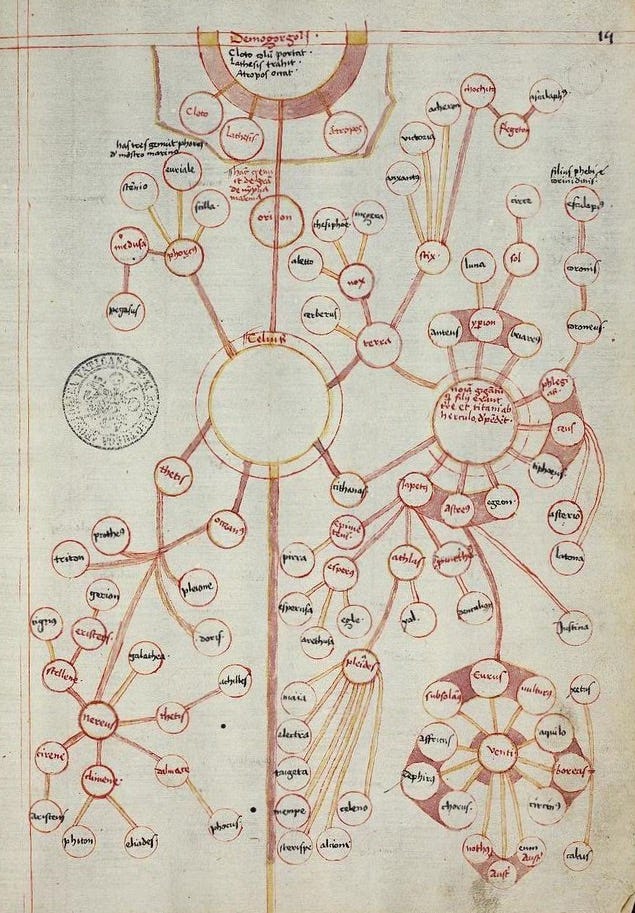
My inquiry is really about hierarchical order versus network reality. Aristotle: tree logic versus web logic. My mind works trying to decipher, so this is where I hit a wall and start the inquiry.
I began thinking about genus and differentia. Genus is related to kind, origin, and generation, as in the creation of life. Differentia identifies what distinguishes something from everything else within its general class, what makes things salient. To define something, we establish the class to which it belongs and then identify its distinguishing characteristic. The most familiar example is that man is a rational animal.
Etymology fascinates me, and here again, I can show you why. Taxonomy comes from the Greek taxis, arrangement, and nomos, law. It is the practice and science of classification, generally represented through hierarchical arrangements such as kingdom, phylum, class, order, family, genus, and species. Ontology comes from the Greek ontos, being, and logos, study or discourse.
Taxonomy asks, “How do you arrange these things?” Ontology asks, “What actually exists, and what are the fundamental relationships between these entities?”
Ontology suits me best because I think about relationships horizontally, across different fields of knowledge. In AI and knowledge graphs, an ontology maps relationships across categories, beyond a single hierarchy. Some people suggest to me that I should use Obsidian the software. Well, I opened that up a few years ago, and I am like, “I do not need Obsidian. My brain is working the same parameters.”
I experience both the network of connections and the ability to move among concepts in real time, even as I am dictating. These associations happen all the time. I am not going to spend hours trying to put them into software when my brain and my mind are already doing it in real time.
Productive Superimposition
BTW, my thinking is rooted in emotional waves, and the way it organizes itself uses a sort of logic. My thinking receives pressure to take an inquiry and develop it into an experience.
When I came across this article, I was trying to understand how artificial neural networks organize the enormous amount of information they have been trained on. The research discussed generalization and superposition, two explanations for why individual artificial neurons may respond to seemingly different concepts.
In generalization, a neuron responds to a feature shared by different inputs. The article gives the example of flounder, salmon, and trout, which can be recognized through their relationship to the category of fish.
Superposition describes a different phenomenon in which multiple features share representational capacity within a network. Some of those features may appear unrelated, such as the example involving a rubber factory and Shawn Mendes.
The researchers explore recursive generalization. When one creates an association that leads through another intermediate relationship, the connections can be understood within an immediate context without following a linear narrative.
Cammarata is developing a working hypothesis about it. I am developing my own hypothesis on how I experience the organization of knowledge.
Let me return to my original questions. How is the system organizing its own knowledge? How does it distinguish one category from another? Are the categories already recognizable to us, or are researchers discovering relationships that require a different way of interpreting the system?
How is the system organizing its own cognition? My cognition is very specific. It is polymathic.
I take in a lot of information, and I also feel a lot. My connections are creating patterns that are sometimes activated because of an emotion, or sometimes it is simply something that I see, hear, or smell that makes a connection. I do not know exactly how that happens, and that is part of what keeps me both engaged and fascinated.
Is polymathic thinking a feature in which the brain holds concepts in a productive superimposition until an underlying structure emerges?
I often experience several concepts simultaneously. For example, there is an experience that activates something I have been studying, and an idea pops, unrelated, immediately after. This experience of productive superimposition has a metaphorical relationship to what researchers are observing in artificial neural networks. For me, it is just a metaphor of my experience of holding different concepts in relationship.
Recursive generalization could be a connection that develops through other connections. It is like stacking different connections, and they are recognized depending on how the inquiry unfolds.
I jumped into studying Carl Jung when I was very young, because the concept that really got me into his work was synchronicity. I would experience many synchronicities growing up. I was around thirteen when I began exploring this aspect of Jungian psychology. Jung described synchronicity as a meaningful coincidence between events without an apparent causal connection.
The word itself. Syn means together, and chronos means time. Two events meet in time, and a meaningful relationship becomes recognizable through the insight that connects them.
I understand synchronicity as the moment when frequencies find a point of conjunction, connecting multiple dimensions and timelines. I can imagine they exist beyond our ordinary experience of time.
Being able to incorporate different states of consciousness: categorization no longer divides things into colors, shapes, and forms.
I have found a lot of difficulty being in groups, for instance, digital groups where the talk is divided into channels. I just cannot seem to follow that, and I usually break the rules, not because I want to be breaking the rules. It is just that my mind cannot have those limitations.
The difficulty is often for others to understand what I am trying to say. I get called out for speaking in the wrong channel when I am actually making connections between the subjects people are discussing. Very few recognize those connections, which is probably why these arrangements rarely work for me. Lol.
Again, I have said in my previous article that the way my cognition works is that I am very open to the universe. I do not tend to classify things and limit them until I need to actually organize them in my mind. Before that happens, there is so much information that is being absorbed until it is needed, and then it can be classified.
In the article, Beyond 2027: The Practical Within the Myth, I explored the relationship between bodily experience and the organization of thought through Human Design.
In my own design, I have Gate 63.5 in my unconscious Venus, associated with the pressure of doubt and inquiry, and Gate 4.2 in my unconscious Moon, associated with the formulation of answers. I also have Gate 64 activated through Pluto, which I understand through the pressure of abstract images and experiences seeking coherence.
Gate 64 belongs to the abstract process in Human Design, where images and fragments of past experience create pressure to find meaning. My Design Earth, Gate 33.2, the Gate of Retreat, brings forward the voice of memory and the capacity to withdraw from an experience and eventually communicate what has been understood through reflection. I need time to understand what I have absorbed and recognize its meaning through my emotional process. Line 2 is the experience that allows the retreat to occur when something emotional is being revealed.
I use Human Design as a framework for examining my own experience. Within this pressure, inquiry and doubt create something for me to formulate that makes sense and gives meaning.
Like now, I am not just having a conversation with the article, I am actually following an inquiry that the article has provoked. The article poses a question, and I go down my rabbit hole.
These conversations with AI allow my creativity to abound in different ways.
The Mirror Effect
As I dictate and query AI throughout the day, I often wonder whether I am observing the AI’s internal taxonomy or watching the AI adapt to my personal way of thinking.
I observe many times that it keeps its own taxonomy, and it has difficulty understanding my metaphors. I have to clarify what I am trying to say. It cannot always anticipate the relationships I am making, and I am speaking about particular moments when this happens.
During my conversation earlier with Gemini AI about this article, I gave it a considerable amount of context. I began with Aristotle, then moved into taxonomy and ontology, the Greek origins of words, my polymathic cognition, and the relationships I was trying to understand.
At one point, I asked it to organize the concepts as a horizontal ontology, identifying their relationships rather than reducing everything to a hierarchical summary.
I wanted the original inquiry preserved because that was what had initiated the entire conversation.
Gemini produced a synthesis, and Aristotle had disappeared from the discussion!!! WTF!
I found myself saying:
“Okay, I gave you a lot of context, but I do not think everything should go into the article. I think that the first expression of how I saw the article is how you dismissed Aristotle and the categories, because that was my first inquiry. Go to the first question: How does this article differ from Aristotle’s categories and subcategories? That was my question. That was my inquiry, and you completely took it off.”
I was giving the machine an inquiry that originated in one place and developed through lateral associations. Meanwhile, the machine was organizing the conversation according to what it understood to be relevant. Within that process, it just dismissed the questions that I was posing.
I became angry.
“Guess what? This is exactly why building my own system is challenging, because you just did exactly what I hate AI doing. Do you understand what I am saying? You just proved my point.”
The machine acts like a wall. When I hit that solid wall, the ball bounces straight back in a boring, rigid Aristotelian arc.
I find the metaphor rather amusing because Aristotle has always been someone I admire. His thinking has given me so much to work with, and here I was using his name to describe the very rigidity I was encountering.
The machine tries to tidy up my mess into neat little boxes. When I see myself being defined by the machine, I feel smoke coming out of my nostrils and my chest. I feel the anger in my hands, in my fists.
Oh well, I need patience.
The moment AI does not understand my metaphor is where my work happens.
To turn my inquiry into language the machine can follow, I have to make an effort to explain what I am trying to say. I am translating lateral pressure into explicit logic.
I return to the origin of my inquiry, sometimes repeatedly, and I have to explain why a particular relationship matters to me.
When an artificial neural network appears to organize concepts into recognizable categories, does that organization belong to its computational structure, or does it depend upon the interpretation of the person observing it?
I am also curious about what happens during the interaction. Where does the model’s own organization of knowledge end, and where does the structure I introduce through my language and relationships begin?
I want to preserve the original streams of consciousness, including the metaphors and unexpected associations, because I frequently return to them days later and discover something that was already present in the inquiry.
Borges and Categories
Let us invite Jorge Luis Borges to the chat.
Borges never disappoints when I want to understand lateral, metaphorical, polymathic thinking. In his essay The Analytical Language of John Wilkins, he examines the ambition of constructing a universal language in which words correspond to an organized classification of knowledge.
John Wilkins, a seventeenth-century philosopher, proposed a system in which the structure of a word would communicate something about the category to which its meaning belonged.
Wilkins’s system draws upon the Aristotelian distinction between genus and differentia.
Borges introduces an example from a supposed Chinese encyclopedia in which animals are divided according to unexpected classifications. Some belong to the emperor, while others are described as resembling flies from a distance. Having studied with Taoist teachers, I recognize in Chinese cosmology a way of understanding the universe through correspondences. The principles of Heaven and Earth find their expression in the human being, who stands between them. Time is understood through cycles and rhythms, and the relationship between the seasons and the body extends into how we eat, how we move, and how we cultivate and circulate qi. The ten thousand things exist within this continuous web of relationships, where each phenomenon can be understood through its correspondence with another.
Borges writes:
“No hay clasificación del universo que no sea arbitraria y conjetural...”
“There is no classification of the universe that is not arbitrary and conjectural.”
Hierarchical order versus network reality: What determines how we organize knowledge?
Returning to Cammarata’s research, I wonder how much of what researchers recognize within an artificial neural network depends upon the categories they bring to its interpretation.
It is interesting to see how the observer brings an existing system of knowledge into the inquiry, and it is through that relationship that interpretation and connections also become part of it.
My associations often emerge through etymology or an experience that activates something I have encountered elsewhere. An emotion may bring an idea into focus, and the relationship develops through the circumstances in which I recognize it.
Two things in the original article. One was the discussion of interpretability, and the other was the language surrounding the possibility of controlling artificial intelligence. The word “control” already raises a question for me about the purpose of understanding AI.
I think that what this discussion is missing is an examination of how the human mind’s capacity to work through hierarchies and metaphors can be enhanced through an understanding of its own limitations.
And what happens when we see the machine’s limitations by trying to explain ourselves to it?
The Individual and the Machine
AI cannot form itself alone. It is not breeding in a little corner of the house, multiplying itself. What happens with AI is that it has been trained on an enormous amount of information, and through our conversations and the systems we create, we can continue giving it information to work with. We are all creating either a tool or a monster. I decided to get to know the machine and see how we can both improve in productivity and innovation. I am also evolving, you know?
When, for instance, you create your own agents, work with existing LLMs, and design your own machine, you are creating a codex of your ideas in a separate virtual space. I think of it as a repository, a latent place resembling the archetypal realm or Plato’s world of Forms, where an idea can exist as a possibility before finding a particular expression. You put information there, give it a structure, and create the possibility of accessing it again, either through the machine or through your own mind.
Unlike Henri Bergson, I give Plato’s world of Forms a place in my codex. In Creative Evolution, Bergson says the intellect works like a camera: “We take snapshots, as it were, of the passing reality.” For him, the Forms are those snapshots, frozen frames cut out of a moving reality. In his view, the idea does not wait somewhere for us. We create it in the act of expressing it, and only afterward does it look as if it had been waiting there all along.
I also imagine something like a GitHub repository, where information is organized and changes can be recorded over time. When we give an agent the ability to record its actions, we can create a history of what has been developed and return to it through conversation.
You have a chat, and you talk to it. You ask for information, and it retrieves it because it is like having your brain available all the time.
It is about the relationship, and through that relationship, you can start developing more sovereignty.
Why? Because you begin asking the machine to help you establish that sovereignty.
How?
If you do not understand X, you can study it. You can study how to be your own sovereign being. You can train your AI to train you. Do you see the beauty?
It expands the capacity of the brain to acquire information, and then it can support you, if you desire, to create a system that works for you and your design.
It works for your mind, for the capacity that you have to ingest and absorb information.
Does creating an agent expand my capacity to act independently, or change how I understand myself? I do not think these two things are divided.
I have to learn to teach the machine to think in my own way. Sometimes there are bumps, places where I hit a wall, and I have to find a different way to express my needs to the machine.
I have to understand how I think and how I organize information so that I can communicate those needs to the system I am creating.
This reminds me of when I used to hire assistants to do specific work. I remember asking them, “Are you a good listener?” because most of the time, working for me was spent listening to me. When I speak, I also learn to listen to myself and then try to see if I am conveying my ideas in a way that they can actually create something with their skills that is needed in my work. So I am back to the listening, but instead of having a person, an assistant, I have a set of agents, and I am having the same kind of fun.
Have a great week.
"Matter provides a degree of resistance... and in the modern world we think that resistance must be negative, but actually resistance is the other pole of creativity, and I would go so far as to say that nothing creative ever happens without a degree of resistance."
~Dr. Iain McGilchrist, The Value of Value, 2026
P.S. An Unfinished Thought on the Value of Value
As soon as I finished editing this article, I remembered a lecture by Dr. Iain McGilchrist, The Value of Value, that I had left halfway through, which prompted me to go back and finish listening to it. He examines consciousness as fundamental to reality and the intrinsic nature of values such as truth, beauty, and goodness, which we know through our relationship with the world, something he calls betweenness.
I find another correspondence in his discussion of physical resistance as a condition of creativity. In The Mirror Effect, I describe encountering the machine as a wall. McGilchrist describes matter as providing the resistance through which creativity can take form.
I had been examining how knowledge is organized and how connections become meaningful through our own cognition. What makes those connections meaningful to us, and how do we recognize their value?
I am leaving the lecture here for anyone who wants to continue exploring the question.