We are right at that point of equal night, equal day, the equinox.
The cycle reaches the opposite point from its beginning.
What initiated six months ago now exists in relationship to something outside of myself, in relationship to the other.
Six months ago was the I AM moment. The beginning. Awareness. Instinct. Emergence.
This year that equinox came with Saturn and Neptune together in Aries, already describing something about where we are heading.
Three months later, at the summer solstice, the impulse had acquired form. Roots. Identity. Belonging. In the Northern Hemisphere the Sun reached its maximum declination.
Now comes the descent.
In three months we arrive at the winter solstice, where the outer movement reaches its minimum. Whatever survives becomes seed.
We are at that moment the autumn begins at an opposition.
In Evolutionary Astrology, the opposition begins the Full Phase. The subjective experience developed through the first half of the cycle encounters objective reality.
Almost like a Full Moon. I was born under one.
The equinox can be understood as: I meet what my anxieties have created. In spring: What wants to emerge?
In autumn: What did that emergence become once it entered relationship with reality? Libra. We enter the descending half of the solar year.
The biological world begins moving toward conservation rather than expansion. Energy goes inward. Leaves fall. The movement descends. Something shelters. Something gets released. Something remains.
Evolution alternates between outward and inward movement, Yang and Yin, emergence and consolidation. The EA phase model describes that movement clearly.
This is annual involution.
We just moved through Virgo, discernment. Now Libra asks for equilibrium.
What do I want? What do we want? How do desires and needs find a place of integration?
The zodiac is its own book. Its own clock about space, time and reality.
It shows. Past. Present. Future. Time as space. Cycles inside cycles.
The equinox is a coordinate. A change of direction.
Look at the four cardinal points and the architecture is there: beginning, culmination, descent, new beginning.
And then, only a few days later, the sky repeats the story.
The Full Moon on September 26 is in Aries, around 3°. Neptune is there too, retrograde, almost on the same degree. Saturn is retrograde around 12° Aries. Mars, ruler of Aries, is finishing Cancer before entering Leo.
Pluto is at the beginning of Aquarius. Uranus is at the beginning of Gemini, Pluto and Uranus remain in trine; Neptune and Pluto in sextile, Neptune and Uranus in sextile too.
There is soft geometry in the sky as the cardinal axis is being activated.
Mars is also leaving Cancer and squaring Chiron, which has recently moved back into Aries retrograde. Mars rules this Full Moon. The vulnerability of being oneself, of showing one’s own desire, is at stake now, and Mars is doing this from Cancer, from the territory of family, ancestry, belonging and emotional inheritance. What happens when what I want begins to move in a direction that is different from what the family field wants, or from what I have inherited as a way of belonging? I do not have the answer to that.
For me, the geometry is different. This Full Moon falls in skip-step with my nodal axis, it activates the cardinal cross around it. The South Node describes an established self-image. The North Node describes the direction of development.
So the question for me is very simple:
What direction has been trying to reveal itself all year that I can now actually see? It has a lot to do with ancestry. Capricorn. Inheritance. Legacy. Duty. Burden. Responsibility. Guilt. But also, it has a lot to do with opening my heart, pouring all that love into creative forms, and reaching out through my work without creating any expectation of being seen, just being solar all the way.
I have Natal Pluto in the 8th house. Current Pluto is squaring my Jupiter-Sun-Mercury Rx in early Taurus. The perspective of my values, my self-validation, and how I internally communicate is being transformed from the inside out.
How I meet value has changed. How I evaluate value has shifted. How I validate myself has gone full revamp.
I recently surrendered this thought: I do not depend on the value of an inheritance/land to be a person of value. My value shows itself in what I actually meet, day by day. Meeting it means giving up something else, the opportunity cost of every choice made instead of another. That cost, weighed against my essential needs, is what I now call pure leverage.
Aries says: I know what I want. I act from instinct. Neptune asks: Where did that desire come from? The desire I used to have is dissolving into something different, something never felt or performed. The beginning that started earlier this year is showing me another possibility, another direction that I am not so much in a rush to conquer, but slowly give shape to.
At the same time Pluto is passing through my Ascendant in a three- to four-year cycle, and I am right at the eye of the storm. I am still inside it. I understand the storm while being inside it. I do not know yet how I leave it, but I know that leaving it begins with acknowledging that it is what it is, a storm, becoming aware of what is moving around me and what belongs to me inside it.
What can be inherited without having to be repeated?
And then, unexpectedly, I started watching Yellowstone. Actually, I became obsessed with Yellowstone, the television series created by Taylor Sheridan, beautifully portrayed in the state of Montana, with the cowboys, the cattle, the land, the families and the history underneath all of it.
I have been binging it, and somewhere underneath all the plots I started thinking about preservation. What do we preserve before we innovate? How do we continue evolving without losing what gave us continuity? And at what point does preservation itself stop evolution?
The word preservation has also been appearing repeatedly in another part of my life. I am preparing a new public commission in Framingham, Massachusetts, and during my conversations with the people involved in the new judiciary building, preservation kept surfacing. I have a presentation next week, and I am digesting the whole process, discerning.
At one point, the architect told me that I had to be careful using the word preservation in the context of the building. I turned around and said, “Oh, really? Interesting. Let’s define preservation from the architectural point of view.”1
It is interesting because I am going to restore and reuse part of the marble from the old building that was built at the beginning of the 20th century. It had multiple uses. It was a high school and became a museum, and now the site is being turned into a regional judiciary center.
I do understand the idea of restoration, repair, reuse, and the value of a material, but at the same time, I understand the constraints that she was feeling during my conversation. While I was talking to many people in the community, I had a sense that they want to preserve something about Massachusetts, and then one of the judges said that they basically want something familiar, such as the landscape, or the seasons.
Those two words go along with what I’m talking about, but if I define them, they both say that change is dangerous. That’s the tension that we are creating here, within the building, within the system
What are the people actually trying to preserve? A structure? A memory? A civic identity? A way of using space? A sense of familiarity? And then another question appears, because familiarity can be supportive, stabilizing, even necessary, and it can become limiting when familiarity hardens into the values a society assumes should remain intact.
So preservation is no longer simply about keeping something. It becomes a question of discernment. What deserves continuity because it carries life, and what is being preserved because it is familiar?
Land. Survival. Cattle. Food. Territory. Property. Autonomy. Stewardship.
The individual and the state.
The individual and the collective.
Who has the right to occupy and sustain a piece of Earth?
Aries, Cancer, Libra, and Capricorn are cardinal. They create a tension between who I am, where I belong, how I am going to find harmony, and what eventually becomes institutional, protective, and supportive.
The next axis, Taurus, Leo, Scorpio, and Aquarius, is fixed. What begins in the cardinal signs becomes established, held, and preserved before the mutable signs, Gemini, Virgo, Sagittarius, and Pisces, begin another movement of adaptation.
Taurus is what I value.Leo is how I validate myself.Scorpio is how I share those values.Aquarius is how I liberate myself and become my own person.
So yes, the land and the territory and the politics are there. Yellowstone is giving me something else to think about in relationship to what is happening in my own family. What are the right decisions? What leverage does each person have? What am I supposed to take from all of this? What am I moving forward with? I do not have those answers.
I am in the process of a repartition of inherited property. I do not need to say much more than that. There is ancestry being continued through property and through other people, and the property itself is being divided. And sometimes these partitions create real divisions.
Family dramas and grievances usually start much earlier than the property itself. They have to do with how each person perceived belonging inside the system, inside the tribe, and how each one experienced the love, or the lack of love, coming from one parent or both. If the impression was that there was never enough love, enough recognition, enough belonging, then dividing property after the parents are gone can trigger something much older than the property. Especially when there was no trust already created to hold the structure before death. The material division can reactivate the emotional division.
That can be very painful, and it needs to become cathartic. Otherwise the grievance stays in the family system and moves into another generation wearing a different costume. I have made a commitment to liberation from that. Some days ago I made that commitment very consciously, and I feel good with it. I do not want to carry the grievance forward simply because it was handed to me. I surrendered all the burden I had carried, set myself free from expectation (Libra), and placed the accent on what really gives me value: my actions (Aries).
That makes the question of preservation much less abstract. What needs to be preserved? What can continue through someone else? What belongs to ancestry and what belongs to me? What am I carrying because I choose to carry it, and what am I carrying simply because it arrived through inheritance?
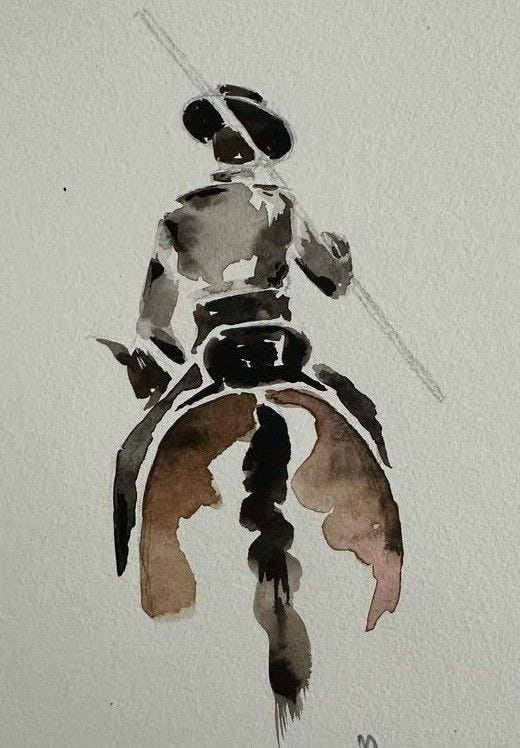
And then the cowboys. I love everything about it, horseback riding, the land, cattle, mountains, and relationships…
The real cowboy story is much richer than the Hollywood cowboy.
The American cowboy comes through the Spanish and Mexican “vaquero” tradition, through the Southwest, through cattle, horses, land, labor, migration and survival.
Spain. Mexico. → The American West. Then mythology takes over. The cowboy becomes freedom. But freedom from what? And based on what?
This brings me to homesteading. John Locke asked a very old question: If the Earth exists before private ownership, how does something become mine?
His answer begins with the individual. The body. Labor. What labor produces. You work something. You transform it. You establish a relationship to it. Property begins there.
Then government appears because now there are competing claims, boundaries, disputes, inheritance, protection. This is where the idea of property becomes very physical.
Body. Food. Land. Labor. Shelter. Survival. Taurus.
The EA material describes Taurus through the survival instinct, the resources needed to sustain life, value and meaning.
Then the United States of America makes the idea literal.
The Homestead Act. Settle the land. Live there. Work it. Cultivate it. Improve it. Stay. Eventually, a deed, -> a title.
The relationship between labor and ownership becomes law. And immediately another question appears. The land was already inhabited.
So whose relationship to the land counts?
The person cultivating it? The person hunting across it? The person grazing animals on it? The person whose ancestors lived there? The government issuing the document? The person holding the deed? The person who improved it? The person who inherited it?
This is why property rights remain unresolved everywhere. Different systems recognize different kinds of claims. Labor. Occupation. Ancestry. Conquest. Purchase. Inheritance. Law. Custom. The problem is still alive. And by all means I am not trying to solve it here.
I am just observing it.
Because Yellowstone keeps me asking the same question: Who owns the land? Who worked it? Who inherited it? Who has a historical claim to it? Who has a legal claim? Who decides?
And what happens when several of those claims are true together? Land becomes political very quickly because land is survival. Food. Water. Shelter. Territory. Continuity. Inheritance. And politics is behavior between people.
What happens when one person’s freedom meets another person’s claim?
What happens when the state enters? What happens when violence emerges? What happens when the collective enters? What happens when the family enters? What happens when ancestry enters?
There is paper. There are lawful/legal rights. There are percentages. There is property that existed before me. There was work before me. There was sweat before me. There were ancestors before me. And now all of it is translated into documents, signatures, numbers and divisions.
Semi-peacefully.
That alone has changed the meaning of inheritance/legacy for me. The inheritance has value. It does not determine my value.
And now preservation enters here too. Ancestry can continue without everything remaining physically intact. Property can continue through other people. Something can be bequeathed, divided, transferred, transformed, and continue to carry ancestry. The question is what needs continuity and what has completed its cycle.
The autumn equinox reflection reads:
What am I harvesting from this year? What am I willing to bring forth into winter?
How do I make sense of what was inherited from the past without becoming possessed by the inheritance itself?
How do I receive what came before and remain free to begin again, and learn to accept it peacefully? A few days ago, I had this beautiful dream. I was in the middle of it, observing what was happening, outside of my body. My body was resting, and as my head was lying on the pillow and I was breathing peacefully into the night, a familiar face came through the dream and left some lamb chops by my night table that needed to be cooked.
This familiar face also left a bottle full of spices. It also carried a letter handwritten with a seal on it. Last but not least, a bottle of aromas that could be seen as something that brings the perfume or the smell of something familiar.
I woke up with a very beautiful feeling, and I understood something that I have never, ever learned: how to receive without having to give back. This dream with a familiar face allowed me to receive without creating any sort of expectations or any kind of equivalent. Inside the dream, I proceeded to cook the lamb chops, wear the aroma, read the letter, spice my food, and remain in the tangible feeling of what caring really feels.
As part of the wheel, I have been researching why I am so tied to the history of the United States when I was born farther south on this same beautiful continent, the Americas.
There are connections between my natal chart, the chart of the United States, and events across my life that I am looking at.
My Ascendant sits at 6° 56’ Aquarius, and Pluto is hovering that same degree the next upcoming months, the same degree where Uranus was discovered in 1781. The same degree where the South Node of the USA sits.
The Sabian symbols read one degree up from the placement, so the symbol governing this point belongs to 7° Aquarius, a child born out of an eggshell.
New mutations arrive here. Fresh potential moves according to the great rhythms of the cosmos, not according to what I plan. This is transpersonal responsibility, moving past old, rigid societal traditions and into a reality that has not existed before. The egg itself is the cosmic egg, an inner matrix, a protection, the birthplace of something virgin and untamed, a life or a consciousness that has not been shaped by anyone else’s hands.
What can be inherited without having to be repeated?
That image belongs somewhere in this larger investigation because it says something very strange about continuity. Something is born carrying life forward without reproducing the ancestral form in the usual way. It may belong to the next article, because it opens the question of my relationship with the United States chart and with 7° Aquarius much further than I want to go here.
That is another article.
For now, I stay with the wheel.
Autumn asks for discernment. What remains after expansion? What is ready to fall? What survives contraction? What do I carry? What becomes seed?
And from inside this Pluto storm, perhaps I am learning what I can preserve, what I can inherit, what I can release, and what can be born without having to repeat what came before. And also, the most joyous of all: how can I actually learn to receive?