February 24, 2024
John 11:7-15
Lent 2
When we lump a group of people in a category like “the Jews,” “the Muslims,” “the Russians,” “the Ukrainians,” “the Americans,” “the Mexicans,” “the Palestinians,” or the “Israelis,” we risk an attempt at reducing the imago dei[ix] – the made in the image of God-ness – of those people into a caricature that fits our prejudices and ignores the rich diversity of the group of people. If we learned anything from the Holocaust, if we are learning anything from what is happening in Gaza today, it is that once a group of peoples’ identity has been reduced to the “other,” the group responsible for the ills of another group, the removal of those people is much easier.
Murder and genocide are much easier to sell when the humanity of “the other” has been removed. In recent years Christians in the United States have been coming to grips with the church’s role in the dehumanization of Indigenous populations of North America along with those forcibly moved to North America throughout the Trans-Atlantic slave trade. Which led to what James Cone describes as “the lynching era” when “white Christians lynched nearly five thousand black men and women in a manner with obvious echoes of the Roman crucifixion of Jesus.”
Why do you think misconceptions about Jewish people exist within the church? Take this question a step further and consider why misconceptions about Muslims, Jews, other religions, and even “other” Christians exist within the church. Share that with the people worshiping around you this morning.
In his letter to the church in Galatia, Saint Paul put an end to the us vs. them “othering” that was occurring in the church. He wrote, “There is no longer Jew or Greek, there is no longer slave or free, there is no longer male and female; for all of you are one in Christ Jesus.”
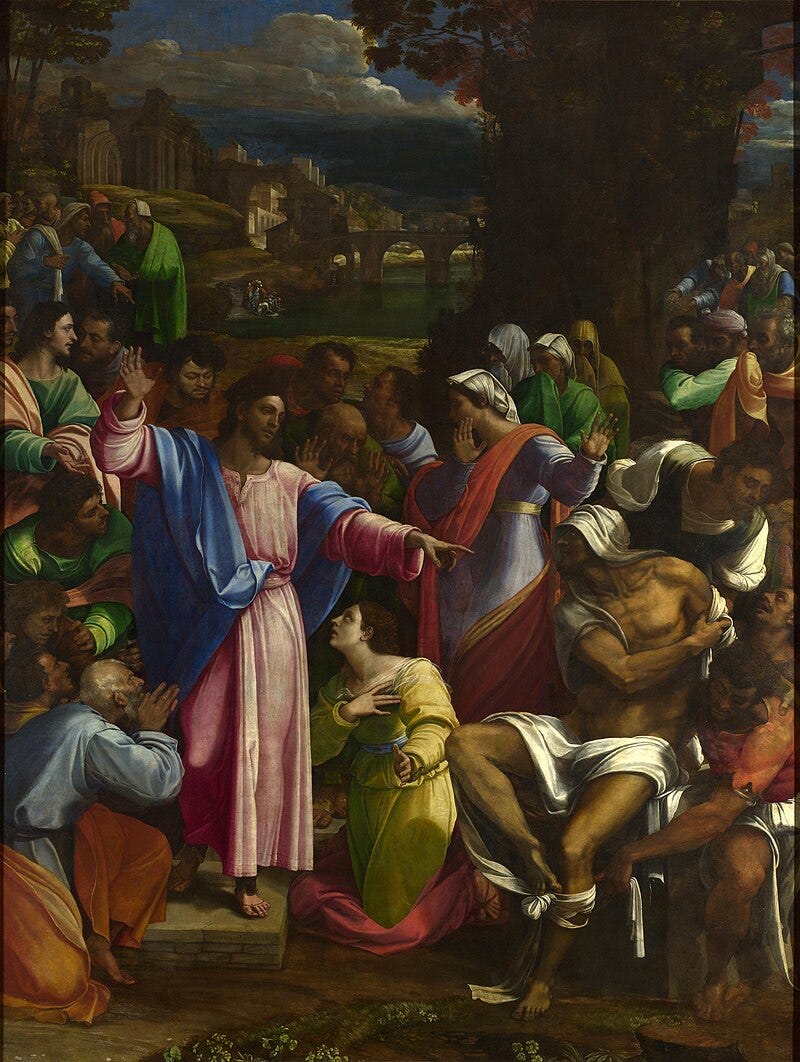
The labels and prejudices we use to “other” one another were torn down on the cross. Christ, in taking the sins of the world upon himself, put an end to us versus them. This is where we find the Good News of this portion of the story of Lazarus: even while John uses problematic language, the grace of God remains. Lazarus, a Jew, was raised. Jesus, a Jew, will be raised. And the promise holds true for you and those we deem anything other than God’s beloved.