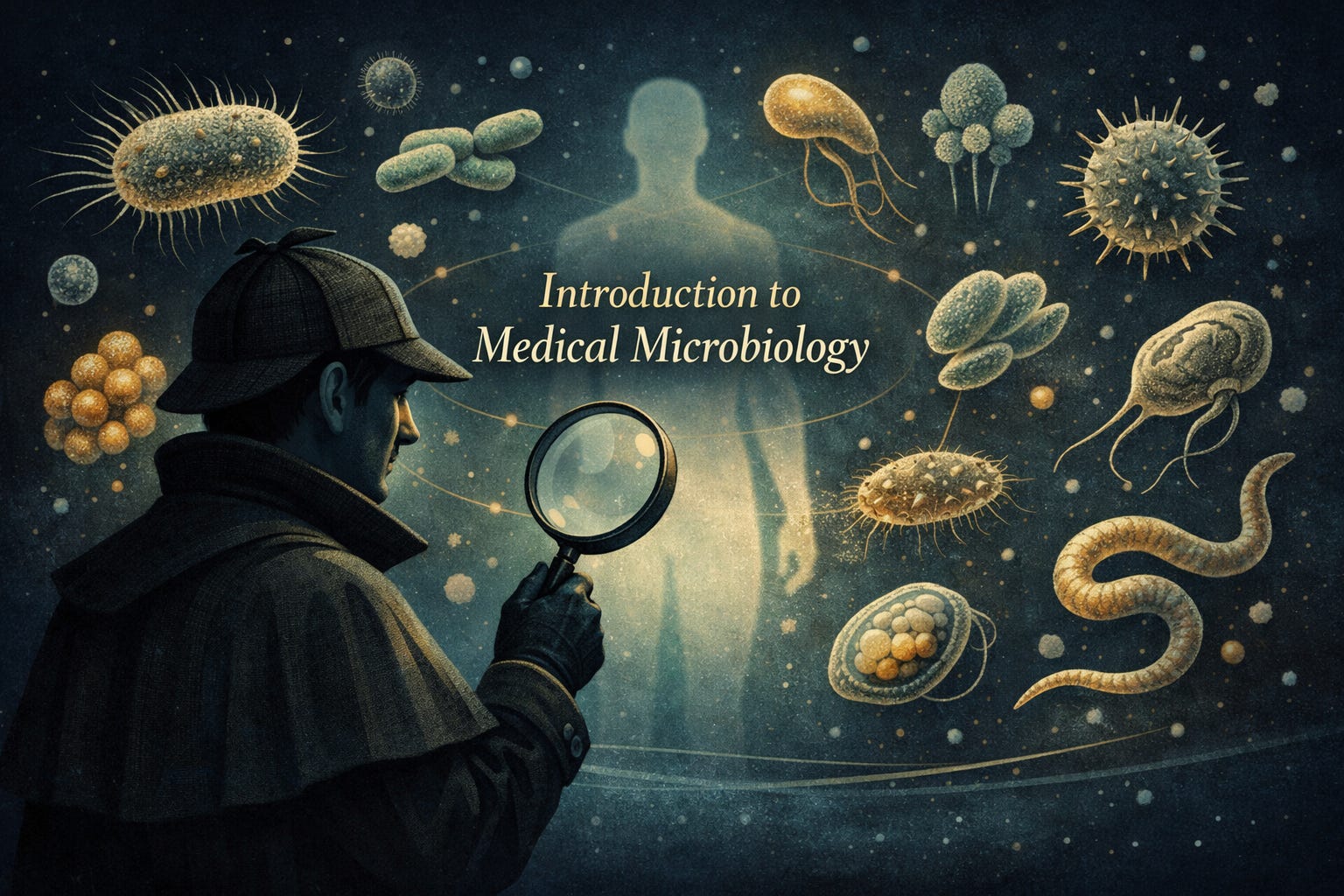
This opening episode lays the intellectual foundations of medical microbiology. It introduces microorganisms not as isolated curiosities, but as dynamic biological agents whose interactions with humans determine health, disease, and survival.
Drawing directly from Murray’s narrative arc, the episode situates microbiology at the intersection of biology, medicine, and clinical reasoning. It explores the scope of medical microbiology, the major classes of microbes, and the fundamental principles that govern host–microbe interactions. Rather than cataloguing organisms, the focus is on how to think microbiologically: why size, structure, replication, and adaptability matter, and how these properties translate into clinical consequences.
This episode sets the tone for the entire series—precision over memorisation, systems over lists, and meaning over mechanics. It invites the listener to see microbes not merely as enemies, but as biological forces that must be understood before they can be controlled.
Key Takeaways
* Medical microbiology is a clinical science, not just a descriptive one
* Microorganisms differ fundamentally in structure, replication, and vulnerability
* Disease results from interaction, not presence alone
* Understanding microbes requires integrating biology, immunity, and environment
* This framework underpins diagnosis, treatment, and prevention throughout medicine