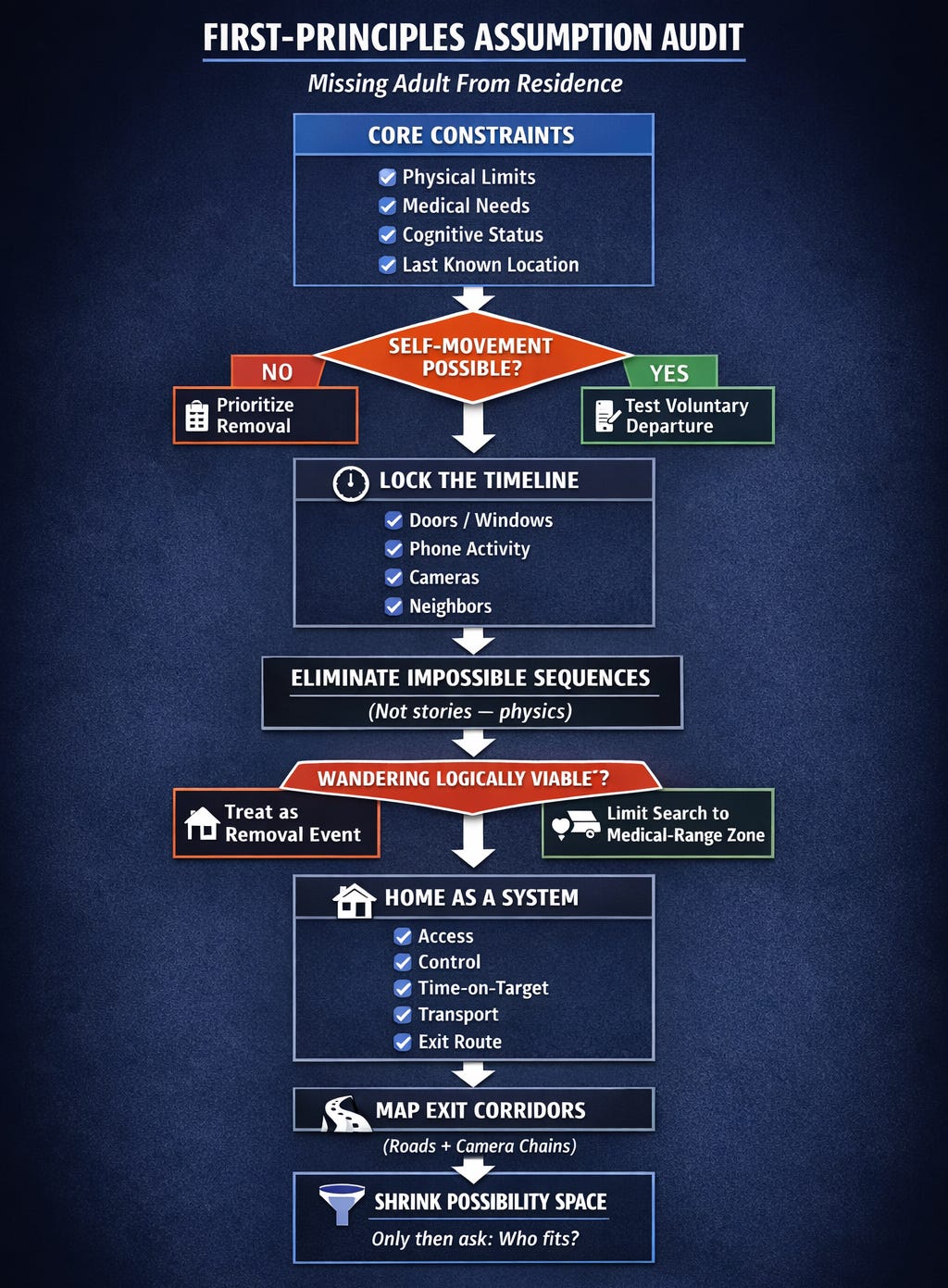
Below is a First Principles way to approach the disappearance of Nancy Guthrie (the mother of Savannah Guthrie) in Arizona, based on what authorities have publicly indicated so far.
1) Start with capability constraints, not theories
Treat the victim’s physical and medical limits as hard boundary conditions that shrink the plausible search space.
* Authorities have emphasized she had limited mobility and needed daily medication, and they do not believe she “wandered off” (sound mind / not dementia-related). First Principles implication: prioritize (a) forced-movement scenarios and (b) rapid medical-risk timelines over broad-area, low-probability wandering searches.
2) Lock the timeline to the tightest verifiable window and exhaust it
The most valuable hours are the ones with the fewest unknowns.
* Public reporting places last-known normal contact around ~9:30–9:45 p.m. at her home near Catalina Foothills, with the missing report triggered the next morning after she missed church. First Principles implication: build a “constraint ledger” for that window (doors/windows, alarms, phone status, neighbor cameras, traffic cameras, delivery/utility activity). You’re not “looking for clues”—you’re eliminating impossible timelines.
3) Treat the home as an event generator and infer minimum offender requirements
Don’t ask “who did it?” first. Ask: “What must be true for this outcome to occur?”
* Pima County Sheriff’s Department has said the home is being treated as a crime scene, with reporting of forced-entry/struggle indicators and biological evidence being processed. First Principles implication: an abduction of an older adult from a residence requires minimum conditions: access route, control method, time-on-target, transport capacity, and an exit corridor. That logic pushes you toward (a) opportunity analysis (who could access the home unnoticed), (b) logistics analysis (vehicle, timing, staging), and (c) geographic constraints outward from the residence toward likely egress paths around Tucson.
ASSUMPTION AUDIT
Case Type: Missing adult from residence
Method: First Principles (constraints → eliminations → high-yield actions)
1. Core Constraints (What must be true)
These are boundary conditions, not opinions.
* Physical & medical limits: Mobility and medication needs restrict travel range and time without assistance.
* Location of last normal contact: Home = point of disappearance.
* Cognitive status: No evidence of dementia-driven wandering.
* Time window: Last verified contact → discovery of absence.
Implication: Voluntary disappearance and long-distance self-movement are low-probability. Forced movement or rapid medical failure are higher-probability.
2. Invalidated or Weak Assumptions (What likely is NOT true)
Eliminate before theorizing.
* “She wandered off.”
* “She left voluntarily.”
* “More evidence will clarify itself.”
* “This is primarily a missing-persons search problem.”
Implication: Treat as a crime-of-removal problem until disproven.
3. Timeline as a Closed System
The timeline is a finite equation, not a narrative.
* Inputs:
* Doors/windows
* Alarm status
* Phone activity
* Neighbor sightings
* Cameras (home, traffic, doorbell)
* Utility/delivery activity
* Objective:
* Eliminate impossible sequences
* Identify the only survivable sequence of events
Question: What sequence must occur for her to be gone by morning?
4. Home as an Event Generator
The house is not just a location — it is the origin system.
Minimum offender requirements:
* Access: How entry occurred
* Control: How victim was subdued
* Time-on-target: How long event took
* Transport: Vehicle or carrying method
* Exit corridor: Direction of movement
Implication: This points to:
* Opportunity analysis
* Logistics analysis
* Geographic profiling outward from residence
5. Constraint-Driven Search Logic
Search where constraints converge, not where emotions pull.
High-yield focus:
* Road networks exiting the neighborhood
* Camera chains (not single cameras)
* Phone power-down or movement
* Short-range disposal or concealment zones consistent with timeline
Avoid:
* Random radius searches
* Social-media suspect crowdsourcing
* Story-driven speculation
6. Core Question Set
These replace “Who did it?” early on.
* What must have happened for this outcome to occur?
* What sequence of actions is physically possible?
* What paths are logistically feasible?
* What explanations survive elimination?
7. Outcome Objective
Not a suspect.
Not a theory.
A reduced possibility space.
Goal: Shrink the case to the smallest number of physically possible explanations.
Thanks for reading Open and Unsolved | Crime: Reconstructed! Subscribe for free to receive new posts and support my work.