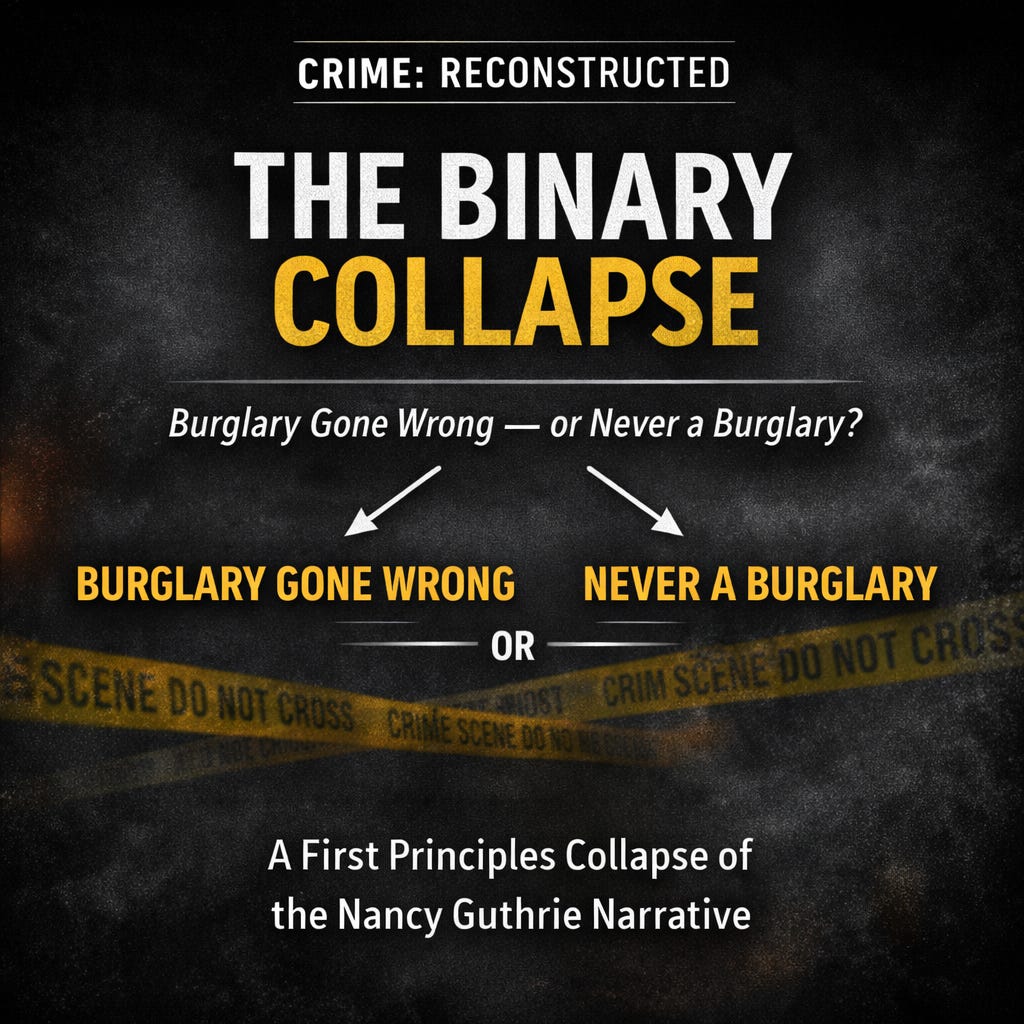
Maybe it was a burglary.
Maybe it was an abduction.
Maybe it was both.
But burglary and abduction do not optimize for the same objectives. One prioritizes speed and invisibility. The other requires control and sustained exposure.
In this episode, we apply a First Principles framework to collapse the Nancy Guthrie case into a clean structural binary:
Either this was a genuine burglary that escalated unexpectedly…
—or—
It was never a burglary at all.
The discriminator variable is simple but decisive:
Was removal reactive — or operational?
We examine risk delta, behavioral optimization, escalation mechanics, and why hybrid narratives weaken investigative clarity.
Because once you decide which model you are in, the suspect pool changes.
The forensic priorities change.
And the direction of the case changes.
This is not speculation.
It’s structural compatibility testing.
What We Cover
• Why burglary and abduction are behaviorally incompatible
• The risk delta between escape and removal
• The mechanics of reactive escalation
• The signals of operational control
• Why hybrid explanations dilute investigative discipline
• The single variable that collapses the narrative
Key Question
Was Nancy’s removal improvised under stress — or integrated into an operational plan?
That answer determines whether burglary is motive… or misdirection.