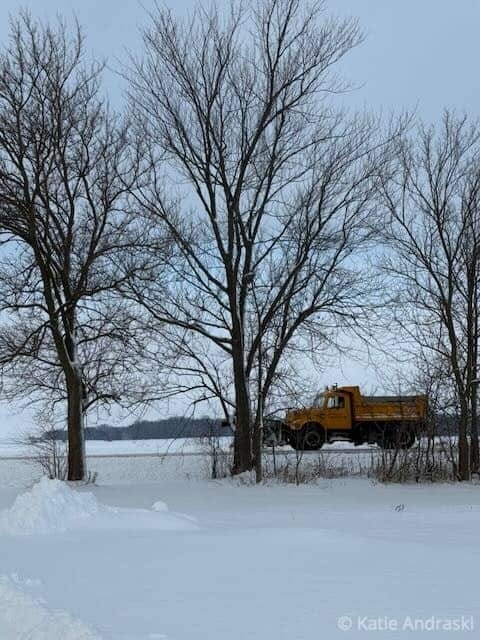
The road where I walk has gone from always straightforward, to it depends on how much snow or ice has fallen as to whether I will walk the dogs there. During the snowstorm, as beautiful as the blur of snow falling across the fields was, I avoid the road. And once the snow is cleared, road salt can burn the dogs’ paws. Aiden is so fascinated by those piles of spilled salt he wants to eat it. Now that we have a fenced in yard, it’s easy to just turn the dogs out and let them run. I miss my walks with the sun breeching the horizon, tugging my thoughts back to a simple thank you. The other day I stumbled into a pile of snow in the ditch, embarrassed when I lurched back onto my feet with snow up to my knees and glad no one was driving by. My number of steps has decreased by several thousand.
I don’t know what it is about this Advent, but the daily office readings for Year Two are taking me to the fierce judgements of God and Jesus. What happened to the poems about shaking off the darkness and putting on the armor of light? Or the prophecy about the branch that will grow from the stump of Jesse, how that branch will be vine, that we are grafted into, and the sweet comforting words abide because it’s the sap of that vine, its roots and leaves, making us live.
No Amos calls out the sins of people groups and how God will punish them. Damascus, Gaza, Tyre, Edom, Ammon, Isreal, Judah all come under God’s rebuke. And it’s not pretty. For instance, he says of Judah:
For three sins of Judah, even for four, I will not relent.Because they have rejected the law of the Lord and have not kept his decrees,because they have been led astray by false gods, the gods their ancestors followed,5 I will send fire on Judah that will consume the fortresses of Jerusalem. (Amos 2: 4 -5 NIV)
Fire consuming the walls that kept people safe.
In the next paragraphs about Isreal, the prophet calls out specific sins like selling the righteous for silver, trampling the head of the poor into the dust of the earth, a man and his father going into the same girl, and drinking in the temple. God reminds them of how he delivered them from Egypt and the giants. He says he will press them down in their place. He says that the man stout of heart will flee away naked in that day. Imagine the weight of stones, slowly crushing you, or fear so great you run past everyone’s eyes, naked.
Amos pronounces a woe to those of us who long for the day of the Lord:
8 Woe to you who desire the day of the LORD!
Why would you have the day of the LORD?
It is darkness, and not light,
19 as if a man fled from a lion,
and a bear met him,
or went into the house and leaned his hand against the wall,
and a serpent bit him.
20 Is not the day of the LORD darkness, and not light,
and gloom with no brightness in it? (Amos 5: 18 – 20, ESV)
I wonder if the day of the Lord, is not just the end of the world, but a day where He comes to us, and we are plunged in darkness, we are emptied of the stuff that separates us from God so that God himself can fill us.
Then I read the next reading that takes me to St Peter who rails against the people who were so wicked God sent the flood but saved righteous Noah. I wonder what Noah’s goodness looked like when everyone else was so full of hate, murder, and cannibalism. How did he defy the cultural pressure because our species is wired to be one of the crowd?
God sent the fire that burned up Sodom, but St. Peter says Lot was tormented by that city’s behavior. Why didn’t he leave if his soul was distressed? How did he manage to resist the pressure to take hold of the voluptuous women who were not his wife? Surely, he fought his own desires as well as the pressure from his buddies, oh come on, take the drink. St. Peter does say
The Lord knows how to rescue the godly from trials and keep the unrighteous under punishment until the day of judgement and especially those who indulge in the lust of defiling passion and despise authority.” (2 Peter 2: 9 – 10)
So maybe we can cling to the hope we too can be rescued from trials. But my gosh, who doesn’t indulge in some passion or other, or be angry at their boss?
God may have promised not to drown the earth again, but St. Peter prophesies how he will burn up the heavens and the earth to make way for the new heaven and new earth:
The day of the Lord will come like a thief and then the heavens will pass away with a roar, and the heavenly bodies will be burned up and dissolved and the earth and all the works that are done on it will be exposed. Since all these things are thus to be dissolved, what sort of people ought you to be in lives of holiness and godliness, waiting for and hastening the coming of the day of God because of which the heavens will be set on fire and dissolved, and the heavenly bodies will melt as they burn. But according the promise we are waiting for new heavens and a new earth in which righteousness dwells (2 Peter 10 – 13, ESV)
I can’t hardly imagine this fire. Destroying the heavens too? But isn’t the earth full of God’s glory? Isn’t it soaked in his love? Even if there is a new heavens and earth, what a sorrow when these fields, subtle and humble as they are, are melted in a consuming fire. Or Orion himself, not just his belt, not just the Pleiades snapped shut like a window shade. Or is this fire the very cleansing presence of God himself, refining, cleansing, making the creation, so damaged by death, it needs to be remade.
St Peter reminds us of God’s mercy, how He sees a thousand years like a day and that he is “not willing anyone should perish but all come to repentance.” Reading that as a young girl who literally sobbed for friends to know Jesus was the beginning of my wondering about how God’s mercy might be more relentless than our hands on our hips, feet spread, saying no, nope, no way do I even believe you exist.
I walk the dogs on a rare night when the moon is white hot, throwing trees into shadows. I want to stay out but it’s cold and the dogs take me back inside.
Then the gospel stories take us to the week before Jesus dies. There’s no meek and mild Jesus in his words or stories.
The best part is when he flips the tables in the temple, calls out the house of prayer turned into a house of mammon. Despite the chaos and wreckage, the people bring the blind and the lame to be healed and he heals them despite the disarray of loose animals, angry merchants and people diving for spilled coins. The tenderness of this, knowing what Jesus is facing that week. The children cry, “Hosanna to the son of David.” And the Pharisees ask by what authority he does these things. Jesus slips out of their question by asking where John the Baptist got his authority. When he walks back to Bethany, he zaps the fig tree because it won’t bear fruit and it withers. And tells the disciples if they have faith they could move mountains. Who of us has that kind of faith?
When the tenants escalate and kill the son, we know he’s talking about himself. The Pharisees are the ones who say, the owner of the vineyard will “put the wretches to a miserable death” not Jesus. But Jesus reminds them:
The stone the builders rejected has become the chief cornerstone…the kingdom of God will be taken away from you and given to people producing its fruits. And the one who falls on the stone will be broken to pieces, and when it falls on anyone it will crush him.” (Matt. 22:42 – 43 ESV)
And then there’s the story of the wedding feast. The master’s friends turn down his invitation with daily business to tend to. So he invites people from the streets. When the party was raging, the master discovers a man without wedding clothes. He throws him to outer darkness where there is weeping and gnashing of teeth.
So how do we know if we have wedding clothes or not? I tremble at that nakedness, at the outer darkness, the weeping and gnashing of teeth. I’ve always taken wedding clothes to be how we put on Christ like a robe and if we don’t show up clothed in Christ we will be sent to the outer darkness. But lately, it seems to me, darkness, weeping and gnashing of teeth describe what primal, deep repentance feels like.
Then I thought maybe it’s possible that the guest with no clothes is Jesus himself, crucified outside the city, and then descending to the outer darkness where there is weeping and gnashing of teeth. The day of the Lord, a day of thick darkness, when the sun dimmed, when Jesus was crucified. I can think of no darkness more deep than the one by whom creation holds together being murdered by humans.
I don’t know what to make of this, except these pictures of “wrath” make a strong case for the baby who will soon arrive in Bethlehem. Our violations of the laws of love-don’t steal, don’t commit adultery, don’t take the Lord’s name in vain, don’t put other gods before him, take a day of rest are very serious. Is calling out the wicked, even if they aren’t Americans permitted these days? Shouldn’t there be consequences for stealing, defrauding, and rape even if it’s that culture’s habit of being? Do we dare? Or have we defined “love” as permissiveness?
It’s a serious thing to fall into the hands of the living God. I tremble, I work out my salvation with fear and trembling and turn to how the readings ended for the week.
Now to him who is able to keep you from stumbling and to present you blameless before the presence of his glory with great joy, to the only God our savior, through Jesus Christ our Lord be glory, majesty, dominion, and authority, before all time and now and forever. (Jude 24 – 25).
I white knuckle this promise. I am gobsmacked by the hope that I will stand blameless before his presence, that I will be joyful. Paul’s confidence can be my own:
And I am sure of this, that he who began a good work in you will bring it to completion at the day of Jesus Christ. (Phil.1:6)
Maybe the enemy is not believing these things.
And Martin Shaw in Staying Focused tells a story of St. Brandon who heard the voice of Micheal singing in the form of a bird. “It was the sound of God announcing his happiness.” The line took me up short. How rarely do I think of God’s happiness, even in the face of these fierce passages? And yet the whole of creation reeks of it.
2.
After my friend’s husband died, I stopped over, helpless as to how to offer comfort. I stopped at Farm and Fleet and brought her a large lamb dog toy. She was busy, so I told her daughter that she could hold this plushie and think of Jesus’ love surrounding her. I know, I know, hokey but I remembered the beautiful bear my mother in law’s caregiver gave her to hold, while she was laid out on a hard couch for a year. And now that bear is sitting in a chair at the foot of our bed.
At lunch the other day, Charlyne took a deep breath. “I left the lamb of God on the couch but my brother’s dog, Wooly B, grabbed him and shook the lamb of God and wrapped his paws around him. He even humped it. The tag said he was a dog toy. So I sent it home to Texas with the dog.”
She laughed. I laughed. So hard I nearly peed my pants.
But there’s something to how creation itself has taken the lamb of God and shaken him, the lamb that was slain before the foundation of the world, the lamb with no place to lay his head, the lamb that butted his horns up through the bowels of death and blew it to smithereens, the little lamb that knocked the feet out from under Rome. And there is the promise that one day the wolf and the lamb will lay down together, that creation will be so upended “justice rolls down like waters, and righteousness like an ever flowing stream” (Amos 5:24). So upended that lions will eat straw like an ox.
Thank you for reading and/or listening to this essay. If you’d like receive new posts and support my work, consider becoming a free or paid subscriber.