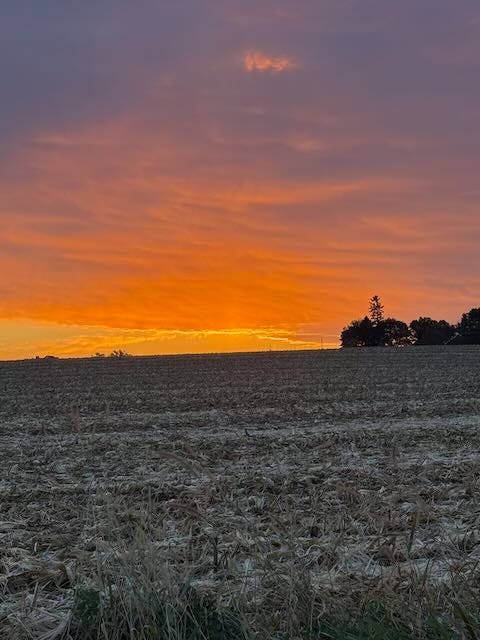
When I walked out one morning, the sun rose as I walked up our road toward home. Its warmth felt like a hand caressing my cheek, as a lover would as he leaned in to kiss me. I’ve felt the horizon drop away as the sun broke the horizon. Omalola walked quietly beside me. I was too tired to take them both down the road. Then an eagle flew twenty feet overhead, wings wide, buoyed by the wind. He flew up into our giant popple tree and sat. I ask Bruce whether he would go after one of the dogs. He says they won’t bother us, but I still feel the threat and the awe at a bird with a seven-foot wingspan. His head and his tail feathers are so white. Even so, I walked across the field to get a better look. The day had settled into nothing special by the time I took Aiden for his walk.
Bruce and I both missed hearing my perspective air live on Northern Public Radio all four times it was aired. For this month I wanted to use a fairy tale. A recent podcast by Jonathan Pageau gave me the inspiration.
As Safe As Little Red Riding Hood
Well, he looked like my granddaughter, with her red riding hood. Her scent wafted off him. Her mother must have sent her to check on me, even though I told her the wolves have come back. The road was so badly grown over, her horse wouldn’t make it through the tangle. So I let him in. And he ate me up. In later stories, the hunter kills the wolf and releases both grandmother and granddaughter from his belly.
In the podcast, Trick or Treat: Halloween Symbolism in Little Red Riding Hood Jonathan Pageau talks about how our homes are where we feel safe, it’s where we can close the door to the world, take off our street clothes, and relax, even sleep. I remember how violated and targeted I felt after someone stole my rings, nothing else, a few years back. Pageau says, “And then there are strangers that are in some ways so far from you that they don’t have your good in mind, right?”
I’ve heard stories of wolves released in populated rural areas, the powers ignoring humans’ ancient terror, the real danger these predators present. Not only that, popular culture tends to side with the wolves over the granddaughter and grandmother.
Since I tend to open the door to anyone, I take this warning seriously. Sometimes people we come across are just as dangerous as the wild wolf in the desolate forest. Sometimes there is no hunter to save us. Sometimes there is— the hunter swallowed, cutting his way out from inside, like Jesus cut the dragon that is death.
I’m Katie Andraski and that’s my perspective.
If you’d like see where this was originally posted, click here.
In Jonathan Pageau’s version he talks about how Little Red Riding Hood’s mother tells her to stay on the straight path. Leaving would be dangerous. But of course she does. She meets the talking wolf. He kills her, her grandmother, her mother and her father. Some versions end with everyone dead. Others end with the father or hunter hacking their way out of the wolf, everyone freed, sort of like what happened to Jonah when he was vomited out of the big fish. (If you’re interested in Pageau’s children’s book, you can purchase it at The Symbolic World Store.)
In another fairy tale, Red Bead Woman, the Prince leaves his bride to check a trapline. Of course she chooses the path that leads her to the evil sorceress who tears her face off. And in the original story, Adam and Eve eat the fruit from the Tree of the Knowledge of Good and Evil when God said not to.
I think of St. Peter’s warning that the devil prowls seeking whom he may devour: Be sober-minded, be watchful: Your adversary the devil prowls around like a roaring lion, seeking someone to devour. (I Peter 5:8). His advice? Humility seems to be a strong defense because he repeats the instruction several times: “Be subject to elders. Clothe yourselves with humility. Humble yourselves under the mighty hand of God” (I Peter 5: 5, 6.). It’s not a good idea to think we’re all that. Perhaps “I don’t know mind” drives us to trust the Lord, lean not on our own understanding, but acknowledge him in all our ways. He will direct our paths. (Prov 3: 5 – 6).
Then St. Peter says: Cast your anxieties on him for he cares for you (I Peter 5: 7). In other words, it’s not a sin to admit your fears. With the devil prowling around like a slavering lion, we might catch a little anxiety. We can tell God what frightens us. We can throw those fears into his hands. When he says resist the devil, I think he means to keep the faith, to believe that Jesus conquered death by death, that if that’s true there’s nothing the state or anyone can do to us, because death is dead, it has no power.
Today at dog class, Aiden was distracted. He focused on everything but me. He sniffed here and there. He looked at the puppy next to him. He jumped up and wagged his body at the instructor because she’d bonded to him during an exercise. I caught his attention a few times with cheese, but then he was off. My task will be to reward his focus and reward calm. This is going to take time and consistency. He is showing me yet again how I need to put my attention on Jesus—that old saying, “Looking unto Jesus, the author and finisher of our faith, who for the joy set before him” and not pull away like Aiden does from me.
This week I listened to Speakeasy Theology on a long drive to pick up thyroid medication for Mrs. Horse and then lunch with a new group of friends who love horses. Chris Green and David Harvey talked about William Stringfellow’s book An Ethic for Christians and Other Aliens in a Strange Landin their podcast: The Spirit, the Church, and the Politics of the Charismatic Gifts, Nov 8, 2025
As the radiant trees full of golds and ambers and reds whizzed by as well as long panoramas Their words caught my ears:
“So [Stringfellow’s] imagining the Christian life as conflict between life and death, between the life of God and the dehumanizing life that the world tries to impose on us, which is actually a way of death. And this is its conflict all the way down, right? Because to follow Jesus is to resist the powers of the world, to resist the world, the flesh, the devil, the principalities and powers that are at work against us.
And so the reason he starts with discernment is you have to be able to tell the difference between the demonic and the holy, between what the principalities and powers are demanding of you and what the will of God is.”
As I drove the right and left turns onto the main road leading to the vet’s office and lunch, my heart lifted up hearing these words. Harvey and Green asked a question I’ve been asking: How do we tell the difference between the demonic and the holy?
The voice of the accuser can speak things that sound like God’s voice, that are suspiciously like the preachers from my childhood. God will withdraw if you don’t give up Diet Coke right now! Don’t waste time on TV because you won’t be ready when things spin apart. Clean your closet now, even though I am overwhelmed as it is. No one will read your memoir. It tells too many secrets. So why bother? You’re by nature sinful and unclean. These may well be calls for obedience that get mixed up in accusations and fear.
One of the most beautiful stories comes from visions of the prophet Zechariah where the high priest who is part of rebuilding the second temple, Joshua, is standing before God and Satan. His clothes are filthy. Imagine wearing rags, how naked you would feel, how you would feel the dirt, while you were in the presence of God. Satan, the fiery being of light, I would imagine beautiful and radiant, accuses Joshua. Imagine your most private sins pointed out in front of God, also beautiful and radiant, so radiant you can’t hardly see. And God says, “The Lord rebuke you. The Lord who has chosen Jerusalem. Is this not a burning stick snatched from the fire?” (Does he mean the fires of hell? The fires of the Holy Spirit? Being on fire for the Lord?)
The angel said to those standing before him, take off his filthy clothes. He…