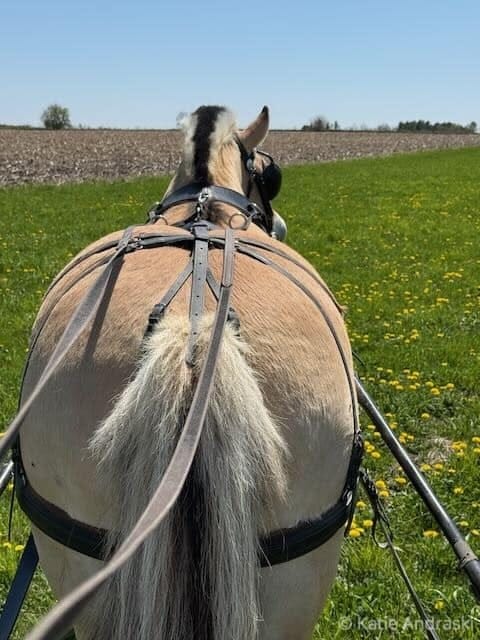
Clover has nearly reached up to Morgen’s bridle. She can drop her nose and snatch a purple flower. About a month ago, the field was newly shorn, nearly down to dirt.
We’ve gotten out before noon the last two days to try to beat the heat. Hesitantly I want to say I think I found the fun, and may drive her down the road, looking for apples on a tree, a mile away. Driving her has given me the motivation to get up early, not read the latest news on my phone and take her around the field.
A barn swallow follows us all the way down field, swooping around us. I wonder what that’s about. I wonder if it’s Little Bird wheeling in circles. (We rescued him as a fledgling.) Or are we somehow the people he is guarding like a border collie circling his flock. Or just swooping for the joy of it.
Mrs. Horse has so much power trotting out, I have to pulse my reins, squeezing the right hand, squeezing the left. If I hold hard both reins at once, she’ll brace and take off. Have you noticed how racehorses run with tight reins? Because they can lean into the bit and run hard off their forehand. I have to be careful to pulse my reins and not hold onto both at the same time. I don’t want her running back to the barn because that’s a rule. But my gosh it’s fun when she moves.
The day has gone quiet. This morning machine noises hurt my ears, with heavy trucks making their way up and down the main road. But by late morning it has quieted.
The Kildeer seem to have disappeared. For awhile we had a family of five hanging around the paddock. And they could be loud enough to annoy my hearing. Have they flown south already? Did last week’s hail and hard winds kill them? Or was it the aerial spray we’ve seen wheeling and dipping over fields?
The other day when I was mowing I listened to Brian Zahnd being interviewed by Jonathan Foster and Tori Owens about his marvelous book about the cross, “The Wood Between the Worlds.” Zahnd said we need to have real life friends because friends we make on the internet aren’t real. We should pick up the phone and call someone or go out to lunch. He stated that the friends you have at forty are the friends you have at 80. Well, that’s not exactly true. He assumes a person’s core friends will live that long or stay in the same area.
Medicare asks us how often we’ve talked to someone on the phone during the week, or what clubs we’re involved in. Are we involved in church? Those questions are busybodies. Docs say that our social life is important for our health. What if you’re a solitary person? What if your whole life seems to be shaped around the lonely places? What if there’s meaning and purpose in not pushing a social life just to push a social life? And being lonely does more to drive people away than draw them to friendship.
Zahnd’s words, the pressure from docs, opened the pit, where I greeted that old friend, loneliness, for a minute. I shook her hand and climbed out remembering how I’m going to lean into solitude, and be a solitary, which yes, is possible while married.
Often people found their way to the saints in the woods. Maybe there’s wisdom in waiting, in letting people come to me. Wisdom in blessing this life. While I was struggling with how to say what I mean, I read “Solitude” the final chapter of Maggie Ross’s The Fire of Your Life. Ross has been a lantern, a round circle of light, like the one I occasionally shine when I walk Omalola after dark. Sometimes it catches the two eyes, bright, of Tyger or Ma Cat. Most of the time I walk into the dark around the house or back behind the garden. These days we see lightning bugs blinking on the ground and in the grasses. The other night I saw a light and thought I was seeing a firefly move across the sky, but it was just a small plane blinking. Sometimes I time it to see the International Space Station. (You can get the app and they will notify you when it’s overhead. You can point your phone so you find the line of sight and see it.)
Maggie Ross says, “In solitude is the wonder of the commonplace, the mystery of the ordinary life: eating, sleeping, reading, listening to God’s secrets and jokes, a sense of delight, of dance, of fruition, learning that solitude is not something we need to scramble to fill up, but that it is full to overflowing if we can learn to accept the familiarity of insecurity and let go”(145).
These things are God’s love notes to us. Or maybe his song, calling us to delight in the world he’s made. This gray morning was marvelously quiet, except for bird song. I stooped and took a picture of a simply white morning glory. I said good morning to my friends the redwing blackbird and robin. Omalola pulled off the road to sniff. I let her. (That permission has bit me in the butt because she will stop dead in her tracks when there's a scent she wants to check out.)
By temperament I crave being alone. And by history. As a newborn I was laid alone on a bed for my picture, a picture that left me chilled and alone, when I saw it as an adult. I have been praying since I was little, usually artless intercessory prayers because that’s how my evangelical background influenced me, though I do remember a formula that went something like praise, thanksgiving confession, intercession. It was the praying for others that stuck with me especially as I wanted to pray without ceasing, something the Pilgrim sought after and learned when he was taught to say "Lord Jesus Christ, son of the living God, have mercy on me a sinner." (Well that's the version I say.) Martin Shaw is retelling his own translation of The Way of the Pilgrim in a series on his Substack House of Beasts and Vines.
I prayed through lists of classmates daily so that they would “accept Jesus as their personal Lord and savior.” That list has narrowed quite a bit these days, perhaps because I can’t hold many people in my head. My prayers have mostly narrowed to "Lord heal them," or "Lord bless them." Sometimes I tell Him what I think He should do, knowing that His Spirit is groaning beyond words, shaping those prayers. Sometimes those specifics come about. But lately I realized I wasn’t telling God my own story. I wasn’t showing him my face, by talking about others. I've want him to know me, so he can't say, I never knew you when he does that great separation between the sheep and the goats. I’ve learned silence can be prayer. And need to not resist it when I’m sitting in the car with Bruce.
Maggie Ross says, “Most of us have the experience that love can be unbearable. John must have received it in solitude and baptized to make the One who was coming, Love incarnate, a little easier to bear. Our baptism in the crucified and risen Christ enables us to bear it; we learn to bear each other’s love so we can learn to bear God’s” (142).
I have felt this. Early in my marriage I wrote:
This terror before my husband is the terror in a thunderstorm when there is nothing protecting me and my house but the luck of the lightning stroke. I taste it. My horses in the barn would have no chance against straw in flame and locked fear.
I sit the farthest inside my house. The windows are silver with rain so hard I can't see the cedars, willow, lilac a few yards off. I sit with a Bible open to First John where it says God is love and perfect love casts off fear. But God is so raw in the sudden thunder, I must sit in terror until the storm moves east.
With my husband I freeze as the child I was and kiss with fear scuddling along my teeth. God is raw when we come to love a man who could die quick as lightning. But sun does break up the storm, horses still stand in the barn, waiting for pasture. One apple tree is down that my parents left to be an arbor for bittersweet I picked for centerpieces.
This has been a work for me, this learning to receive Bruce’s love, to see in his throwing down hay from the loft because I’m afraid of climbing up there, afraid of that first step off the ladder, a gift of love. His withstanding my terror of abandonment, which stung my teeth, l…