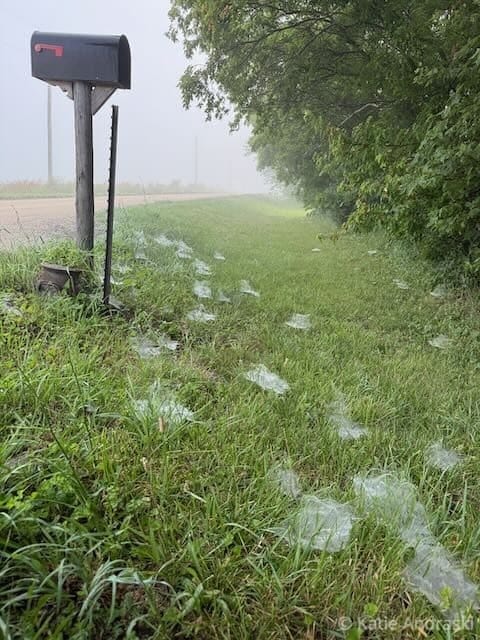
Despite road noises, the air itself was quiet when I walked out. Everything was washed gray, the sky, the air, the distant trees and farms. As I turned the corner by our mailbox, I saw several cobwebs spread like mini blankets on the ground. I spoke to the birds—grackles, kildeer, red wing blackbirds. As I turned toward the sun I could face him, cloaked in the clouds, and thought about how God did King Saul dirty.
I don’t get it. If God had left the man alone, maybe he would have died in obscurity, but he would have lived a life, that might have been safely hidden, and humbly righteous.
Is Saul’s story about too much Spirit without enough spiritual discipline? Or did Saul’s insecurity drown out the new heart and Spirit God gave him? Samuel, the man who heard God’s voice as a child, dedicated to God by his mother, loved him and mourned so hard when God rejected him, that God had to say get a grip, I’ve picked someone else. He loved Saul so much he came back from the dead to promise Saul would soon die.
Looking at the 2000 years of church history, I wonder are we any different?
The Daily Office has paralleled the story of Bad King Saul with Saul the killer of Christians until he converted. I wonder if that’s deliberate. Is the name Saul redeemed in Saul, then Paul the apostle’s story, his being struck down by the uncreated light of Jesus?
In a private class Jonathan Pageau urged us to not be afraid of difficult Biblical stories, to perhaps imagine what it was like to be someone like Saul. So here is my imagination:
You’d think being tall would garner respect, but it brought mocking. “Did your mother mate with a Nephilim,” his friends taunted. Often Saul hid himself by the river, practicing swordsmanship with a dried-up branch. He trained the donkeys, wrestling them into obedience. He grew strong and lonely. His heart leapt up when Samuel agreed to grant the people’s call for a king because he loved Samuel’s words: “The king will take your sons and appoint them to plow his land, fight his battles. He will take your daughters and make them cooks and perfumers. He will give his servants your best vineyards, olive groves, fields. He will demand taxes from your work.”
Saul was fast asleep when he heard the hooves of his father’s donkeys. He must have left the gate open. He fell back against his mat and buried his face in the sack cloth he used as a pillow. And sleep took him, plunging him deep into his longing to be king—his brain flashed with oil running down his beard, what little he had, the savory smell of meat burning mixed with the sting of hair on fire, the smoke rising. The prophet shrieking, what have you done? Then he saw a strange king, filled with fear and sorrow, so he spared him. Then the prophet’s rage, a dagger slicing the king, spattering blood. The torn robe.
His father shook him hard. Saul swam up from the dream. He woke shaking. “Did you leave the gate open?” his father shook him. Again. “The donkeys are gone. Take the young man. Go find them.” His father’s voice sliced through his dreams. He didn’t have to say, “No good. Good for nothing. You will come to nothing.” His face said it all.
No donkeys at the closest arabah. No donkeys at the next one. They walked through the hill country. Up one hill and down another with the next hill and valley holding out hope the donkeys might be there. Sometime Saul and his servant called their names. Echoes came back. They walked through Ephraim. They walked through Shalishah. The walked through Shaalim. They walked through Benjamin. Their legs ached. Their feet were crusted with filth. Saul’s heart sank into these words: I’m no good. I can’t even find my father’s donkeys. He turned to his young man, “Let’s go back. My father will worry if we’re gone much longer.” He could not look his servant in the eyes, so looked off to the sun breaking through shadows on the hills.
“There’s a prophet near here. Everything he says comes true,” his servant said, eyes sparkling. “Perhaps he can tell us which way to go.”
“We have nothing to bring him.” Saul shrugged his shoulders.
“I have a quarter a shekel of silver.” His young man held out the coin.
They walked up yet another hill, the women coming out to draw water, saying he’s just ahead. (That image of women coming to draw water sings of bride and bridegroom Isaac and Rebekah, Jacob and Rachel, Moses and Zipporah and Jesus and the woman at the well.) Only there is no human woman to marry, but Saul will be betrothed to Isreal, when Samuel poured oil over his head.
I don’t know how God spoke to Samuel, whether he appeared to him, brighter than the sun, or he came as a voice like he did when Samuel was a boy. God says, “I’ve seen my people. Their cry has come up to me.” Is that the same cry that came up when Abel was killed? The same cry that came because Sodom was so evil?
God nudged Samuel, “Here he is. He will restrain my people.” Samuel turns to see a dusty, tall man, whose looks make him step backward, they are so fine, despite the dust, despite the weariness in his eyes. And a kind young man beside him.
Restrain? So Saul with deliver and restrain them? Does that mean give them what they wanted? Give it good and hard?
“We’re having a sacrifice. Please join us. We’ve prepared a place for you at the head of the table. Your donkeys have been found.”
It dawns on Saul that this is Samuel, the prophet who said Isreal could have a king. He sees love in his eyes and a touch of joy mixed with sadness, an expression he’d never seen in his father’s face.
Saul drops his eyes. “Who am I. I come from the least tribe, the humblest clan that you’d talk to me this way?” How would he bear the eyes of the people, as he tore meat off the bone? When he heard his mother saying, “Where are your manners?”
Send your boy ahead, Samuel says the next day. When he is out of sight, Samuel pours pure golden olive oil over Saul’s head. He is blinded by the oil as it runs over his eyes. His hearing is muffled. His hair is matted. But the smell that rises is like honey. “You are now prince over God’s people. You will deliver them from their enemies.”
I think about the song: How good it is to “dwell together in unity. It is like precious oil poured on the head, running down on the beard, running down on Aaron’s beard, down on the collar of his robe” (Ps 133:2, NIV).
Samuel spells out what’s going to happen. And it does. Then Saul must wait seven days.
When Saul meets up with prophets and prophesies with them. What was that like? Did he speak in tongues? Did he say things that later came true? Did the words that came out of his mouth carry dread and joy both, a warning about what’s to come? Did he go on a giant ego trip? Here’s my imagination:
Saul felt like he was going to fly, his body filled with wind so hard he could hardly breathe. It felt like the hot winds pouring off the hills, withering everything. It felt like the fires that followed. He felt weighed down, like the yoke he lifted on his oxen had settled across his shoulders. Fire tickled above the others’ heads. He sang words he didn’t know. His mind’s eyes filled with fields of slaughtered warriors, their blood fertilizing the ground, the sure signs of victory. He heard a lyre, the fierce words: “For you save a humble people, but haughty eyes you bring down. For it is you who light my lamp; the Lord my God lightens my darkness. For by you I can run against a troop and by my God I can leap over a wall” (Psalm 18: 27 – 29).
God gives him a new heart.
Isn’t that the promise in Ezekiel and in Jeremiah—God will replace our heart of stone and give us a heart of flesh? I long for my scarred over heart to be healed, the scarring a natural defense, when hurt upon hurt piles on. A heart of flesh sounds like a great and good promise.
Samuel gathers the whole nation of Isreal to announce who will be their king, by drawing lots. People held each other’s hands. They held their breath in anticipation. Could it be one of their fathers? Brothers? Sons? The lot fell on the Ben…