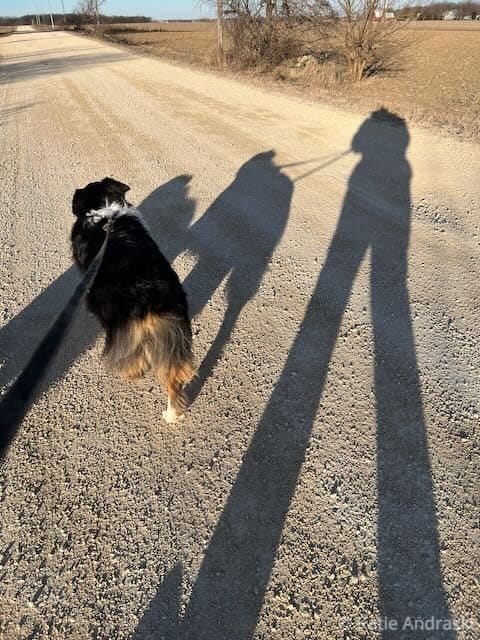
When I turn back to walk towards home, I walk past our neighbor’s neat white house and red barns. A breeze combs through yard pines. The small cattle pen behind the barn, is empty. The steers spooked Morgen when we drove by, even if she couldn’t see them, their smell just as alarming to her. These were the steers our neighbors fattened for their own table as well as friends' tables. Once we bought a quarter beef from them, the meat almost too rich and sweet.
Our neighbor’s joints have stiffened so he shipped them. He and his son continue to plant and harvest cash crops and some hay. His wife’s horse left last fall, a year after she had passed. The farm once full of stories has grown quiet. Twice the ambulance came this week because the farmer got himself down on the floor but could not get up. We hold back from stopping over, not sure showing up would be welcomed when the red blues are flashing in the yard.
I see a jet flying over the far woods coming in for a landing at Rockford International Airport. Even from here, I can tell if it’s Prime, UPS or Atlas Air. Sometimes I look up its departure city, on Flight Radar 24 but this time I do not. Some writers friends disparage machines, but I find them beautiful, graceful floating through the sky. When I was a girl, I watched them on approach to Albany airport and longed climb on, go elsewhere. The other night we heard a jet fly smack dab over the house. We peered through the curtains to see him tipping his wings, so low I wondered if he was going to crash, but he was merely banking on approach to the airport, a good ten miles away. I’ve seen plane crashes in my dreams, waking up startled, knowing I’m being tapped for how unsettled my life is, how afraid I am, as I walk into my days.
This week, two jets crashed, stabbing the hearts of their families and friends, the whole country. The crash into the Potomac took me back to the week my father died because I had driven past the Florida Flight 90 crash site in 1982, seen the broken bridge, marveled at the man who dove back into the water to save passengers who were so cold they had no strength to get to shore. He died doing it. (I’ve been watching Special Forces World’s Toughest Test and noted that only one team rescued all the hostages, during that particular test. The others simply followed orders to bring out one. What does that say about our independent thinking and bravery?)
When we boarded the jet from Chicago bound for Charlottesville, Virginia, Francis Schaeffer said the devil was going test us. He was uneasy about seeing Jerry Falwell, but an ally was an ally. In the 70’s and 80’s Schaeffer was famous for encouraging evangelicals to become involved in their culture. As Christians, they should salt occupations ranging from lawyers to poets. He was well known for two documentaries How Shall We Then Live? and Whatever Happened to the Human Race? As his publicist I was helping him promote his book A Christian Manifesto which called for Christians to engage in the culture war, in order to stop the United States’ slide into corruption.
Two days later, I returned to my room, and pink phone messages, saying “Call Home, your brother wants to talk with you. Call home your uncle wants to talk with you. Call home.” As I fumbled with the phone keypad, I knew then that my father had gone home to be with the Lord, my father who just last night said how I was having the time of my life, how he was proud of me, when I bitched about how the dress we’d bought together, with its sheer blouse, had called up a comment, that I was one of those artist types. It had called up too many stares, not at my eyes. "What about the women who were suffering unplanned pregnancies? What the heck are evangelicals doing getting involved in politics," I ranted. Fog had socked in the airport. Fran and Edith came next door and prayed with me. As their publicist I did not want to burden them, but there I was needing their kind words and prayers.
The next day Jerry Falwell’s assistant arranged for my flight to Albany. I rode to Washington in his “Lear” jet. (I forget the make). Jack Kemp’s wife walked me to my connecting flight, with barely minutes to spare at Washington National. She took me to the counter. She took me to the gate. The jet lifted above the clouds to the cold blue sky. I leaned my tears into the window.
While we shoveled snow together, my brother called me "a genius for God." (Maybe I shouldn’t share this?) But it was his only blessing. He would be gone in six years. My dad’s funeral reminded me of the silvers we see in weddings—the wrapping paper on gifts, the cake—because freezing rain poured down. We left my dad in the church. My brother and I did not want to come back for a graveside service.
Dad loved me enough to not call me back after his wife, my mother, died. I could not stop and weep with my brother, so I returned to the tour at the National Religious Broadcasters convention. Ken Meyers, the producer for NPR’s Sunday morning offered to put me up for the weekend gap in our schedule. If I’d flown to Chicago to my apartment for those days, I don’t know how I would have stood it. Meyers and his wife bought me carnations and listened while I raged about some evangelical guy who muscled his way into seeing the Schaeffers, arranging for them to see Ed Meese and James Watt, but closing me out. I raged about the whole business of Christians kissing up to the politically powerful. I raged about how this divided me from myself. My tears locked up. Several years later, Jo Sobran from The National Review, offered an insight: “Sometimes it’s easier to be angry than to feel your grief.” Well, that about says it. My grief spoke in anger for over a decade. It spoke in my novel The River Caught Sunlight, a fictionalized version of these events. I still have the Valentine I bought for my dad at the airport.
I see a pigeon, well, a dove fly over, white on gray. He flies over me twice, a kind of omen. I think of the dove Noah sent out to see if the ground had dried out. She came back with a sprig from an olive tree, the olive sprig a sign for peace. How could an olive tree survive a flood that settled on the earth for a year? I take comfort in the mystery.
Then there’s the cry of the Psalmist, full of pain, “My heart is in anguish within me; the terrors of death have fallen upon me. Fear and trembling come upon me, and horror overwhelms me. And I say, ‘Oh that I had the wings of a dove! I would fly away and be at rest; yes, I would wander far away; I would lodge in the wilderness” (Ps 55: 4 – 6, NIV).
Then there’s the Holy Spirit descending on Jesus and driving him to the wilderness. Did Jesus feel this anguish, as he walked up to the river Jordan? Was his heart in anguish within him as he saw the muddy water, knowing he’d go down, down where all of mankind was drowned except for Noah and his family? Did he think about the men, horses and chariots who were drowned? Or the Syrian commander, Israel’s enemy, who was dunked and healed, who turned to him? Or the brooding of his Spirit as he roamed over them before there was anything? Did he feel this anguish, this fear and trembling as he stepped into the water, and his cousin John took him in his arms and laid him down? Did his goodness stream out of him cleansing those waters?
Was his prayer to flee to the desert on the wings of a dove, answered when the Holy Spirit like a dove descended, and his Father’s voice spoke, "This is my beloved son in whom I am well pleased"? Even then did he despise the shame that would come at his death for the joy set before him. Did that joy keep him from worshipping the devil when he was offered the kingdoms of the world merely for a bent knee?
Did he see us, in our beauty, the church without spot and wrinkle, his beloved bride as he did in the Song of Songs, “Behold, you are beautiful, my love; behold you are beautiful; your eyes are like doves” (Song of Sol 1: 15, ESV). And “O my dove, in the clefts of the rock, i…