Last week’s joy came through an abscess cut open and cleared. A relative posted a picture of my mother sitting on the couch the last Christmas she was alive. When I arrived home from grad school, her round curves were gone, but in the picture she looked the same, soft round person I’d known, but she looked tired. In a month, I would be moved to Chicago, all hell would break loose in my life, when I heard she had less than a year to live.
An abscess broke and cleared. An old scar over a wound that I thought had healed was ripped off. The pain of it roared up in the telling and I let myself sob. My spiritual director was a presence, bearing witness. And the air cleared, the joy came back. In some ways the tearing of that scar was a gift. My spiritual director has quoted James Finley: “When we risk sharing what is most vulnerable, in the presence of someone who will not abandon or invade us, we come upon the pearl of great price, which is the preciousness of our own self, our own soul.”
Tears are so easy to squelch. One of my earliest memories was my father saying, “If you don’t stop crying, I’ll give you something to cry about.” Since he brought presents home a lot, I wondered what toy it might be. Maggie Ross says in A Fountain and a Furnace, “As early as infancy work begins to train the weeping out of us, or to distort it to support delusion, lest our crying disturb the seemingly tranquil veneer of life around us” (39).
As a young woman I ran to the woods or the barn to weep, longing for Jesus to wipe those tears. In some ways He did as I cried down to quiet. Since my mother smoked, I grieved her dying. I wept for my friends to know Jesus and cried for students murdered by the National Guard. My tear-streaked face had to be hard on my parents. I am grateful I wasn’t sent to a counselor. These easy tears were a mystery until I heard whispers that tears were a spiritual gift. Maggie Ross’s The Fountain and the Furnace slows way down and explains that the spiritual gift of tears is not grief. She says, “Tears evidence the continual breaking into time of eternity of transfiguration and the vision of God even when nothing, and more than nothing, seems to be one’s lot” (168). As a young girl, I had the gift, a sense of empathy for the suffering of the world and the suffering of Jesus. These days I chafe at the blood and gore of the cross, and the pressure to hoist that thing on my back, even though Jesus says my yoke is easy, my burden is light.
Come unto me all that labor and are heavy laden and I will give you rest. When do we get that rest? What does it look like? Chucking the nag that says whatever you do isn’t enough? Chucking the guilt that you are “by nature sinful and unclean” when it says in the Good Book that God saw all that he created and it was good, that God made man in his own image, male and female created he them. In his own image.
Then in the Discussing the Letters of Paul class, Brad Jersak explained how important the word, “live quiet lives” (I Thess. 4:11) might be for us. He said we need to learn how to rest, how to be quiet so when we die we don’t experience a tearing from living hard to stopping. “You need to sow as you walk sow rest. You prepare for rest so reap rest in the end. Instead of experiencing a tearing. If you push hard, it would be a tearing at the end. You have to build the capacity to die through a practice.” I think of an evangelical saying that we should slide into our graves burned out because that’s the way to please God. But that flies in the face of how we’re called to rest. The writer to the Hebrews calls us to rest from our works. He says “There remaineth therefore a rest to the people of God” (Heb. 4: 9). And the writer warns us not to reject that rest. Living into our rest, ceasing from our works, isn’t just one day a week, it’s everyday.
Albert Rossi in his Becoming a Healing Presence podcast said that there’s no way we can make ourselves righteous on our own. The appropriate prayer we can pray is “Lord be merciful to me, a sinner.” The Orthodox call it theosis and the western Christians call it sanctification. I take it to mean that we become more like Christ as we walk through our lives.
A year ago, I participated in an intention setting workshop with Annie Kip. She asks us to draw cards with mixed up images in them. This mix up is supposed to jog us into making connections that we might not have seen otherwise. I pulled a card with water drop splashing up. Water that looked like a crown. Living water that bubbles out of our hearts. God the fountain of living water, not a dry cistern. Each rain drop a crown. We are sons and daughters of the King. Maybe knowing this is the way to thread the needle between knowing our weakness before God and others and knowing who we are in God as heirs and joint heirs, where we cry Abba Father, Daddy.
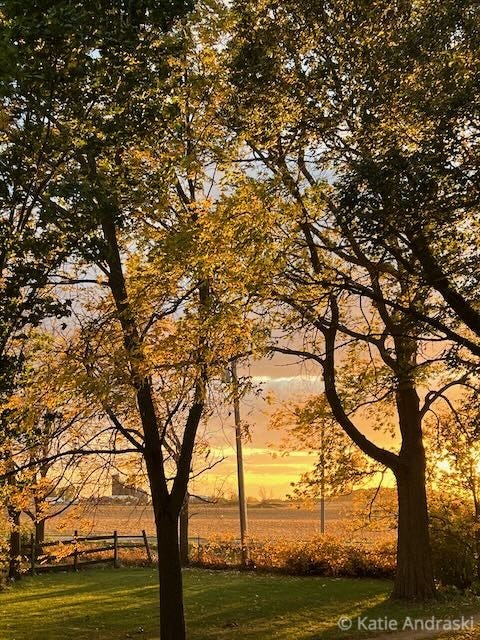
Our sky has been full of marvels around here. I needed to talk to the Lord so took myself and the dogs for a walk down the road at sunset. The fear had sunk inside and I couldn’t shake it off with the Jesus prayer, so I told God about it. My gosh it was good to talk to him while the sun set and the horizon glowed with the rest of his light, some orange, some purple fading into blue. We talked and we walked.
My heart has been hurting, physically tight in my chest. I have wondered if I should go to the ER and my doctor has ordered a CT Scan of my heart to look for plaque. I asked for testing because my father died at 69, five months after my mother died. And I am turning 69. A survey from Northwest Medicine said my heart is five years older than it should be. And I am a fatty lumpkin, my weight around my belly, my pants like plumber’s pants falling off my hips.
I looked to the west and slowly it appeared like a ghost, just beyond my eyesight, like I was hallucinating, and then coming to my eyes. I opened my camera and snapped pictures and texted Bruce to come out and look. It looks like a bride, her veil streaming behind her, running to her husband, joyous and mysterious. And a portent. The ancients saw comets as warnings that something terrible was going to happen. We see them as balls of ice swinging around the sun and then out again. This one won’t appear for 80,000 years. I think the ancients were right. I have felt this dread for several years. I have been nudged to study, but to be honest I’d rather watch television or scroll Facebook. I can’t seem to hold what I read in my mind.
During Bible class we talked about the last chapter of I Thessalonians 5 where Paul talks about how we are not children of darkness but of light. One of the teachers talked about a frightened friend who is so traumatized by our election, she wasn’t sleeping. She told her friend to just walk in the light.
Paul says, “For you are all children of the light, children of the day. We are not of the night or of the darkness, so then let us not sleep as others do, but let us. Keep awake and sober” (I Thess5: 5 – 6 ESV).
Well, I can walk out in the morning and marvel at the moon setting at the same time the sun is rising. I can see the lesser light grow fat and fade and see the sun throw his light across the fields throwing my shadow on torn corn stalks coating the fields from the recent harvest. I face that light and squint, feeling the power pushing me down. I don’t like to climb the hill to the east because the light pushes me back. I squint. I listen for trucks coming at me or behind.
So how can I walk in the light when I wake up with my heart pounding, from dreams, from the fear that something awful is going to happen because we have no leader in his right mind running the country. International and internal threats are simmering. Two massive, destructive hurricanes mowed down parts of our country. There will be no easy recovery. The government we hired doesn’t seem to care about Americans.
This election gives credence to the Psalmist’s saying, “Put not your trust in princes, in a son of man, in whom there is no …