As I’ve mentioned before I write a response to Martin Shaw’s Beasts and Vines Substack every Sunday morning. His kind response draws these little essays from me. This week I’m going to open up what I wrote.
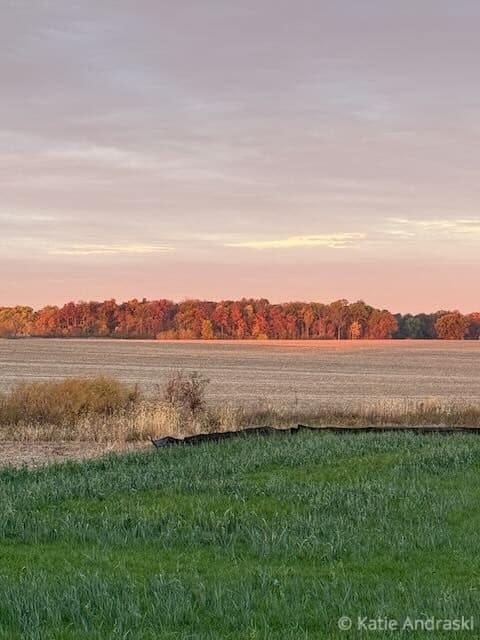
While I listened to Martin Shaw’s Jesus on the River Path I walked across shed leaves, mostly from black walnut and maple trees. We didn’t get much color this year and the leaves went from green to blown down. Some trees are still green. Our squirrels have been feasting. I’d drawn enough water last night so I didn’t need to draw any today. The sun is out. The sky is blue. The breeze is brisk, blowing the big barn door away from its frame. I placed some buckets with pea gravel to hold it back. We open a side door in her stall to let her out at night, so she won’t wreck the big door, rubbing her butt or shoulder against it, with the threat of wrecking it. How do you replace a door that big with winter coming? Once she rolled it off the rails, but we somehow lifted it back on. Like always I curried her now thick pelt and she stuck her nose out in pleasure.
Because he’d arrived in Cambridge for a stint teaching divinity students. Shaw asked, “How do you arrive in a place? What’s your manner of approach?” These are hard questions for me to answer.
It’s been awhile since I’ve gone to a new place. I suppose with our home, I was shy, didn’t walk the road like I do now, though I rode the other pony, Tessie, around the fields, until she bolted, bucked, and struck me with fear of riding I never got over. Through the years, my love for riding in those fields faded fast. I leaned on my trail riding friends or my trainer and the arena.
I moved my books in first, lining them in shelves along our garage room and letting them sit for a year while we broke parts of the house down and made it new. We opened up the stairway, with bulging plaster and so steep, it could have flipped one of us or the dogs into a bad fall. It was haunted. Well, I won’t go into all the changes here but it was a very deep renovation. And the house was not happy.
So I suppose when I arrive in a new place, I seek to make it my own.
That title Jesus and the river. Yes. I found a boulder, granite from the Canadian Shield, by the Normans Kill, where I grew up, sat there and wept over a boyfriend, and first read the good news “there remaineth a rest to the people of God.” The Normans Kill empties into the Hudson at the Port of Albany. Oh my goodness there were a lot of spirits by that ground. Here’s a poem I wrote as a child, well in college, well still a child. Forgive the purple.
It was a magic day, a magic land,
chanced upon some years ago; found beyond
the natural bowl of twisted vines, tanned
pastureland and earthen water jugs. Blonde
hills breathed lazy curves like tumble down seas
and trees corralled heaven’s delft with gnarled fronts.
Poised parapets, hawks swung the air with ease
They steady swooped basins, mocking my stance.
Grounded I dreamed of air currents. The breeze
Shuttered with danger. My saddle horse danced,
Trembled in fright at the ugly three heads
Of black Great Danes guarding the barbed entrance.
Despite yellow fangs and sharp paws they fled
My upflung, whip high, yelling mad rush.
I entered the magic land where high bred
Spirits lined goldenrod, sumac and brush
With spring paint and rain dust. Secrets were sung
At the watercourse. Nymphs filled the hush
With flaxen song spun in an unknown tongue.
Clumped ribs, femurs and vertebrae remarked
Sacrifice. The grass stained pearls hardly wrung
A sliver of fear through my side. Sharp, stark
Cow bones spread as if chew by angry gods
Mentioned appeasement. The wilderness park
Would soon swallow the bones with wirey sod
Already tinged with green. I rode my horse
Into the gully where stratified shale rods
Embedded scarred banks. Our slow winding course
Followed the stream where spirits danced light rings
On shale. It was a day rinsed of remorse
Plaited with gold and silver. Spider strings
Glued my face as we climbed up the ravine.
Laughter unclasped when I saw the ring
Sculpted in clay on the path. Elf’s design
It was a treasure in mud, swirled by rain.
The Potter’s gift sparkling with opaline.
I miss the power of that place. Apart from frequent rainbows, and a white one, the ground here seems barren, but oh my goodness, subtle folds of land my legs have wearied bicycling them, but beautiful. In a recent Q and A for The Green Knight course, Martin Shaw talked about how it’s good to become famous in a five square mile area, get to know your neighbors, learn the history and lore of the place, act like you’ll be there the rest of your life. So maybe that’s a project to try here in my neighborhood.
In talking about rainbows last week, I realize I’ve forgotten the other part of the rainbow story. Noah and his sons and their wives were saved in that tar pitched ark, along with all the animals, mostly two by two. But I am not sure they got off merely tucked in and cozy, a way I imagined their riding out that rainstorm as a child.
Imagine warning your friends and neighbors about the impending disaster and all they do is mock you, some even spit on you, but you’re building the ark, timber after timber, slapping heavy fragrant pitch on the boards, that made your head swim and your stomach queasy. The construction should have been proof enough something terrible was coming.
Did Noah read the signs of the times? Did he feel the rumbles of the continents starting to break apart? The sudden gushing of rivers out of dry caves? Did the storms settle over the land dumping feet of rain? Did he watch how the sun and moon turned blood red? Or did the angel of the Lord show up at his doorstep, unmistakably Other, clean, a brightness in his eyes that hurt, when Noah had only seen a mix of fury and fear and devouring in his neighbors’ eyes.
Weren’t his friends and neighbors alarmed at the animals walking up the ramp to the ark, two by two? Didn’t they wonder at the lions and panthers and tigers, not chasing the horses, cattle, sheep? Was it odd to see birds flocking and diving through the door? Had Noah given up by then, tired of their jeers, knowing there was only room for him and his family? Did the door slam with a bang that shook timbers? What did God look like when he shut the door?
Ever wonder what Noah was righteous in God’s eyes looked like? I do.
Noah must have heard their screams when the water rose, the horror of it rushing around the wood, people’s screams, the horror of the boat lifting off the ground, rocking in the currents. Even if the people masturbated to porn hour after hour or threw their children in the incinerator to please some hateful god, or the giants, mighty men of old, slaughtering people like sheep, drinking their blood, eating them alive, Noah had to have cared for the frightened people, hoped they would have listen to his warning, turn back from wasting their lives. If he was righteous, wouldn’t he have prayed for them, longed for their deliverance from the disaster that was coming? And the animals outside yelping and neighing and going silent. And the cities, the beautiful cities that ran like magic that would be no more. Wouldn’t his heart break? Would every last member of his family lock up in silence and shock or melt into sobbing?
Then there was the stench of the animals cooped up together, their assorted smells filling the ark, how it had to have been hard to breathe and the hard work of feeding them for a year. How well did eight people, some in laws get along? Did the daughters-in-law squabble with Noah’s wife? Did Shem, Ham and Japheth fight with their father as sons are wont to do? Did the lack of sunlight drive them further into madness? Did the angel of the Lord step into that stench and dry their eyes?
No wonder Noah got so drunk, when his vines produced grapes. He had to have been haunted by the screams, by the loss of his friends and neighbors, by the beautiful fields, he’d gaze over, cloud shadows moving no longer there. And then when the ark landed, he looked at mountains that were entirely strange. Being knocked out drunk and his son crawling on top of his wife*, he was too far gone to stop it, despite her struggle. He woke with a cloak thrown over them. He woke to fury at his son. And the child born of it, Canaan, he cursed.
But still, there’s promise of deliverance in this final part of the rainbow story. These days I wake up, pre-dawn afraid, wondering what I’ve seen in my sleep. Jesus has said it would be like the days of Noah when he returns. Seems to me we’re there. Seems like we’re at the end of the world, our world. Climate change scientists and the makers of AI warn that humans might go extinct. It’s been said that God will burn up both heaven and earth, since he’s done drowning the world in a flood. But hasn’t he already burned heaven and earth when the Holy Spirit descended? Isn’t that fire dwelling in each of us? Hasn’t the glory descended on the church, like it glowed and smoked in the ark and Solomon’s temple? Only we don’t know it, that we are seated with Jesus in the heavenlies.
Noah had the ark, the remnant had sympathetic kings, I wonder how our species will be delivered. What will Jesus return look like? He said His kingdom is like a mustard seed growing or like leaven spreading through dough. I know people mock the idea of a rapture, but what if it’s true, what if we are caught up to be with Jesus in the air? What if we’re urged to blessed hope for Jesus to return, as he was taken away, lifted up to the clouds? What if we will grieve for those left like Noah must have grieved and Jesus will wipe the tears from our eyes. Even if it’s not how the mysterious end will come, we have been given the ark of Jesus’ promise he would in no wise cast us out, the rod and staff comforting us in the valley of shadow, the Lord taking out the sting of death.
In Marriage is Latayne Scott relates how Thomas Hopko, a man who had suffered greatly says:
“Keep your icons. Keep your crosses. Keep your churches. Keep your monasteries. Keep your books. Keep your liturgies. Take away everything you want.”
His bottom line, though, shocked me. He said,
“But they can’t take away our death.”
He continued. “Because in our death, we are united to the death of the Lord Jesus Christ, and through His death, we enter into His resurrection and life eternal.”
Do you hear that? Even if the rapture doesn’t deliver us from the end of the world, even if we’re martyred, our death is the ultimate deliverance.
As St. John says, “Beloved, we are god’s children now, and what we will be has not yet appeared; but we know that when he appears we shall be like him, because we shall see him as he is. And everyone who thus hopes in him purifies himself as he is pure. (I John 3: 3 – 3, ESV).
*Scholars say that when Ham saw the nakedness of his father, that was a euphemism for sleeping with his mother, Noah’s wife, so that’s how I portrayed this.
What are your thoughts about these times we live in?
Thank you for reading/listening to this essay. If you would like to support my work, consider becoming a free or paid subscriber or drop a tip in the tip jar below.