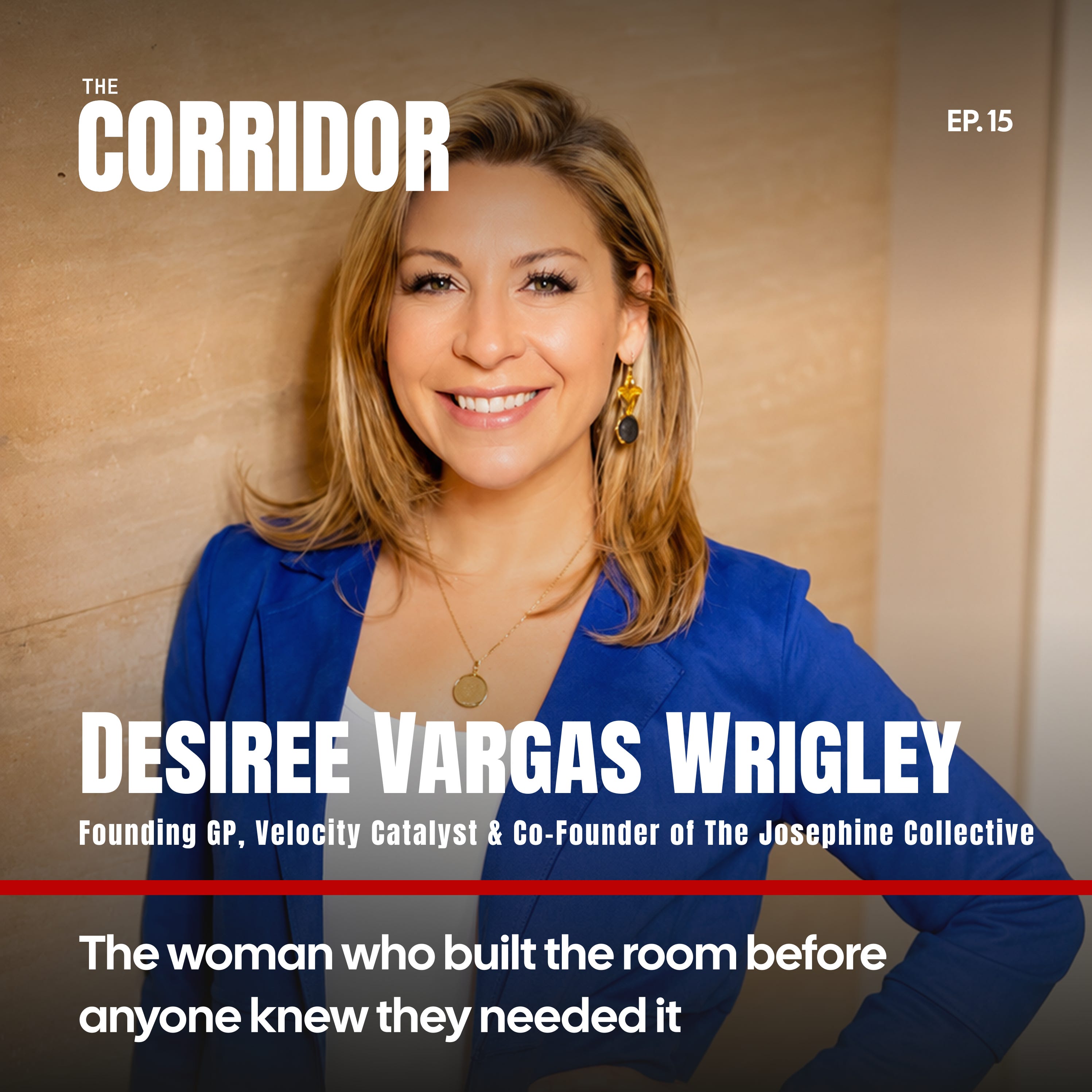
Most investors pick a lane. Desiree Vargas Wrigley built a fund that runs two at once.
She’s the founding GP of Velocity Catalyst, and her model is genuinely unusual: she invests directly into pre-seed startups, and she anchors the emerging fund managers building around them. A fund and a fund-of-funds, working in tandem, designed not to make one good bet but to rebuild an entire regional capital stack from the ground up. This episode of The Corridor is about why she built it that way, and what she’s learned climbing from one side of the table to the other.
From founder to funder
Desiree didn’t start on the investing side. She was a founder first. She built companies and went through the raise herself, the rejection, the doubt, the grind of convincing people to believe in something that only exists in your head. She lived the thing before she ever funded it.
That order matters, because it shapes everything about how she invests now. When she talks about backing founders, she’s not theorizing about a struggle she read about. She’s remembering it. And the single line that captures what that experience taught her is the one that anchors this whole episode: no doesn’t always mean no forever. A rejection isn’t a verdict. It’s a moment in time, often about timing or fit rather than merit, and the founders who understand that are the ones who keep going long enough to get to yes.
Two lanes, one system
The heart of Velocity Catalyst is its dual structure, and Desiree is clear about why it exists.
Investing directly into startups gets you exposure to the companies. But a single fund writing checks into founders doesn’t fix the deeper problem, which is that entire regions and entire communities lack the surrounding infrastructure of capital that lets founders climb from one stage to the next. So alongside the direct investing, Velocity anchors emerging fund managers, the smaller, focused funds who will provide the follow-on capital and the local relationships that founders need.
The two lanes reinforce each other. The direct investments give her a ground-level view of the ecosystem. The fund-of-funds work multiplies her impact, because every emerging manager she backs goes on to fund dozens of founders she’d never reach alone. It’s a system designed to build a stack, not just a portfolio.
Why emerging managers
Desiree’s bet on emerging managers is a bet most large investors don’t make, and her reasoning is worth understanding.
Small, focused funds see what the big generalists miss. They have proximity, to a region, to an industry, to a community, that a large coastal fund simply doesn’t. They’re closer to the founders, they move faster, and they understand the local context that determines which companies actually work. For a region trying to build a real startup ecosystem, these managers are the connective tissue. Back them, and you’re not funding one fund; you’re seeding the infrastructure that lets a whole ecosystem compound.
That’s also why the regional advantage matters so much to her. Venture has spent decades concentrated in a few zip codes. Desiree’s thesis is that the overlooked regions, and the managers who know them, are where a lot of the next opportunity lives, precisely because everyone else stopped looking.
Not charity. Catalyst.
The part of the conversation I most want people to sit with is how Desiree frames the work of backing underrepresented founders.
She is direct that this is not charity. It’s a returns strategy built on a market that’s been misread. But she’s also honest about something more nuanced: that at the earliest, riskiest stage, philanthropic capital can be a catalyst. Certain high-risk, high-reward bets, the ones traditional capital won’t touch until someone else de-risks them, sometimes need a different kind of first dollar to get off the ground. Used well, that catalytic capital doesn’t replace venture returns; it unlocks the companies that go on to generate them.
The distinction she’s drawing is important. Treating underrepresented founders as charity cases is exactly the framing that has held the whole system back, it lowers expectations and misprices the opportunity. But recognizing that the earliest stage of high-risk innovation sometimes needs catalytic fuel is just good ecosystem design. One is condescension. The other is strategy.
What building a fund taught her that building a company didn’t
Having done both, Desiree is clear-eyed about how different they are. Building a startup and raising a fund look similar from the outside, both are acts of convincing people to believe before there’s proof, but the mechanics diverge. And underneath both, she keeps returning to the same truth about how venture actually works: it’s more network-driven and reputation-based than anything else.
That’s not a cynical observation. It’s a practical one, and it’s generous advice for anyone building without an inherited network. The relationships and the reputation you build are the real currency. They’re what turn a cold pitch into a warm introduction, a maybe into a yes, and a first fund into a second. For founders and emerging managers alike, the lesson is the same: invest in the network and the reputation as deliberately as you invest in the product.
The throughline
What connects all of it, the dual fund model, the bet on emerging managers, the catalytic capital, the emphasis on network, is a single conviction: the system is fixable, but not one check at a time. Desiree isn’t trying to fund a few great companies. She’s trying to build the infrastructure that lets whole ecosystems and whole communities climb. And she’s doing it from the belief that the talent was always there, waiting on capital and access that finally show up.
For the founder who just got a no, or the emerging manager wondering whether they belong in the room, her message is the one she opened with. No doesn’t always mean no forever. Keep building. Keep asking. The room is bigger than it looks, and people like Desiree are working to make sure there’s a place in it for you.
Listen to the full episode of The Corridor with Desiree Vargas Wrigley.
Seguimos. 🇵🇷
Angel León, Coquí Ventures
Coquí Notes is the editorial publication of Coquí Ventures, the diaspora platform connecting Latino founders to community, capital, and the infrastructure that turns ideas into category-defining tech companies.