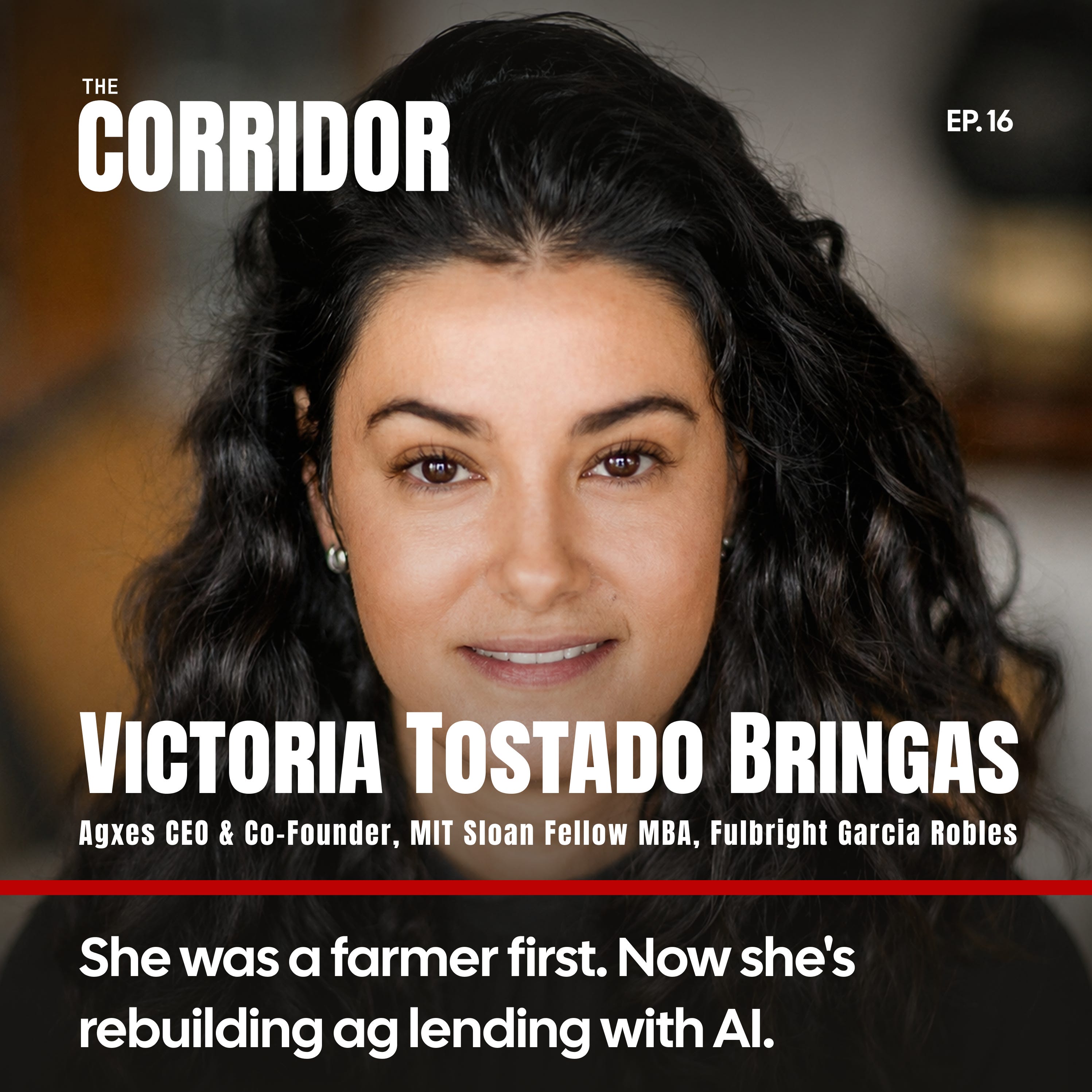
Most people building financial technology have never lived the problem they’re solving. They study it. They model it. They interview people who’ve felt it. Victoria Tostado didn’t have to. She was the one feeling it, for seven years, in the field.
Before she was a founder, before MIT, before any of it, Victoria was a farmer. And that single fact is what makes this episode different from any other conversation about fintech you’ll hear this year. Because she isn’t solving an abstract problem she read about in a pitch deck. She’s solving the one that nearly broke her, and every farmer she knows.
The wait that doesn’t make sense
Here’s the tension at the center of this episode, and it’s one most people have never thought about for a single second.
A farmer needs credit. Their land is producing. Their operation is real. And yet, getting a loan can take somewhere between thirty and ninety days, buried in paperwork, waiting, while the season moves on without them. In an era where you can get approved for almost anything in minutes, why does the industry that literally feeds us still move at the speed of fax machines?
The answer is more frustrating than you’d expect, and Victoria explains exactly where the system breaks. There’s a gap, she told me, between what’s actually happening on a farm and what a lender is able to see. Bridging that gap has always required something the industry never had enough of. What that missing ingredient is, and why it’s kept an entire trillion-dollar industry stuck, is one of the most clarifying things she says in the whole conversation.
From months to minutes
Then there’s the number that made me stop the recording in my head.
What takes the traditional system thirty to ninety days, Victoria’s company, Agxes, can do in a fraction of that time. Not a little faster. A different order of magnitude. The way she and her team pulled that off, what they actually feed the machine, how it reads a piece of land, and why it can suddenly see what a human loan officer never could, is the part of this episode I won’t spoil here. It’s better heard from the person who built it.
I’ll just say this: once she explains how it works, you’ll wonder why nobody did it sooner. And the answer to that question is the whole reason this episode matters.
Why nobody else could have built this
There’s a reason this company came from a farmer and not from a room full of engineers in San Francisco.
Victoria understands something about lending to farmers that you cannot learn from a spreadsheet, that the same crop, in two different places, under two different sets of local conditions, is two completely different risks. That kind of ground-truth knowledge is exactly what the industry has been missing, and it’s exactly what she carries in her bones from those years in the field. In the episode, she gets into why local understanding is the difference between a good loan and a bad one, and why the people who’ve only ever looked at agriculture from the outside keep getting it wrong.
It’s a quiet argument for something bigger than farming: that the best person to fix a broken industry is often the one who lived inside it.
The part founders need to hear
If you’re building something, especially in an old, overlooked, unglamorous industry, there’s a stretch of this conversation that’s worth the listen on its own.
Victoria is honest about how hard it is to build trust in a traditional industry that doesn’t move fast and has every reason to be skeptical of a newcomer. How she earns it, what she has to prove before anyone will change how they’ve done things for decades, is a real lesson for any founder trying to sell something new to a world that likes things the old way. And her advice for founders building in the industries the tech world overlooks is the kind of thing you’ll want to write down. I’m not going to repeat it here, because the way she says it, having actually done it, carries more weight than any summary of mine could.
The bigger story
This is an episode about agricultural lending. But it’s really about something The Corridor comes back to again and again: that the most valuable opportunities are hiding in the industries nobody’s watching, and the best founders are often the ones who lived the problem before they ever decided to solve it.
Victoria Tostado went from the field to the front of one of the most overlooked, and most important, markets there is. How she did it, and where she’s taking it, is the whole conversation.
You’re going to want to hear this one from her.
Listen to the full episode of The Corridor with Victoria Tostado.
Seguimos. 🇵🇷
Angel León, Coquí Ventures
Coquí Notes is the editorial publication of Coquí Ventures, the diaspora platform connecting Latino founders to community, capital, and the infrastructure that turns ideas into category-defining tech companies.