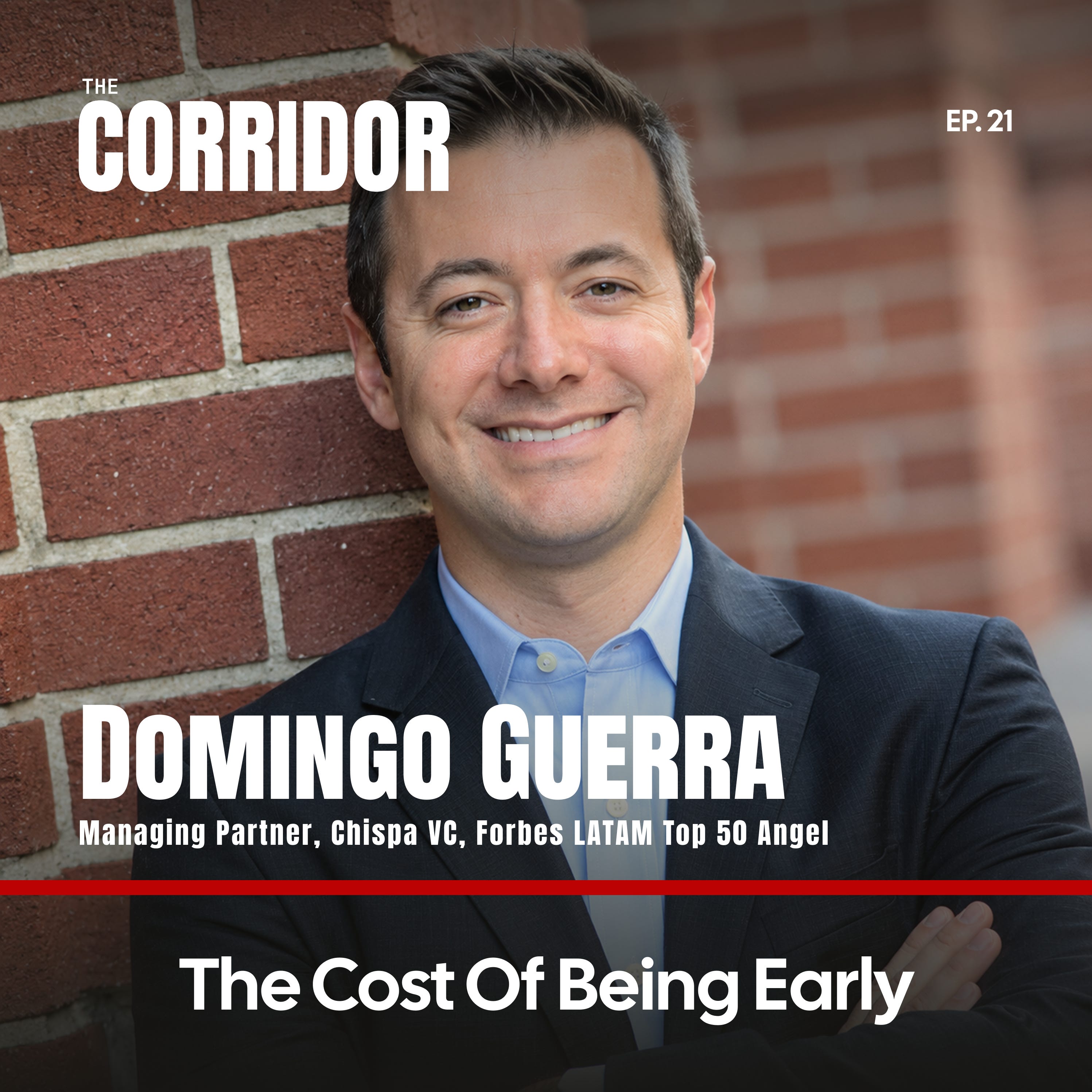
There is a lesson that only founders who have been too early ever really learn. Being right about where the world is going is not enough. You also have to be right about when it gets there. Show up with the correct answer a few years before the market is ready for it, and the market does not reward you for your foresight. It just lets you run out of money while you wait for everyone else to catch up.
Domingo Guerra has lived both sides of that clock. In this episode of The Corridor, he traced a path that started in Mexico, ran through the hard middle of building and eventually selling a company, and landed where he is now, as Managing Partner at Chispa VC, writing checks into the founders building the next generation of security. What makes the conversation worth your time is that he does not tell the story the way most investors tell it, cleaned up and inevitable. He tells it the way an operator remembers it, with the scars still visible.
The move that started everything
Domingo’s journey from Mexico to Silicon Valley is the kind of story our community knows well, even when the specifics differ. You leave what is familiar, you carry more than your fair share of doubt, and you arrive somewhere that was not built with you in mind. That experience does not disappear when you succeed. It becomes the lens you see everything else through, including, years later, the founders sitting across the table from you asking for money.
He is clear that the outsider’s path was not a disadvantage he overcame. It was part of what taught him to see opportunities other people walked right past.
What bootstrapping teaches that a term sheet cannot
Before Domingo was an investor, he was a founder who had to make payroll. We spent real time on what that actually teaches you, because it is the part that gets romanticized and then forgotten.
Bootstrapping forces a kind of discipline that funded companies often skip. Every dollar has to come from a customer who chose to pay you, which means you learn very quickly whether anyone actually wants what you are building. There is no runway to hide behind and no narrative that substitutes for revenue. Domingo talked about timing and market readiness not as abstract strategy but as something he felt in his own cash flow, the difference between a product the market was ready for and one it simply was not yet.
That is why he keeps coming back to founders and sales. In the earliest stage, the company is the founder, and the founder’s ability to sell, to a customer, to a hire, to an investor, is often the whole business. Everything else is still a promise.
The operator becomes a sharper investor
There is a reason the best early-stage investors tend to be people who have built something themselves. When you have sat in the founder’s chair, you stop grading the pitch and start reading the person. You know which problems are survivable and which ones quietly kill a company. You know the difference between a founder who is early and a founder who is wrong, because you have been both.
Domingo’s operator experience shows up in what he chooses to back. He is less interested in the company that looks finished and more interested in the one solving a problem that genuinely matters, where impact and return are not at odds but point in the same direction.
Why security is the fight that defines this era
Then we got to the work he cares most about, which is cybersecurity in the age of AI.
The uncomfortable truth is that AI does not just help the defenders. It arms the attackers at the same time, and often faster. The same tools that let a small team build remarkable things also let a bad actor generate attacks at a scale and sophistication that used to require a nation-state. The gap between offense and defense is widening, and the people working to close it are doing some of the most consequential building happening anywhere right now.
Domingo’s view is that security is no longer a feature you add at the end. In the AI era it is the foundation everything else stands on, and the founders who understand that early, there is that word again, are the ones building the companies that will matter.
Why this conversation matters
Domingo Guerra’s story is a reminder that the lessons you earn as an operator do not expire. They compound. The founder who learned the hard way what it costs to be early became an investor who can spot the founders who are early in the right way, at the right moment, on the right problem.
In a moment when everyone is chasing the same AI narrative, that kind of judgment is the rarest thing there is.
Listen to the full episode of The Corridor with Domingo Guerra.
Seguimos. 🇵🇷
Angel León, Coquí Ventures
Coquí Notes is the editorial publication of Coquí Ventures, the diaspora platform connecting Latino founders to community, capital, and the infrastructure that turns ideas into category-defining tech companies.