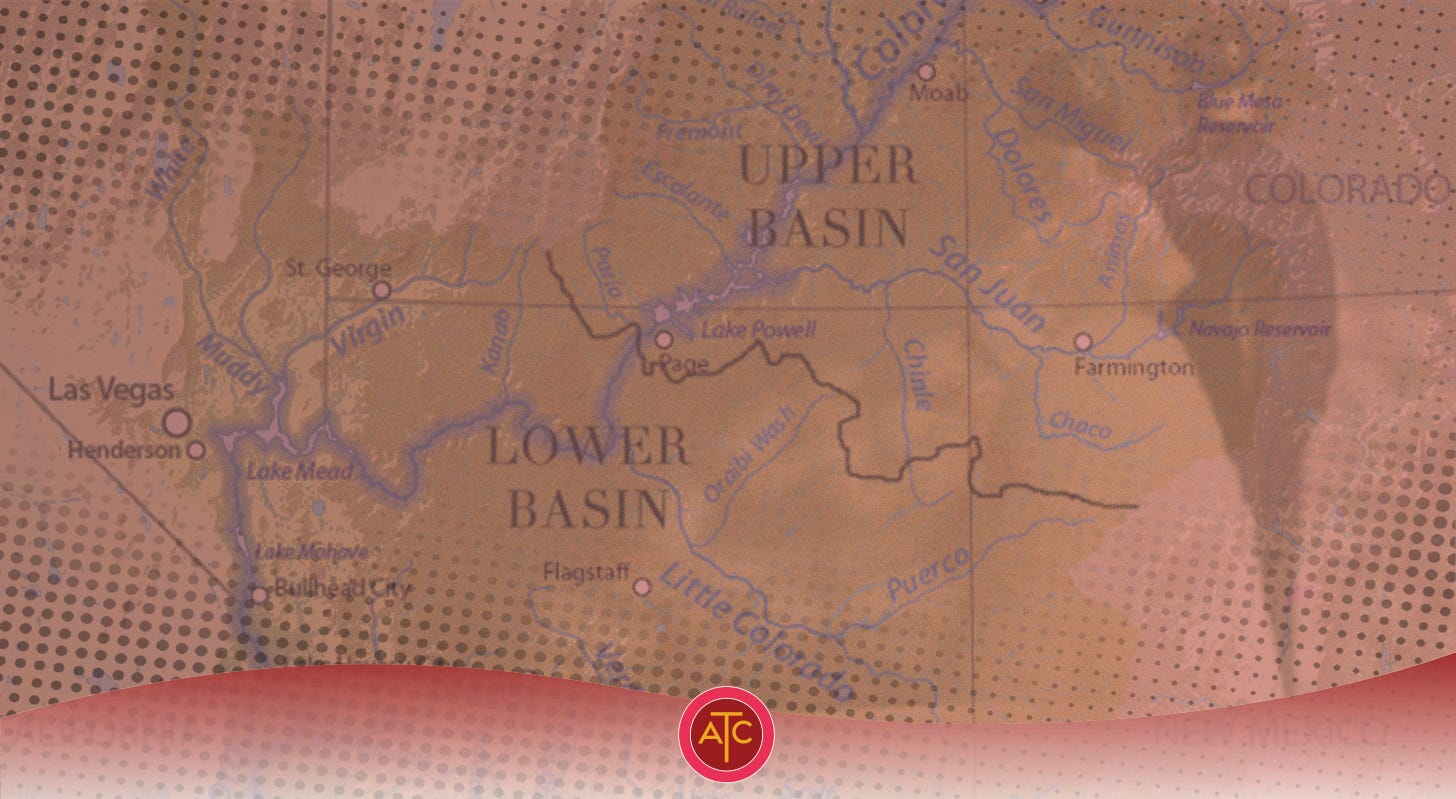
Seven states share one river, and they’ve been stuck in the same codependent, can’t-live-together-can’t-break-up situationship for a hundred years. And the divorce negotiations are about to start.
In 1922, seven western states sat down at a table and divided up water rights between themselves. The Upper Basin are the headwaters crowd which is made up of Colorado, Utah, Wyoming, and New Mexico, the ones who live where the snow falls and the river is actually born. And the Lower Basin, Arizona, Nevada, and California, are the thirsty high-maintenance neighbors with the green lawns, the fountains, Las Vegas, and golf courses in the desert. (Mexico’s way down at the end of the group chat, technically owed a cut, but always the last to hear anything.)
And like most failing marriages, the relationship was built on a lie. The 1922 Colorado River Compact was signed during the wettest stretch the river had seen in years, and the states promised each other about 16 million acre-feet a year. The river actually brings home more like 12 or 13 acre-feet. They’ve been living beyond their means since 1922 and calling it normal.
You’d think living closest to the water is the good seat but it’s actually the worst one. The deal requires the Upper Basin to let half of the river flow past to the Lower Basin every year. So the headwaters states, standing right next to the river, are legally on the hook to send it downstream first and live on the leftovers. And nobody can even agree on who’s overdrawn. The whole thing is measured at a single gauge near the Utah line, averaged over ten years, with each side keeping its own books. And, to complicate matters, the Lower Basin spent decades not counting the water that evaporates out of its own reservoirs.
For a hundred years they’ve made it work anyway, because nobody used their full share and there was always slack in the system. But now, the river’s running low, everyone finally wants exactly what they were promised, and those promises add up to more water than exists.
Which brings us to the collapse of couples therapy. The truce that’s kept everyone civil since 2007 expires this year, and the Lower Basin stopped negotiating, lawyered up, and filed its own plan without the others. The feds are standing in the doorway threatening to divide everything themselves, and hanging over all of it is the one weapon nobody’s dared touch in a century.
The Prenup Nobody Wants to Enforce
It’s called a compact call and you can think of it like the downstream spouse finally calling a terrifying lawyer to legally enforce the exact terms of the prenup. For a hundred years the Lower Basin has had the right to stand up and say you promised us half this river, you’re not delivering, a court is going to make you. Nobody has ever actually pulled it. It’s so radioactive that seven states have spent a century doing almost anything to avoid it, because once it’s invoked, it almost certainly lands at the Supreme Court, and a process nobody can predict starts deciding whose taps get shut off.
Whoever started using the water earliest has a claim that’s nearly bulletproof. Whoever showed up latest gets cut off first. And Utah is the late comer.
The untouchable rights belong to 1800s ranchers and old California farm empires. Utah did most of its Colorado River growing up much later, a lot of it after 1922 when the Compact itself became the senior claim standing in front of you.
The pipeline, the data centers, the new subdivisions, and a big share of the Wasatch Front’s tap water, are all some of the newest, most junior rights in the whole basin. And the last in line is the first to be cut.
Lake Powell was built to be the savings account that kept anyone from ever needing to make this call, but as it drains toward the bottom, the cushion goes, and the trigger gets easier to reach. Utah’s own negotiator has said the risk is high.
So why not just fix the broken document at the center of all this? Because reopening the Compact would take all seven states and an act of Congress agreeing at once, and not one state will gamble its share at that table. Easier to leave the foundation frozen and fight over the layer above it.
That layer is what’s actually on the table in 2026. It’s not the Compact itself, but the operating rules stacked on top of it which equates to a roughly 20-year deal governing how much water moves through the system. And Utah’s entire say in it comes down to one appointed person, Colorado River Commissioner Gene Shawcroft, working through the Colorado River Authority of Utah. If the states can’t agree, the Secretary of the Interior writes the terms for them.
While all of this is going on, our local politicians are beating their chests on social media about state sovereignty and neighborhood growth, but the irony is that they have quietly funneled all of our collective leverage into a single unelected bureaucrat sitting across a table from California lawyers. Surely that can’t be good for the state with the least amount of seniority at the table.
So what happens to us kids in the divorce?
More than most Utahns realize. Through the Central Utah Project, it’s piped over the mountains to the Wasatch Front, where a big chunk of Salt Lake and Utah County drinks river water they assume fell as snow on the peaks they can see.
Washington County is betting on the same blind spot. The Lake Powell Pipeline. The long-promised second source that’s supposed to keep St. George growing and assumes Utah’s “undeveloped” share of the river is just sitting there, waiting to be claimed. It’s the same logic as a kid spending an inheritance that hasn’t cleared probate yet.
We don’t actually have a seat at the table where this gets decided. We have a seat at the table where Utah’s position gets decided. The Legislature funds the litigation and writes the water law. The congressional delegation signs off on any of the pieces that touch federal law, and the Authority holds meetings that are technically public even when the actual dealmaking isn’t. Then all of that gets handed to one appointed person, who walks into a room with six other states and the federal government and tries not to lose.
We don’t get a vote in the divorce. But the custody arrangement isn’t final, and the one thing still being written is how much Utah asks for going forward, and that number gets written in one of those “quiet rooms” we’re telling you to watch.