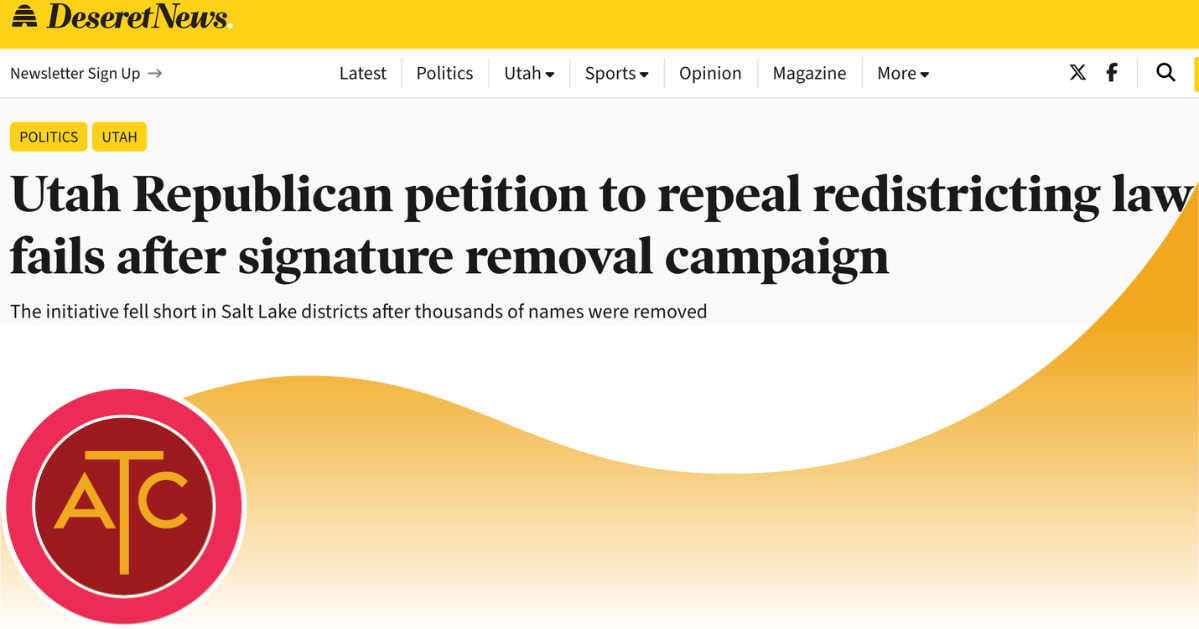
Everyone is celebrating in Utah, and for good reason. After a nearly eight year redistricting battle, the congressional maps are locked in place, the lawyers have finally put down their pens, and the last ditch effort to put redistricting back on the ballot, is unofficially dead. (We have to wait until the end of April to write the obituary).
Huzzah!
The timing couldn’t be more perfect. Right now, redistricting is one of the hottest political flashpoints in the country. Texas, California, Missouri, North Carolina, and Virginia are all in the middle of redistricting battles for partisan gain.
Changing voting map boundaries has become a political arms race ahead of the 2026 election at the behest of President Trump, and the casualty is the idea that district lines should reflect voters rather than protect politicians.
Now, there are a million great pieces out there right now about the history of how Utah got here, about the tireless work that drove this victory, and the incredible people who led this effort like the League of Women Voters, Mormon Women for Ethical Government (MWEG), and Better Boundaries. But we intentionally don’t want to add to the sea of historical reviews. In fact, we waited until the coverage died down some before writing about this topic.
Utah’s victory landing in the middle of a national redistricting frenzy is entirely coincidental and a bit unfortunate. Because what happened here was exactly the opposite of a party power grab or partisan retaliation as we’re seeing in other states.
For example, in Texas, Republicans tried to redraw district lines to ensure congressional victories, and California retaliated, by doing the same to “cancel it all out”. As if congressional seats are only used to score majority points, and you know, not actually legislate for the people of their state. It feels gross on both sides doesn’t it? It’s honestly like watching two toddlers have a meltdown in aisle 9 while the rest of us are just trying to get the groceries paid for.
But the story behind the victory is more complicated, and more interesting in our eyes. Because unlike in California or Texas, one side couldn’t do this alone. No amount of political organizing, party registration changes, or door knocking could have moved the needle because of the simple truth that a coalition that looks like the left, is a coalition that loses in Utah.
You can be right on the merits, airtight on the case law, and still get absolutely steamrolled, if the people in charge don’t feel the social pressure of their own neighbors watching them, they’ll just keep right on changing the rules for their own benefit.
And that’s what makes Utah’s redistricting case unique. This was never just political activism or a court battle over redistricting. It was a culture war over accountability.
The legislature seems to have forgotten something important about Mormon women (and women in general really…) It turns out that when you spend your whole life being told to follow the rules and honor your commitments, you develop a pretty low tolerance for watching powerful men do neither.
The state legislature expected deference, but they got accountability. And you can’t really dismiss reform as liberal agitation when the reformers themselves are Relief Society presidents and Young Women leaders, can you?
MWEG and the League of Women Voters showed that you can be faithful, conservative-leaning Utahns, and still believe in the fundamental principle that our democracy should work for everyone.
And as a result, they ended up doing more to advance the Democratic party than the Democratic party itself has been able to do in the last 20 years. And, if we’re being honest, the Republican party has done more to erode its moral standing than any name calling or social media campaigns have been able to do. If we’re going to get anywhere, we have to at least be in the same car. Right now, it feels like the legislature is in the driver’s seat with the doors locked, and the rest of us are running along the sidewalk trying to shout directions through a rolled-up window.
So where else can we find that common ground to fight for our democracy? Because in all seriousness, we have more important things to worry about. Once the rules are fair, we can finally tackle the core issues, like gas prices, that are the real conversations happening around our kitchen counters these days.
Thanks for pulling up a stool. Want to grab a glass and join the conversation? Here’s how:
* Love it: Hit that heart button to show you like this post.
* Join the Conversation: We’d love to hear your thoughts on today’s piece.
* Restack: Share this out to your personal feed to help us expand our reach.
* Share the warmth: If this resonated, feel free to forward it to a friend.