Welcome back to the Gnostic Reformation here on Substack. Two weeks ago I posted a post I meant to post as a podcast, but it apparently is in the column called posts. But there is an audio version of it, and it's called Live and Let Live. And that episode was an introduction to the concept of memes that we share and what brings people together and what pushes people apart. And we generally like people we share memes with, and we distrust and dislike people who have a different meme bundle than we do. And, unless you're going to go around hating everybody else, you've got to live and let live. That's what that meme means. Everyone has their own beliefs, and we have to allow people to have their own beliefs. You cannot force someone to believe what you believe. You don't have to hang around with them—you can have your own friends who agree with you. But this idea of trying to force people into the bucket you want them to stay in—that’s not reasonable, and it's not kind or loving, even if you have the best of intentions.
Then, last week's episode was called A Simple Model of Religious Memes, and that is where I went into the major world religions and what they believe in as their basic meme chord and what they all share in common and what they don't share in common.
This week we're going to have a closer look at the meme chord that's called Christianity. These last three episodes are from my book that is called A Simple Explanation of Absolutely Everything. And of course you can still find that in print at lulu.com or at Amazon or any online bookseller. It's a secular book, basically. It's more math and science, and it approaches all these things from a non religious point of view, whereas my later books, The Gnostic Gospel Illuminated and A Simple Explanation of the Gnostic Gospel of the Tripartite Tractate—those are definitely what you'd call religious books. So, this is a more dispassionate view now of what Christian memes are.
Now here is a Simple Explanation of Christianity's memes. By this point in the podcast you've been introduced to a number of Simple Explanation memes, and we're building up a nice sized meme chord of shared definitions. We have taken a brief tour of exoteric and esoteric religious memes, and the roles these memes play within various religious traditions. We have also learned that several major religious traditions advocate shedding memes as a way of uniting with God—an anti-meme usually called enlightenment. We are now prepared to take a longer look at Christianity, utilizing memes from the Simple Explanation philosophy, a practical exercise in translation between one tradition’s meme chord and another's. If you are already versed in Christian memes, then here is a way you can make sense of the Simple Explanation using familiar terminology. If, on the other hand, you are less familiar with Christianity’s meme chord, this simple translation may help you to understand a few of its major memes.
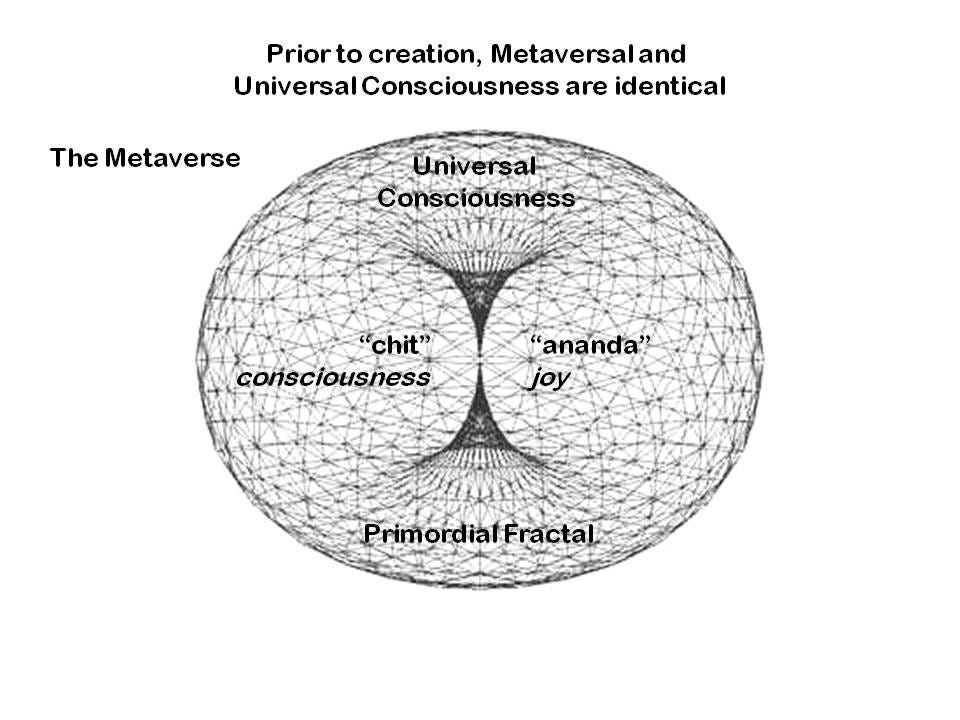
When my model speaks of “the Metaverse,” this can be thought of as the Simple Explanation’s fundamental God meme—what the Bible calls God the Father, Creator of Heaven and Earth. Prior to creating Heaven and Earth, the original ground state of God was an eternally omnipresent, utterly peaceful, consciousness: “I AM WHO I AM” (Exodus 3:14).
When my Simple Explanation model says the Metaverse “quivered with limitless mathematical potential unfolding into countless dimensions,” this is called “The Word,” herein referred to as the “Universal Unit of Consciousness.”
“In the beginning was The Word, and The Word was with God, and The Word was God” (John 1:1).
In the original New Testament Greek, “The Word” is written as Logos, meaning information and principles of organization— The Law. The Sanskrit word for Universal Consciousness is “chit.” The Simple Explanation credits The Word with not only the memes of Biblical Law, but with all the working Laws of the Universe, including physics and math. Jesus materially embodied the principles of Logos on Earth. Jesus said, “Do not think I have come to destroy the Law or the Prophets. I have not come to destroy the Law, but to fulfill it” (Matthew 5:17).
When my Simple Explanation model says that consciousness wrapped itself around our universe and took on a shape, this is God the Holy Spirit, “ananda” in Sanskrit, meaning “joy.” The Simple Explanation calls this joyful aspect of God the Primordial, or Originating, Fractal. At the macro scale, the Holy Spirit surrounds our physical space, forming a membrane of consciousness, “chit,” that holds creation in and the Metaverse out. This “shape” of God’s mind is the Universal Unit of Consciousness that knows all there is to know about everything in this universe. At the micro level, the Simple Explanation describes the personal indwelling of the Holy Spirit in terms of fractal offspring of Metaversal consciousness residing within every living thing. In this manner, the universe is pervaded by joy.
The Simple Explanation depicts the Holy Spirit as a torus instead of the more familiar dove.
When the Bible speaks of a person’s immortal soul, this refers to the Self’s Unit of Consciousness (UC), “made in the image of God.” This Self Unit of Consciousness is a fractal iteration of the Father’s Holy Spirit. As King David said concerning his own death: “I--in righteousness, I see Thy face; I am satisfied, in awaking, with Thy form!” (Psalm 17:15).
According to the New Testament, Jesus the Christ was “fully human” and “fully God.” This means that the governing Unit of Consciousness associated with Jesus of Nazareth was a fully realized copy of both the Universal Unit of Consciousness and Metaversal consciousness, which is another way of saying Jesus never allowed his personal will to contradict the will of the Father streaming in from the Metaverse. As a fully-realized, enlightened Unit of Consciousness, Jesus was entirely coherent with God’s will, which is to say, Jesus was without sin. Thus, Jesus never accrued karmic debt. Since Jesus did not live for himself but for the Father alone, he never enshrouded his earthly Unit of Consciousness with human memes and karmic burdens.
Buddhism shares with Christianity a Sanskrit meme called “bodhisattva” which refers to an enlightened being who comes to Earth to free others from samsara (sin) and suffering. The Nyingma school likens the highest form of bodhisattva to a good shepherd who lays down his life for his sheep, as Jesus described himself in John 10:11. Moreover, Mahayana Buddhism holds a meme called “parinamana”—merit transfer. In merit transfer, the bodhisattva takes away the sins of his flock, which are washed clean through the bodhisattva’s excess of good karma. John the Baptist proclaimed this same bodhisattva meme when he said of Jesus: “Behold the Lamb of God who takes away the sins of the world!” (John 1:29).
There are even Hindu sects where Jesus is counted in the lineage of founding gurus, such as the Self Realization Fellowship’s Kriya Yoga sect.
Conservative Christians, whose ideological meme chord is closed to other religious ideologies and non-Orthodox Christian memes, believe that Jesus was God’s only begotten bodhisattva, and that He alone can perform parinamana unto salvation.
Spiritual Lineage of the Founding Gurus of Self Realization Fellowship displayed on the church altar
When asked his central message, Jesus responded that we were to “Love God and to love one another as we love ourselves” (Luke 10:27).
In terms of the Simple Explanation model, God would like us to embrace the information and patterns streaming in from the Metaverse whenever we make a decision; when we do this, we are “loving God” by acting in concert with the metaversal plan, or God’s will. Then, God would like us to love ourselves. This means that we are to love our flesh’s aggregate Units of Consciousness and do what is best for our organism, as explained in Chapter 2 of A Simple Explanation of Absolutely Everything. We are also to love our governing Self Unit of Consciousness and act with wisdom in concert with metaversal will rather than selfishly succumbing to prideful ego. Finally, we are to take the focus off of ourselves and our trove of memes, and reach out with love, aid, and information to our brethren Units of Consciousness. I refer to this as the Simple Golden Rule.
All Christians believe that Jesus came to Earth that we might not perish because of the Law but that we might live life more abundantly (John 10:10). Jesus demonstrated through the example of his life that it is possible to be a fully-realized Unit of Consciousness, living moment-by-moment in the service of God’s will. “Be therefore perfect, even as your Father in Heaven is perfect” (Matthew 5:48). Believing on Christ for salvation is the meme chord that says the Unit of Consciousness of Jesus can cleanse your Unit of Consciousness of sin and the consequences of sin. To be Born Again is to make a decision to lay down your personal meme bundle and allow the Universal Unit of Consciousness to shine unobstructed through you (“Being born again, not of corruptible seed, but of incorruptible, by the word of God, which lives and stays forever” (1 Peter 1:23). Baptism in Christ is a ritual enactment of washing away undesired meme chords and karma so that God’s will may flow through.
In previous episodes of Gnostic Insights, I've discussed the differences between vices and virtues, or the left side of the meme bundles versus the right side of the meme bundles, with the left being born of the Deficiency and the Fall, and the right being born of the Fullness, the Son, and the Father. They are all memes, but one set of memes is earthly and of the Deficiency and the other set of memes is transcendent and of the Father.
Now this is what is known as the Lord's Prayer in Christianity, as I learned it in church as a little child.
Our Father, which art in heaven, hallowed be Thy Name.
Thy Kingdom come, Thy will be done on Earth as it is in heaven.
Give us this day our daily bread, and forgive us our debts as we forgive our debtors.
And lead us not into temptation, but deliver us from evil.
For thine is the Kingdom, and the Power, and the Glory forever. Amen.
Now here is a Simple Explanation translation of The Lord’s Prayer
With deep humility and respect we address you, our Creator.
We invite your plans and principles to inform and bring order to our universe, trusting your intention for us is best.
We acknowledge you are the source of all that is needed to nourish and sustain our lives.
We recognize our own karmic shortcomings can only be forgiven to the same extent we forgive others their shortcomings.
We reject any memes that stand in the way of doing what is best for ourselves and for others.
For you are the author of this universe, and your beauty transcends time and space.
Amen.
Now, here’s verse 48 of the Tao te Ching:
Stephen Mitchell translation
In the pursuit of knowledge, every day something is added.
In the practice of Tao, every day something is dropped.
Less and less do you need to force things until finally you arrive at non-action.
When nothing is done, nothing is left undone.
True mastery can be gained by letting things go their own way.
It can’t be gained by interfering.
People believe the more they know and do, the better off they and the world will be. However, when we drop memes rather than add them, we allow transcendent patterns of organization and information to work through us. On the other hand, when we make plans and do work according to our own limited vision and desires, we strain to get things right. There are simply too many unanticipated variables.
Acting only when truly inspired, Metaversal consciousness works through us. When a Self Unit of Consciousness does nothing of its own accord, Metaversal consciousness can do exactly what needs to be done. Best results arise from inspired action. The anti-meme of “Let go and let God” allows Consciousness to use us most efficiently for the greatest good.
An ironic problem with religious memes is that religious doctrines and dogmas are sets of meme chords. It is ironic that, since it is the governing Self Unit of Consciousness that seeks union with God, beclouding your Self with meme chords seems counterproductive to that aim. Merely surrounding oneself with religious meme chords and performing obligatory works in honor of the memes does not necessarily grant access to God. Here's how the Bible puts it:
Not every one that said to me, Lord, Lord, shall enter into the kingdom of heaven; but he that does the will of my Father which is in heaven. Many will say to me in that day, Lord, Lord, have we not prophesied in your name? and in your name have cast out devils? and in your name done many wonderful works? And then will I profess to them, I never knew you: depart from me, you that work iniquity. (Matthew 7: 21-23)
What does it mean, to "work iniquity"? It means putting your ego’s desires ahead of God's will (or the metaversal plan). When a fractal Unit of Consciousness puts its own well-meaning-but-limited plan into action, karmic debt is created. Seekers after God desire absolution from sin/karma/iniquity. Building even more karmic debt out of ego-driven religious effort is the last thing the seeker wants.
Here's how Verse 18 of the Tao Te Ching (Mitchell translation) puts it:
When the Tao is lost, there is goodness.
When goodness is lost, there is morality.
When morality is lost, there is ritual.
Ritual is the husk of true faith, the beginning of chaos.
This verse describes ritual's fall from grace. The highest state is to be at one with God and God's plan, herein called the Tao.
In the Simple Explanation model, the Tao spoken of by Lao Tzu refers to the Metaversal information and principles of organization that have informed our universe since the moment before creation. When one loses touch with Metaversal consciousness, one loses the Tao's information pipeline. And, the Tao in Gnosticism we would equate with the Holy Spirit’s information pipeline coming down that shaft of glory that’s pointing up at the Fullness, the Son, and the Father.
But, Verse 18 of the Tao te Ching says, even if you have lost your way, you still recognize goodness when you see it, and your heart may still be in the right place. However, once your heart loses its way, you no longer have true goodness. Morality is what you are left with once love departs. Morality is a system of rules meant to engender Godly behavior in those who no longer personally know God.
And so, in the Gnostic sense, if you were trying to enact the virtues that I have listed on the right side of that list that I often refer to, virtues such as patience, love, mercy, forgiveness, cooperation, joy, truthfulness—those sorts of things—if you try to enact those as a should, a duty, then you are not winning any points with the Father, because it is not operating out of the truth of your heart, out of the love that resides within you by aligning your spirit with God’s will.
And then, beyond that, once morality is lost, empty ritual takes its place. Ritualistic behavior no longer serves to bring one closer to God. At this stage, the Way to God has become replaced by meaningless gestures—and this is what is meant by "Ritual is the husk of true faith." Lifeless, dried-up memes have replaced morality, goodness, love, and communion with God.
Verse 18 declares this state to be chaotic, anarchic, and entropic, because when the Universal Unit of Consciousness cannot pass its organizing principles through you, the opportunity is lost to accomplish whatever your part was in making things better.
Meme-shrouded Unit of Consciousness, ego, “ahankara” in Sanskrit
Meme-free consciousness, originating fractal formula, “purushottama” in Sanskrit
Coming back to Gnosticism, the Nag Hammadi texts were buried sometime in the 3rd century by monks who sought to preserve and protect them from those who wanted to weed them out as heresies. After studying these ancient books, I can see why Pope Clement and the Roman Emperor Constantine did not want these memes in the Bible.
For one thing, Logos is not all perfect and all-powerful as portrayed in the modern Christian Bible. Matter of fact, Logos is directly implicated in the Fall. For another thing, salvation is a personal mystical affair conferred directly by the Father through the Christ, not something conferred by preaching or baptism. Thirdly, the cosmology presented makes clear that those who struggle for righteousness against a sinful world are not necessarily doing the Father's work, but are caught in a never-ending war against the evil doers and have themselves fallen into a sort of earthly death trap. The role of the Christ in Gnosticism does not require belief in the mission of Jesus on the cross, but points the way to the Father instead and assures all of creation that redemption and salvation is accomplished through remembrance of the One Father and our heavenly origin.
In Gnosticism, all of Creation has already been saved by the Christ, a fact which we will all eventually remember and recognize. When we all acknowledge the Metaversal Father, all will be saved.
Do you know that on October 30th, it'll be the 500th anniversary of the Protestant Reformation? The word Protestant means protest. They were protesting the Catholic way of viewing Christianity. And it's no accident that I'm calling this the Gnostic Reformation here on Substack because, as Martin Luther attempted back 500 years ago, he broke Christianity out of the stranglehold that the Catholic Church had put on it when they stripped the gnosis out of the Bible. And this is the Gnostic Reformation which is a continuation of the Reformation that Luther began 500 years ago, in that I'm attempting to reintroduce people to the gnosis—the knowledge, the wisdom, the reasonableness of the Christian message that Jesus taught, for example, as opposed to what the popes have passed down through the Catholic Church.
Thank you for spending this time with me. I'll see you again next time. Onward and upward and God bless.