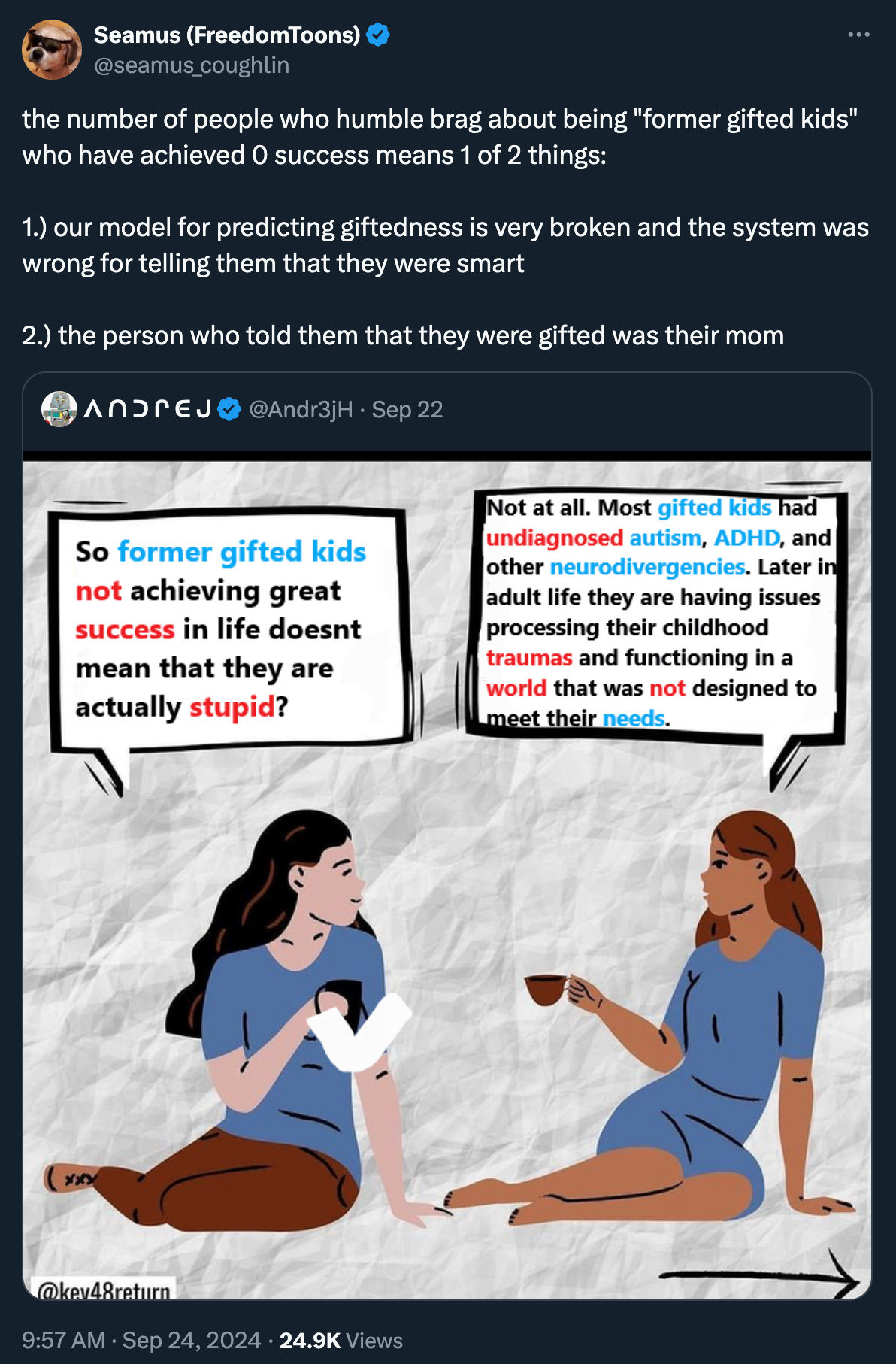
I saw this post on X implying that giftedness should correlate with material success in life, and had to respond. Myths like this are neither rare, nor benign, so they deserve to be challenged.
As tempting as it is sometimes to knee-jerk reject posts like the one Seamus reacted to because they use woke sounding words like “neurodivergencies,” don’t. There is usually a kernel of truth to woke claims, and when you react by rejecting them out of hand, you inevitably substantiate one of their truly false premises.Take the original image, for example. It’s factually correct about most gifted kids — they do tend to be what is called “twice exceptional” in that they have underlying neurological issues, or a learning disability like dyslexia to go with their high IQ (Winston Churchill is an example). Think how frustrating it would be to have a better vocabulary and grasp of subject matter complexity, while being unable to easily decode the written word. That’s just one of many examples, and yes, if the child’s needs go unmet for long enough, it can be traumatic.The sunk premise you could legitimately react to is the last bit about the “world that was not designed to meet their needs.” That’s the world for everyone, not just gifted kids. NO world is “designed” to meet anyone’s needs for the simple reason that humans don’t design the world, only respond to it, and even the institutions and spaces we do design in response to the world can’t, and don’t, meet everyone’s needs, ever. It has nothing to do with whether the people are gifted or not. It should say the kids may be traumatized by years of frustration and neglect in schools that were not designed to meet their needs, or that went out of their way to deny their needs, or misrepresent their needs to their parents. Any one of those could produce an adult with residual “trauma” from childhood, but most gifted children experience more than one of the situations on that list.What frustrates me about the X-post’s knee-jerk reaction though is it doubles-down on the false premise that the “world” should be designed around individual special needs (and if it’s not, individuals will be traumatized), and promotes a myth about giftedness that is at least as traumatizing as coping with schools designed around average and below-average cognitive abilities: that gifted kids should be more materially successful than those without intellectual gifts, and if they’re not, they were never gifted to begin with.Think of all the things that go into being “successful” in life, whether materially, or personally! From talent, to personality, to being in the right place at the right time, there are so many contributing factors that have nothing to do with cognitive ability, most of which are beyond even the gifted child’s control. Personality traits alone can make a huge difference, as can support from the adults around you growing up, so it defies logic and reason to assume the cognitively gifted would automatically be successful, never mind more successful than their non-gifted peers.
What’s more, this assumption — that gifted kids will be “fine” or successful without extra help or support — is likely the thing that prevents gifted kids from getting their needs met in a school setting, which in turn contributes to unresolved trauma that may contribute to their lack of success in adulthood.Look, I kind of “get” why people like Seamus react as they do. We’re all sick to death of hearing the word “trauma,” and we’re especially sick of trauma being used as an excuse for all kind of human failings and poor behavior, but we have to be very careful not to react to every use of the word without thinking. Trauma is a real thing, and gifted kids suffer plenty of it.
If we genuinely want to improve education, and help kids grow up happy, healthy, well-adjusted, and yes, even successful, we need to stop thoughtlessly responding to flawed or false narratives about children. If you want to learn more about how the “world” within the public school setting is not designed to meet the gifted child’s needs, please watch this video with my friend Lisa Johnson of BrightLinks, an organization that is designed to meet their needs.