We were warned.
Almost seventy years ago, reading expert Rudolph Flesch’s bestselling book, Why Johnny Can’t Read, and What You Can Do About It warned Americans of the dangers of using the ‘look-say’ method to teach reading rather than phonics. Flesch argued that because look-say teaches students to memorize whole words by sight, rather than phonics, it was ineffective. He also said the simple stories typical of the look-say readers (e.g., Dick & Jane) did not help students develop a broad enough vocabulary to prepare them for reading increasingly complex material as they progressed through school. Rather than heed his warning, we doubled down on whole word reading instruction, and by the year 2000, most American schools, led by the New York City Schools, and Columbia Teacher’s College, had implemented Lucy Calkins’ Balanced Literacy Units of Study For Teaching Reading curriculum. Calkins’ program took the look-say method, and expanded on it, teaching children to guess words they didn’t know using “context clues” like pictures, rather than phonics.
Balanced literacy limited the vocabulary students could learn just as much as look-say, but added an element of frustration for the children. Since they were expected to fill in their own gaps using “context clues,” students would interpret their lack of progress as evidence they were “no good at reading.” If they didn’t improve at school, teachers would advise parents to encourage students to read more outside of school, and if that failed, teachers would simply blame parents.There were always those exceptions, those students who learned to read at home, before entering school, or whose parents filled in gaps with things like Hooked on Phonics, or tutoring, and plenty of private schools still taught reading using phonics for a while, but eventually, even private schools adopted the Calkins method, and for decades, America’s children learned to read in a way that took what ought to have resulted in hours of cognitive growth, and enjoyment, into self-esteem-crushing drudgery that few students voluntarily pursued outside of school.The groundswell of anger and frustration that had been building amongst parents and teachers over the years finally caught up with Calkins in the form of a podcast. Sold a Story, produced by award-winning journalist Emily Hanford in 2022, had more people sharing it than any other show in 2023, and finally, in October of the same year, Columbia Teacher’s College finally parted ways with the Calkins curriculum.
Did we take too long to listen?
Just this week, The Atlantic published a piece entitled The Elite College Students Who Can’t Read Books, by Rose Horowitch, in which she tells readers something I’ve known for a long time: starting in middle school America’s teachers have stopped asking students to read books. Yes, you read that correctly. Students in the vast majority of middle and high schools are never assigned a book. That is not to say they don’t read at all, or that they aren’t told to select a book to read on their own; they’re just never required to read a book with the class, or asked to read it closely enough to learn new vocabulary, or analyze the text along with a teacher who knows it well, and can help the student think about the themes, characters, or problems more deeply than they possibly could with their limited life experience and cultural knowledge. Most students today read passages, and most of those are non-fiction as well. As a result, even elite college students today lack the stamina to read the sheer amount of material they would (should) be expected to read at the college level. Compounding the problem is the fact that their lack of reading has resulted in a limited vocabulary, and lack of writing skill. These are students who have not been exposed to great writing at all in some cases, never mind often enough, and with enough study or understanding (never mind grammar instruction) to write coherently, never mind well.
This isn’t just a description of what most students are capable of doing, it’s also indicative of what they are inclined to do. Factor in competition for their attention from technology, and their anxieties about everything from their job prospects (made more limited by their lack of reading and writing skill) to climate change, and we have a huge challenge on our hands in this country.Most professors have simply decided not to assign challenging books at all because they know the students won’t read them. After all, at many elite schools, thanks to grade inflation, the students know they don’t have to complete their assignments at all, and they won’t “flunk out.” If their schools are anything like Harvard, as many as 79% of them could still have an A average.So did we wait too long? I suppose time will tell, but the simple fact is, this is where we are: even elite college students don’t read, and their employers, and possibly the rest of us, to the extent we need them to do things that require reading (teaching included), will have to deal with whatever that means.
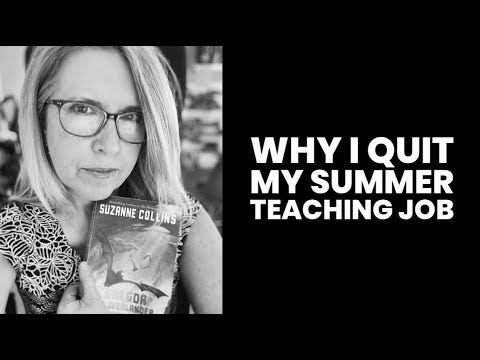
To hear me tell a story about my own experience trying to teach a group of middle-school students who refused to read, watch this:
To listen to a conversation about the important life lessons our children miss when they don’t read books, watch this:
The Reason We Learn is a reader-supported publication. To receive new posts and support my work, consider becoming a free or paid subscriber.