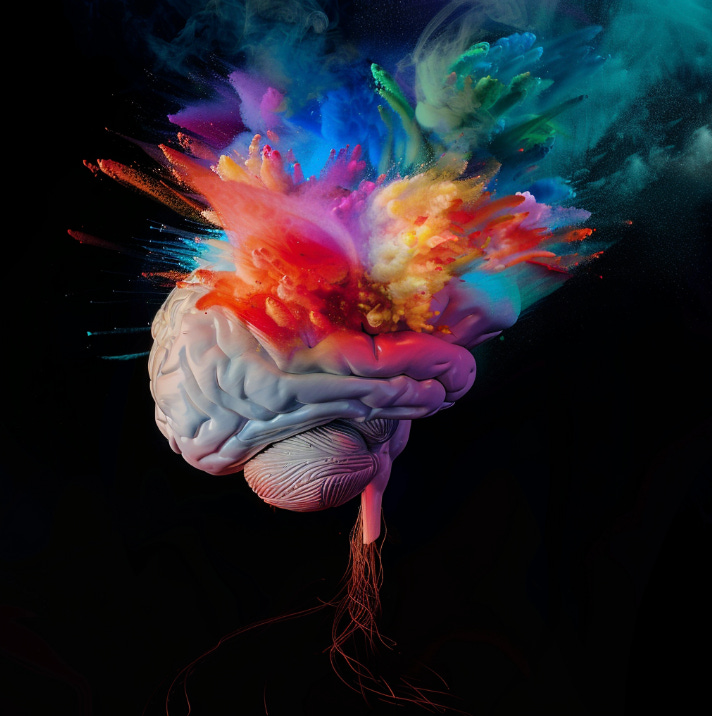
Hello and welcome to another episode of Quantum Waves of Wellness. This is Dr. Paula Apro, and today I'm going to share with you the importance of regularly hitting the delete button of your brain.
So tell me, when was the last time you walked into a room and completely forgotten why you went in there? Or stood in front of the fridge wondering what exactly you were looking for? I'm betting the older you get, the more it happens. It's scary, isn't it?
If you’re over 50, chances are these moments come with terrifying questions like, "Is this memory loss? Is my brain starting to decline? Is this the beginning of dementia?"
But what if I told you something surprising...those little lapses might actually be your brain doing its job! In fact, these episodes may be exactly what you need to retain your brain health.
Because your brain wasn’t designed to just store things—it was also designed to LET GO of things.
But most of us have a hard time with this letting go, even if it's just old junk that we are letting go of. Wait, did I just call the thoughts in your brain "old junk?" Yes, I did. Because in most cases, that is exactly what it is, useless junk.
Your brain is filled to the brim with emotional baggage and limiting beliefs that are dragging you down in so many ways. And when most of us think of brain health, we imagine it as a race to add new knowledge and remember more things.
But neuroscience has revealed a deeper truth: Your brain stays healthy not by holding on to everything, but by knowing what to delete.
This built-in delete button is part of a process called synaptic pruning, and if you learn to use it, you can stay sharper, more creative, and more mentally agile at any age. So the next time you forget what you were looking for in the fridge—or can’t find your words mid-sentence—don’t panic. Maybe your brain is just emptying the trash to make room for something new.
Because remember, real brain health isn’t about remembering everything. It’s about knowing what to let go of!
Let's imagine your brain as if it were your home. Each thought, each habit, and each skill you practice is like a new object that you bring into and store inside of your home. And the older your home, the more clutter you accumulate. In your brain, all of these objects would be connected to each other through synapses.
Now imagine your brain like a cluttered garage, attic, or basement—so many tangled synapses, that it's hard, and sometimes impossible to find anything when you need it. To keep the system healthy, your brain uses tiny helper cells called microglial cells to prune the unused synaptic connections. This process clears space for the ones you actually use.
These little cells are like your brain’s Marie Kondo—tidying up the thoughts that no longer spark joy. When you regularly take out the trash that you no longer need, you make room for new things to come in. This is called balance, something we all struggle with.
We struggle because this cleaning process doesn’t happen when you’re multitasking or stressed out. And just ask yourself, how many waking hours per day are you NOT multi-tasking or stressing out? Scary right?
This cleaning-out process primarily happens when you sleep. During deep sleep, your brain cells actually shrink to make room for the cleanup crew. This is why after a good night's sleep, you awake feeling refreshed and ready to take on the day.
In addition to the problems of multi-tasking and stress, another reason you may not empty your trash as often as you should is because you have trouble deciding what to keep and what to throw away. It's a common problem when you're cleaning out your attic. It's also a common problem in life.
We fall into habitual patterns, most of which are usually self-defeating. But it's not our fault. By the time we reach the age of 7, we have been programmed by our parents and other adult figures in our lives.
Like it or not, we are now the byproducts of our parents’ limiting belief system. We were molded into something we might not have chosen for ourselves, which can leave us feeling stuck and unable to step into the life we truly want to live.
Do you know why we get so stuck? We make this problem even worse when we repeatedly do the same things day after day. Yes, it's called the daily grind.
* We drive the same exact roads to work every day and spend all of our time with the same people.
* We think the same thoughts day in and day out, complaining about the same politics or family issues.
* Our daily schedule and routine are like carbon copies of one another...and we wonder why we feel stuck.
The more we repeat those routines, the harder it becomes for our brains to grow and adapt. If you want to change your life, you need to change your thoughts and your actions. But we all know that's not so easy to do. In order to change your brain, you have to interrupt the habitual patterns.
At the very least, we should make an effort to change up our daily routines, even in small ways. Take a different route to work occasionally. Do a different exercise routine. Learn or practice a new skill.
For years, science told us the adult brain was fixed. We used to believe that once you became an adult, the brain stopped growing—and that after 50, it was all downhill from there. Well, that is simply not true.
Thanks to the science of neuroplasticity, we now know the brain can rewire, adapt, and grow throughout our lives. Neuroplasticity allows us to break out of the rut and create new neural pathways. This happens when we try those new things and have those new experiences.
But look, I get it. Sometimes when you’re stuck in the daily grind, even trying something new feels overwhelming and exhausting. So what do you do? Well, here's an idea. Let's talk about my favorite subject—consciousness.
Most of us live in the ordered, logical, structured mind that helps us survive. But there’s another state called Primary Consciousness, which is a more expansive mode where creativity flourishes and where new learning happens. This is my favorite place to be! Nothing thrills me more than creativity.
You enter this state often when you dream. Some lucky people reach it through meditation, and others through psychedelics. But there’s a sneaky other way—a kind of shortcut—and it involves a powerful combination of light and sound. That's right, this is my world of frequency and energy.
New research shows that carefully crafted light and sound stimulation can gently nudge the brain out of its default patterns—specifically by quieting the part of the brain responsible for your ego. When this system is dialed down, your brain opens up. You become more present, more imaginative, and more open to new ideas.
Now, wouldn't it be great if there was a cool gadget that helped us delete unnecessary clutter, break out of habitual routines, and provide new experiences? It sure would be... and thanks to a piece of incredible new technology called a Neurovizr, you can achieve all of these things in just 11 effortless and enjoyable minutes per day.
The Neurovizr is a personal wellness device that uses neuro-stimulation and brainwave entrainment to stimulate brain activity to promote long-term cognitive growth. And it does all of this through an enjoyable multi-sensory light and sound experience.
It’s not a pill. You don't need a prescription. It’s a light and sound experience that helps you access your brain’s full potential—in just 11 minutes a day.
I'm telling you, I own more healing and self-care devices than I care to admit. I have invested obscene amounts of money on health and wellness tools, but right now, nothing is thrilling me more than my Neurovizr. What sets this tool apart from all the others is that I truly ENJOY using it. I look forward to it because it instantly makes me feel good.
Not only do I enjoy the experience and feel good using it, but I truly believe that our brains are our master control system. You can work tirelessly, eating the right diet, doing the right physical exercises, even balancing your invisible energy, but if your master control system goes haywire, you're in big trouble.
If I can help my brain by carving out 11 minutes each day to truly enjoy a magical, mystical trip, I'm all in!
So I just want to close by reminding you that...
Your brain never stops evolving.
And the best part? You get to decide if your brain declines with age… or evolves. My favorite quote from the inventor of the Neurovizr is this...
"Whatever state your mind is in today, it can be better tomorrow."
And I like to say,
"If you can change your mind, you can change your life!"
Thanks so much for listening to this episode of Quantum Waves of Wellness. If you enjoyed it, please consider sharing it with a friend or family member. Who couldn't use better mental health and a brain boost?
And as always, a quick reminder to hit one of those subscribe buttons if you would like to be informed of new episodes. You never know what you might hear that opens your mind to new possibilities.
Quantum Waves of Wellness is a reader-supported publication. To receive new posts and support my work, consider becoming a free or paid subscriber.