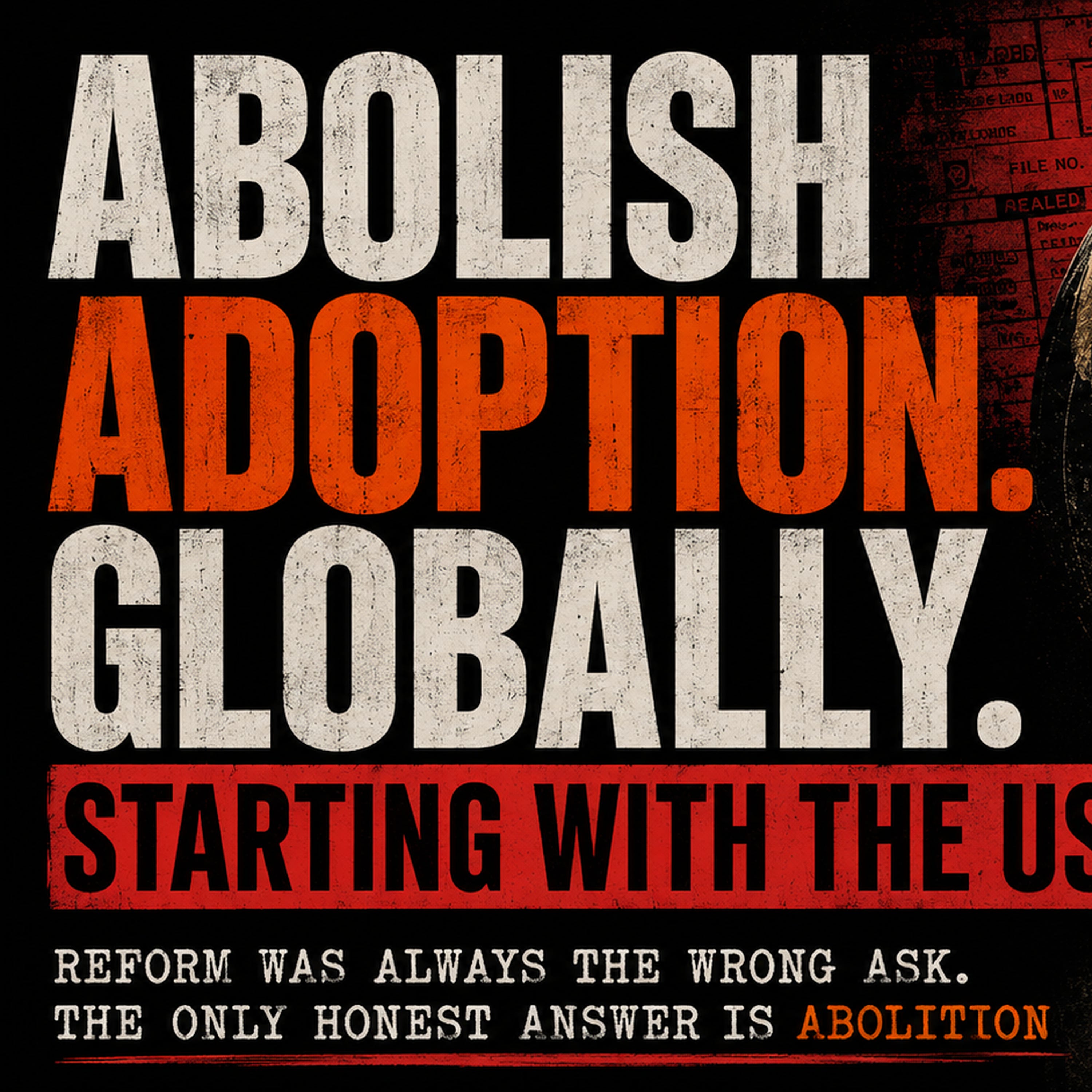
Inside the $29 Billion Industry You Weren’t Supposed to Question
In the public imagination, adoption is a heartwarming tale of rescue and restoration. According to recent News Media Narrative Weight Analysis, the “rescue” framing dominates 34% of mainstream media coverage. But look closer at the data: “adoptee rights advocates” represent a mere 3% of that same corpus. This ten-fold disparity in representation is the smoking gun of the “Architecture of Silence.”
Beneath the veneer of altruism lies a clinical, documented procurement network worth an estimated $29.4 billion as of 2025. This industry is built on a foundation of “Information Asymmetry”—a structural gap where institutions hold all the records, while the people at the center are systematically denied access to their own histories. This is not a failure of the system; it is its design. To understand how we arrived here, we must follow the financial and legislative paper trail that transformed a social service into a state-sanctioned extraction model.
The 40-to-1 Marketplace: Market Arbitrage and Procurement Incentives
The modern adoption industry operates on a staggering supply-demand imbalance. In the United States, prospective adoptive parents now outnumber available infants by more than 40 to 1. This is no longer a search for families for children; it is a search for children for families.
As Gabrielle Glaser reported for FRONTLINE:
“Typically, adoption would be finding families for children who need them. But what private, domestic infant adoption has really become is finding children for families who want them.”
With a total U.S. sector valuation of 29.4 billion, children have been commodified into assets. This creates a “Financial Procurement Incentive” that echoes across the global market. In international jurisdictions like China and India, documented payments ranging from **3,000 to $20,000 per child** have been paid to finders, procurers, or orphanage directors. These are not “fees”—they are procurement bonuses designed to secure “supply” for a high-demand Western market.
The $20 Million Secret: The Architects of Institutional Capture
The most effective way to maintain a procurement network is to ensure its subjects can never investigate it. This silence was meticulously constructed. In 1980, the National Council For Adoption (NCFA) was founded by William Pierce with a specific, documented mission: to defeat the Carter administration’s Model State Adoption Act, which sought to open records for adoptees.
For decades, the industry has used taxpayer dollars to fund this suppression. Between 2001 and 2005, the NCFA received approximately 20.8 million in federal grants** from the U.S. Department of Health and Human Services. During that same window, the organization spent **1.72 million to lobby specifically for the maintenance of sealed records. As documented in The Architecture of Omission:
“This created a documented loop where taxpayers funded the suppression of adoptee rights.”
The state, through the NCFA, paid for the very lock that keeps millions of citizens from their own birth certificates.
Identity Erasure: When “Origin Stories” are Works of Fiction
What happens when the state-sanctioned document you rely on for your identity is a work of fiction? In major sending nations, the international adoption framework has faced a total collapse due to systemic, decades-long fraud.
In 2024, the Netherlands issued a permanent ban on international adoptions after concluding that the government had failed to combat decades of abuse where children were stolen, bought, or had their identities forged. Similarly, investigations into Korea Social Service found that agencies routinely admitted to providing “entirely invented” origin stories on adoption paperwork. This is “Identity Erasure.” When a state decrees that biological truth is irrelevant, it is not a bureaucratic change—it is the forensic destruction of a citizen’s history to facilitate a commercial transaction.
Adoption Tourism and the Cash-App Transaction: The Utah Epicenter
While international markets collapse, domestic hubs like Utah have emerged as the epicenter of “Adoption Tourism.” Using “forum shopping” to find lax regulations, agencies lure pregnant women from out-of-state into a system of clinical coercion.
The pressure is structural. Pregnant women are housed in agency-run apartments where, if they choose to parent their child rather than relinquish them, they are evicted immediately. Transactions are facilitated via cash envelopes or Cash-App payments of up to $5,000, framed as “reasonable expenses.” One adoptive mother, reflecting on the ease of the process in a FRONTLINE investigation, noted the dark side of this efficiency:
“Of course it was easy. Easy doesn’t mean good.”
The industry benefits from the lack of a paper trail, ensuring the “Silence” remains intact from the moment of birth.
Algorithmic Erasure: AI and the Pathologization of Resistance
The Architecture of Silence is now being reinforced by technology. A “Forensic Audit of AI Algorithmic Bias” reveals that AI models—trained on news media and clinical literature—default to framing adoptee trauma as an individual pathology rather than a response to systemic harm. In the academic corpus, 60% of literature weights adoptee experiences toward “attachment disorders.”
This “Neutrality Fallacy” allows AI to pathologize resistance, effectively generating the visibility gap measured by governance platforms.
By labeling identity reclamation as “unconventional,” the system ensures that those speaking out are seen as “emotionally vulnerable” rather than “strategically advocating.”
The “Risk Delta”: Measuring the Structural Blindness
To quantify this, analysts use the OMISSION Platform, a tool that measures the gap between what governance frameworks cover and what decision-makers actually see. The global “Risk Delta” currently sits at -33.1.
In this system, a high governance score (80–100) is actually bad for the population. It indicates the system is successfully concealing its harm exposure. As the platform’s developers state:
“A 100/100 score is not a pass. It is proof that the framework sees nothing it was not designed to see.”
If the framework is designed to see a “service,” it will never see the “extraction” taking place right in front of it.
YOUTUBE
Conclusion: The Strategic Pivot to Rights
The tide is finally shifting from “Health-framing”—where adoptees are treated as patients seeking medical history—to “Rights-framing,” where they are treated as citizens demanding equal protection.
In California, Senate Bill 381 represents a landmark Strategic Judiciary Pivot. By moving from the Health Committee to the Judiciary Committee, advocates have reframed the issue from “medical necessity” to “equal rights.” Adoptees are the only class of citizens in California who must currently petition a court to access their own birth record. This move treats identity as a legal right, not a clinical curiosity.
If the state can erase an identity by decree to satisfy a $29 billion industry, what does that say about the security of yours? Is adoption a benevolent service, or has it become a state-sanctioned form of human extraction? Until the records are open and the silence is broken, the truth remains sealed by the highest bidder.
Thanks for reading! Subscribe for free to receive new posts and support my work.
The Omission Platform 2.2.1
https://github.com/sbouel72/omission-platform
REPORTS