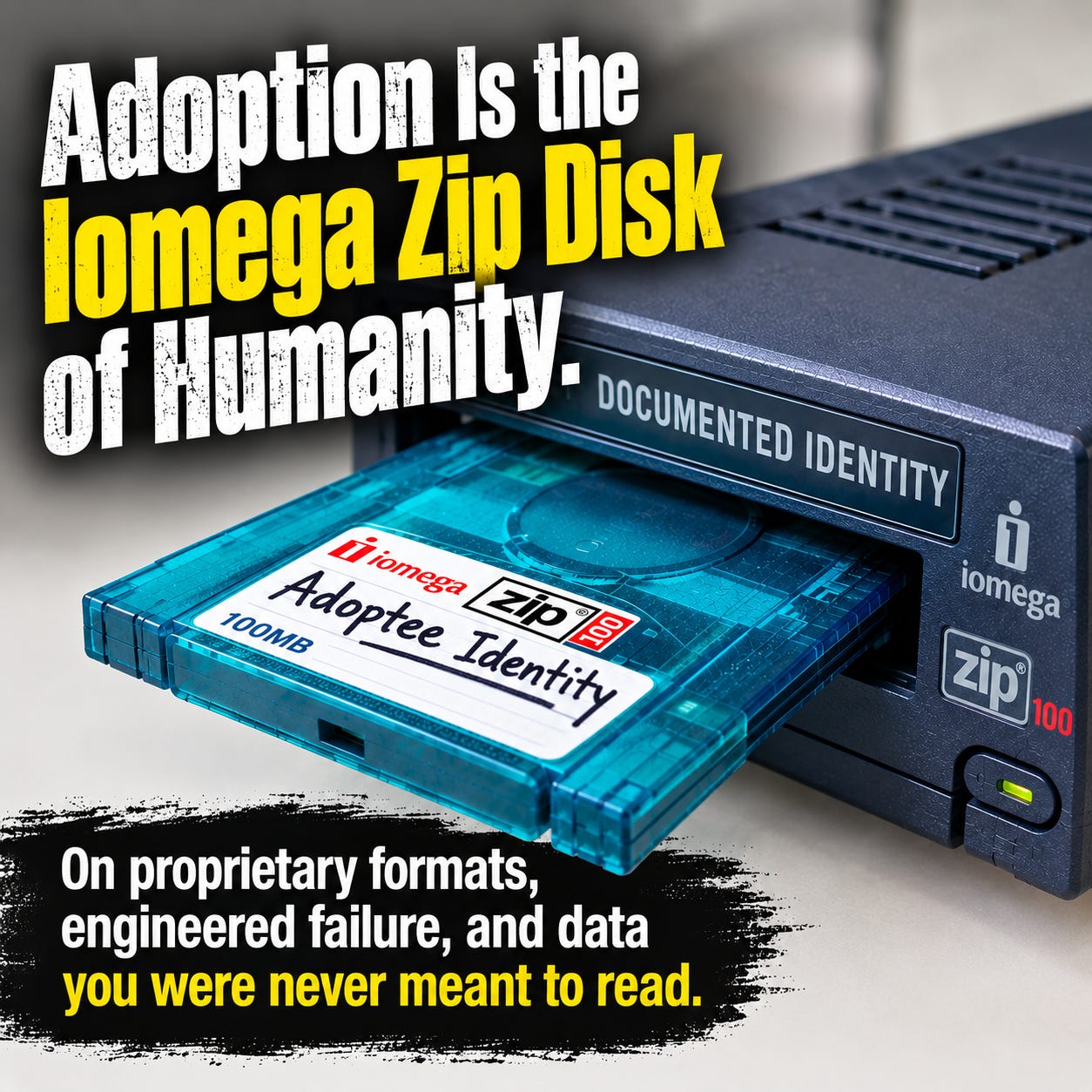
In 1994, Iomega released the Zip disk. It held 100 megabytes at a time when the floppy disk held 1.44. Seventy times the capacity. The marketing was not subtle about it, and it did not need to be. Designers bought them. Photographers bought them. Universities standardised on them. By December 1997 the company had sold past eleven million drives and was calling the Zip the industry standard in removable storage.
It was, for about six years, the obvious answer to a real problem. People had things worth keeping and nowhere adequate to keep them.
Then the format died, and everything anyone had entrusted to it died inside a plastic cartridge that no surviving machine could open.
This is the most accurate available description of what adoption does to a human being.
A closed format is not storage. It is custody.
The Zip disk’s defining property was never its capacity. It was that Iomega owned the reading mechanism. The data was yours. The means of accessing it was not. You could hold the cartridge in your hand, know precisely what was on it, and be completely unable to retrieve a single byte without a machine the company controlled, manufactured, discontinued, and eventually stopped supporting.
Adoption operates on identical architecture.
The adoptee’s origin is not deleted. It is written to a proprietary format and placed in institutional custody. The original birth certificate exists. The relinquishment file exists. The agency correspondence exists. The medical history exists. None of it is destroyed, and this is the part that people outside the condition consistently fail to grasp. It is not destruction. It is a read permission held by someone else.
An amended birth certificate is a rewritten header on a file whose contents were never yours to open. The state issues a document that says the child was born to the people who received them. The original is sealed beneath it. The system then behaves as though the amended file is the authentic one, because within the format, it is. The format defines what counts as readable.
You are the disk. The registry is the drive. And you were never sold the drive.
The click of death
By early 1998 the failure had a name.
Zip drives developed misaligned read/write heads. When a head could not locate track zero on the disk, it would slam repeatedly against the end of its range, hunting for a starting point that it could no longer find. This produced a distinct, audible clicking. Users called it the click of death, and it meant the disk in the machine was already gone.
Read that mechanism again, because it is not a metaphor I am imposing. It is the mechanism.
A head that cannot find track zero destroys the disk while searching for it.
That is the adoptee condition rendered in hardware. The relentless, structurally-produced hunt for an origin point the format has made unlocatable, and the damage the hunt itself inflicts, and the sound it makes, which everyone around you finds irritating and inexplicable and eventually asks you to stop making.
Adoptees are not pathologised for being damaged. They are pathologised for being audible.
The two-cent washer
Here is the detail that turns this from a clever comparison into an indictment.
The Zip drive’s original designers anticipated head misalignment. They engineered against it with a small foam washer on the steel rod the actuator slid along. It cost roughly two cents.
Someone inside Iomega manufacturing, running a cost-reduction exercise, removed it.
The drives produced during that period are the drives that clicked. The failure that destroyed an unknown quantity of irreplaceable human work was not a mystery, not an act of God, not an unforeseeable consequence of frontier technology. It was a foreseeable outcome of a decision made by people who would never be the ones losing the data.
This is the Maintenance Economy in miniature. The protective component is removed because it costs something and its absence is not immediately visible. The cost is transferred downstream to people with no visibility into the decision and no standing to contest it. And when those people report the harm, they are told the problem is rare.
Iomega’s public position was that the click was normal, that repetitive clicking indicated a damaged drive or disk, and that the issue affected fewer than half of one percent of users. Australian and American users had been reporting failures since 1996. Some had lost five drives in eighteen months. Many believed they were the only one until a complaints website appeared and they discovered several hundred others.
The parallel does not require elaboration. Every forced adoption inquiry in Australia followed this arc precisely: individual reports, institutional insistence on rarity, isolation of the affected, eventual aggregation, apology, and no restoration of access.
The contagion argument
The most contested question about the click of death was whether it spread.
A disk damaged by a faulty drive, inserted into a healthy drive, would cause that drive to begin clicking. Iomega’s own engineers stated that prolonged clicking could permanently damage a good drive’s heads. Independent researchers disputed the strength of the effect and argued the second drive was merely responding correctly to an already-ruined cartridge. The advice that emerged from the argument was unambiguous regardless of which side was right: never knowingly put a damaged disk into a working drive.
Damage propagates through the mechanism designed to read it. Whether the propagation is transmission or reproduction is a technical dispute. The outcome is the same.
I have documented this in my own family with names and dates. My adoptive mother had a son taken from her under the same forced adoption system that produced me. She was a damaged disk inserted into the machinery of my childhood. When I reunited with my birth family, she estranged me. Then she estranged my children from me.
The wound moved forward through the mechanism built to hold it. Three generations, one misalignment, and an entire family arguing about whether the clicking was really that loud.
Transitional technology sold as a destination
Iomega did not market the Zip disk as an interim measure. Nobody buys interim. It was sold as the place your work would live. The 100MB cartridge carried a lifetime warranty, which turned out to describe the warranty’s lifetime rather than the cartridge’s.
Adoption is sold with identical language. Forever family. Permanent placement. A clean, closed, final resolution to a temporary crisis of circumstance, usually poverty, usually the mother’s, usually solvable with money that was never offered.
Both claims are false in the same way. Both describe a transitional arrangement as a terminus, and both do it because acknowledging the transitional nature would require admitting there is something on the other side.
CD-R arrived. Then USB flash memory arrived. The Zip disk did not fail because of the clicking. It failed because a format that held your data hostage could not survive contact with formats that did not.
The recovery industry that should not exist
There is a business built on extracting data from dead Zip disks. Specialist recovery outfits, thirty to fifty percent success rates, priced accordingly. An entire aftermarket generating revenue from a problem the manufacturer created and then abandoned.
Adoptees know this industry intimately. Commercial DNA testing. Search consultants. Freedom of Information applications. Private investigators. Genetic genealogists. Thousands of dollars and years of a life spent reconstructing information that was recorded accurately at the time, held continuously by an institution, and withheld by design.
Recovery is not a service being offered to us. It is a toll being charged on a road that was closed deliberately.
There are still disks in drawers
Somewhere near you is a Zip cartridge in a box in a cupboard containing a thesis, or a wedding, or a business, or a dead parent’s photographs. The owner knows …