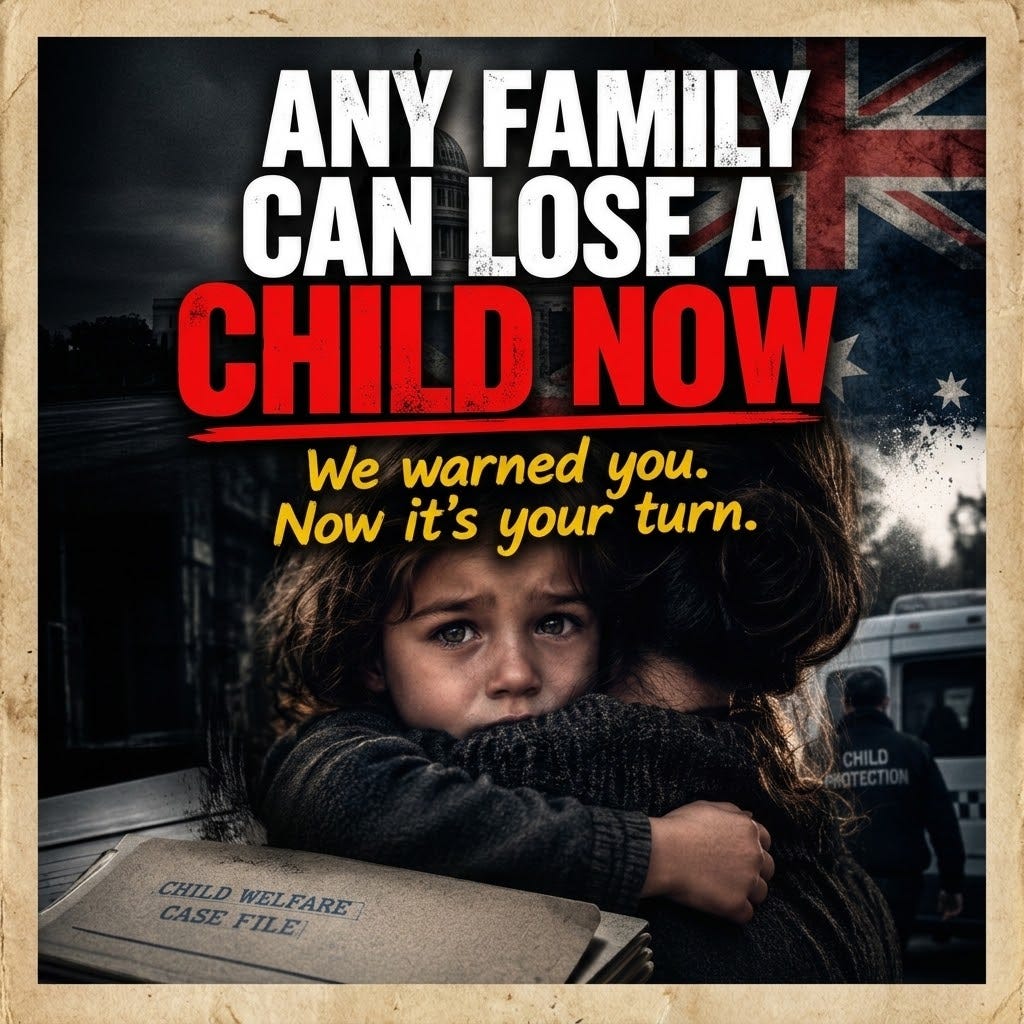
Adopted people warned you.
For decades we said the systems that took us were not about protecting children. They were about which families the state decided deserved to stay whole. We were told we were ungrateful. Angry. Damaged. Unrepresentative. A bad experience, not a pattern.
In 2026 the pattern is back in plain sight, across the United States, the United Kingdom and Australia. Different governments, different vocabularies, the same machine. And it is already moving beyond the families it was built to target.
The method
Strip away the language and the machine has three moving parts:
* Withdraw support. Cut the income, housing, healthcare, childcare and safety that keep families together.
* Rename hardship as risk. When the family struggles, call it neglect, and remove the child.
* Sell severance as kindness. Offer permanent separation as the compassionate solution: adoption, anonymous surrender, a new identity, a sealed past.
No single step looks like an atrocity. A budget line. An eligibility rule. A risk assessment. A reform bill. That is what makes it work.
Step one: withdraw support
In the United States, the federal government froze more than $10 billion in family assistance, childcare and social services funding to five states, citing fraud (Reuters via Yahoo). Those funds serve the most vulnerable families, including families already in the foster system (The Imprint).
Young adults leaving state foster care must now work, volunteer or study 80 hours a month to keep food assistance (Houston Chronicle). Child welfare advocates warn that losing food aid could keep children in state custody longer, because reunification case plans require food and shelter (Live 5 News). The state removes the means, then judges the parent for lacking them.
England shows where this leads. Spending on early intervention services there was cut by 44% over a decade, while the cost of children in state custody rose 50%. Care proceedings for babies have risen 64% in two decades, and now reach one in every 118 infants. Only a fifth to a quarter of cases involve clear-cut serious harm. Most are “grey area” neglect, involving complex needs and housing issues that might have improved with support (BBC File on 4).
Step two: hardship becomes risk
In Western Australia, Human Rights Watch documented authorities removing children from Aboriginal mothers fleeing domestic violence, and from parents without housing, instead of providing services to address the violence and the homelessness (HRW). The mother escaped the violence. The state took the children.
Nationally, First Nations children are about 7% of Australia’s children but 44% of those in state out-of-home care. In the Northern Territory, 89% (National Indigenous Times). Eighteen years after a national apology for the Stolen Generations, the share is still rising.
In the United States, immigration detention reached nearly 70,000 people in April 2026 (Black Enterprise). Children are entering state foster care when their parents are detained, but the federal government does not count how many (KFF Health News). A parent in detention often cannot attend the hearings that decide whether they get their child back. The separation becomes the case against them.
Step three: severance sold as kindness
Across American states, laws now authorise baby boxes: drop-in devices at fire stations, police stations and hospitals where a newborn can be left anonymously. Georgia opened its first in August 2026 (GPB). Maine opened its first box in May, and Alaska’s Senate passed a baby box bill in April (Stop Safe Haven Baby Boxes Now). Each box is a device for erasing a child’s origins in the first weeks of life, presented as compassion.
In Australia, a 2026 opinion piece describes the national response to the Stolen Generations as “anti-adoption,” and calls it harmful to children (About Regional). The apologies are recast as the obstacle. In Queensland, a child safety inquiry recommended prioritising family-based care, including adoption, over residential care, and studying “simple adoption,” while acknowledging that First Nations submissions strongly opposed it, then declining to exclude First Nations children anyway (National Indigenous Times). The objection was heard and overridden in the same sentence.
The same inquiry found no evidence that racism drives the removal of children who are taken into state care at 9.3 times the rate of their non-Indigenous peers (National Indigenous Times). If the cause is not named, the cure can be anything. Including the thing that was apologised for.
It never stays where it starts
If you are not poor, Indigenous, a migrant or a single mother, it is easy to believe none of this touches you. That is the mistake every generation makes.
These systems are always built on the families with the least power, because that is where nobody objects loudly enough to stop them. But what gets built does not stay there. Risk thresholds drift. Surveillance databases expand. Eligibility rules tighten for everyone. The tools designed for “those families” become the tools.
And the record keeping is already failing. The US federal government does not track children placed in state custody after immigration detention. In Queensland, the minister told parliament in June there were 2,258 children in state residential care. In July, after restoring data affected by its failed Unify records system, the government said there had been 2,819 at the end of March. Either hundreds of children left residential care in two months, or one of those figures is wrong (Queensland government; NIT). A system that cannot reliably count the children it holds is being trusted to decide which ones to sever permanently.
We have seen this before
Forced adoption did not run on cruelty alone. It ran on the same three steps. Unmarried mothers were denied income, housing and family support. Their circumstances were called unfit. Then permanent separation was offered as the loving choice, and the paperwork called it consent.
Governments have since apologised, in Australia, Ireland and elsewhere. Every apology came after the people affected had spent decades being dismissed. Every apology came after the children were grown, the mothers were old or dead, and the records were sealed.
England has now apologised for its historic forced adoptions. Yet 72% of children adopted there were taken into state care before their first birthday, and only about 10% of adoptions have the natural parents’ written consent. A Lancaster University professor calls the term “forced adoption” politically loaded, but says it is what is happening, because parents do not agree (BBC File on 4). The apology and the practice are running side by side.
An apology is what a state offers when it is already too late to stop the harm.
Before the next apology
Waking up does not mean outrage. It means refusing the framing.
When a government cuts family support, ask how many children it will cost their parents. When a reform promises “permanency,” ask whether it means stability or permanent legal severance from the natural family. The Queensland Family and Child Commission itself warns those are not the same thing (QFCC). When a box in a fire station is called compassion, ask what that child will never be allowed to know.
And listen to the people who have lived it: adopted people, First Nations families, mothers who were told they had no choice, parents separated at borders. We are not the bad experiences. We are the evidence.
We warned you once. Don’t wait for the apology this time.
Thanks for reading! This post is public so feel free to share it.
FREE Reports and Presentations
Sources
* Reuters via Yahoo – $10B family assistance freeze
* The Imprint – freeze and child welfare
* Houston Chronicle – SNAP rules for foster youth
* Live 5 News – SNAP and reunification
* Human Rights Watch – Western Australia
* National Indigenous Times – RoGS 2026 figures
* Black Enterprise – ICE detention figures
* KFF Health News – children of detained immigrants