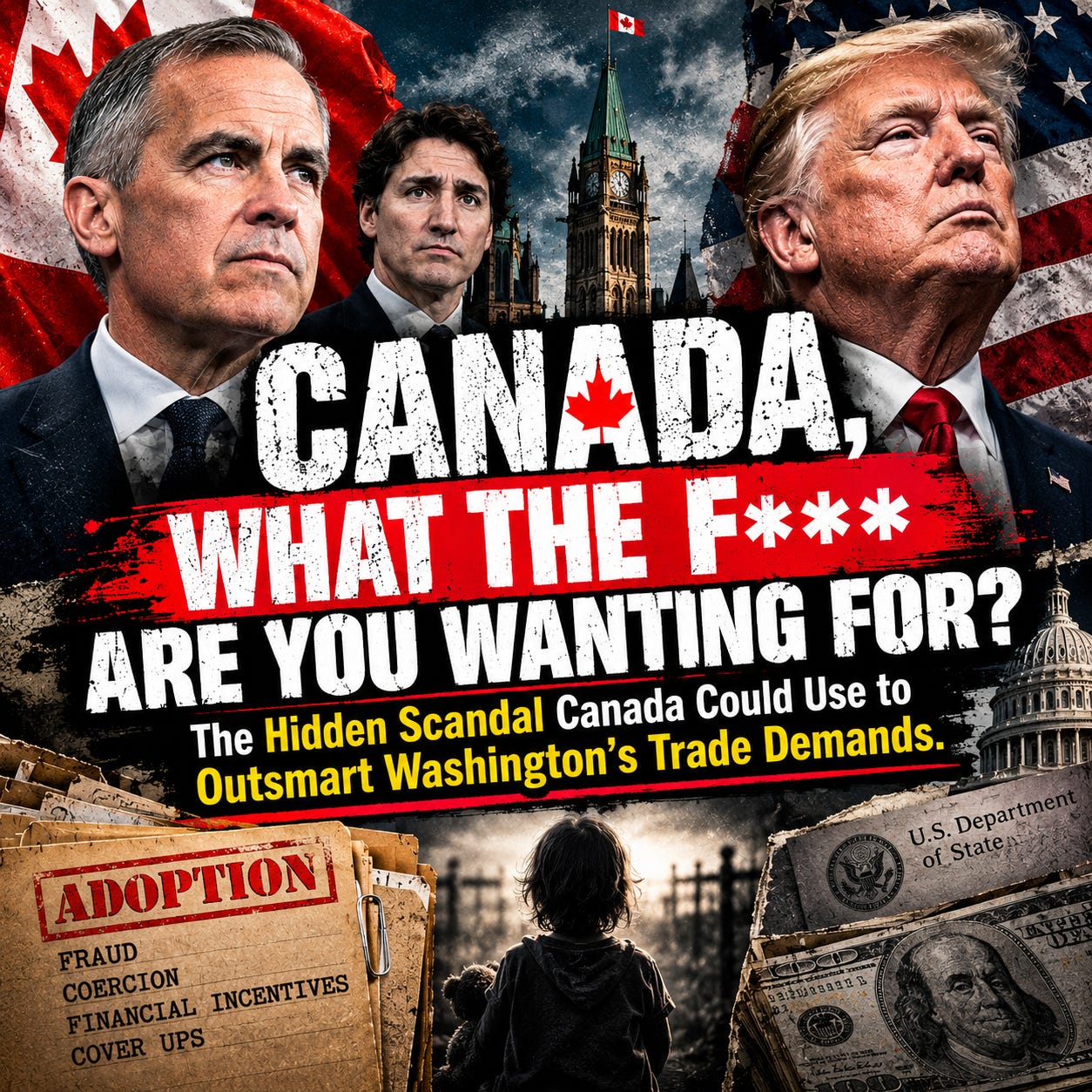
Trump Weaponized Palestine Against Canada. Canada Has a Bigger Card.
Trade wars run on tariffs and threats. There’s a weapon sitting next to them that nobody in Ottawa has touched — because using it would mean admitting the system runs on both sides of the border.
Trump has already shown the shape of the game. When Canada recognized a Palestinian state in 2025, he didn’t respond with a policy argument — he said it would “make it very hard” to reach a trade deal, tying an unrelated political decision directly to tariff leverage. It wasn’t the first time he’d used the trade war to coerce countries on matters that had nothing to do with trade. It won’t be the last.
Palestine was a borrowed grievance — a symbolic wound Trump could point at because it played to his own coalition, not because Canada did anything to the United States directly. Canada has something else available to it: a documented, decades-long, still-running domestic scandal inside U.S. borders that Canada didn’t create and doesn’t have to invent a pretext for. It only has to point.
So the question worth asking isn’t whether emotional leverage works in a negotiation this asymmetric. It’s whether Canada has anything comparable to point back — and whether it’s brave enough to use it.
It doesn’t have to invent one. It’s sitting in plain sight, in a system both countries participate in and neither wants examined too closely.
YouTube
The industry with no name it will use for itself
Nobody in the intercountry adoption sector calls it an industry. It’s called “child welfare,” “permanency,” “finding forever families.” But the U.S. State Department’s own numbers tell you what it actually is: a market in visible decline, moving because the supply side has been closing off, not because the demand side has changed.
Intercountry adoptions to the United States peaked in 2004 at 22,991 children. By fiscal year 2025, that number was 973 — a 94 percent collapse, and a 17 percent drop from the year before that. Every year the number falls, and every year the National Council For Adoption issues a statement lamenting the decline in supply, never asking why sending countries keep shutting the pipeline down: fraud findings, coerced-relinquishment scandals, exit-visa suspensions, and diplomatic ruptures over trafficking allegations, one after another, country after country. Guatemala. Ethiopia. The Democratic Republic of the Congo — which suspended exit visas entirely and saw its adoption numbers collapse 93 percent in a single year. Uganda. The pattern isn’t scarcity of children. It’s a pattern of the world quietly refusing to keep supplying this market once it looks too closely at what happens to the money and the paperwork.
And there’s real money. This is where “child welfare” stops being the honest name. The financial architecture behind U.S. adoption advocacy — the funding chains connecting agencies like Bethany Christian Services, umbrella lobbying bodies like the NCFA, and political funding networks including the DeVos family’s long-standing financial support for the sector — is a Maintenance Economy in the fullest sense: an incentive structure where the continuation of the pipeline, not the welfare of any specific child, is what gets protected. Accreditation failures get quietly patched. Fee increases get imposed on adoption service providers with no public accounting of where the money goes. An anonymous State Department whistleblower once alleged the very office responsible for oversight had an “anti-adoption bias” — which tells you plainly which direction the institutional pressure runs, and which direction it doesn’t.
None of this is secret. It’s published, litigated, testified to Congress. What’s missing is a government with the standing and the motive to say it out loud, on the record, in a forum that costs the United States something.
Why Canada is positioned to say it
Canada doesn’t need a live adoption dispute with the U.S. to make this land. It needs three things it already has: proximity, credibility, and a domestic reckoning it has already been forced to have.
Canada has spent the last decade publicly confronting its own history of forced and coerced adoption and residential-school family separation — a process that, whatever its failures, has produced an official vocabulary for naming institutional child-removal as harm rather than as help. That vocabulary transfers. A government that has said, in its own Parliament, that separating children from families under state sanction was a wrong requiring redress has more standing to name the same structure in a neighboring country than one that hasn’t.
And the audience isn’t hypothetical. Adoptee-rights organizations already operating inside the U.S. — birth-parent advocacy groups, adoptee-led reform movements, a bipartisan and growing discomfort with for-profit adoption brokering — are the exact constituency that would amplify, not dismiss, an outside government naming what they’ve been documenting for years. Trump’s Palestine move worked because it cost Carney something with an audience that already cared. This works the same way, aimed the other direction: it costs Washington something with an audience — adoptees, birth parents, reform-minded legislators on both sides of the aisle — who already have the receipts.
Why it still wouldn’t move a trade deadline — and why that’s not the point
Be honest about the ceiling here. Trade negotiators respond to quarterly numbers: tariffs, market access, auto parts. A reputational campaign about adoption fraud and coercive financial incentives is true, documented, and damaging — and still too slow and diffuse to force a concession by Friday. This was never going to be the thing that gets a 35 percent tariff threat withdrawn.
What it would do is outlast the negotiation. Hague Permanent Bureau scrutiny doesn’t have a deadline. UN Special Procedures engagement doesn’t expire when a trade deal gets signed. An institutional embarrassment, once it’s on the record with a government’s name attached to it rather than an NGO’s, doesn’t go away because the news cycle moves on. That’s a different kind of win than trade leverage — slower, but structurally harder to walk back.
What it would actually require
Not a threat. Not a diplomatic ultimatum tied to a Friday deadline. A sustained, documented, government-amplified case: the funding architecture, the accreditation failures, the exit-visa collapses across sending countries, the whistleblower allegations, laid out with the same forensic register Canada has been forced to apply to its own history.
Canada holding up a mirror costs it nothing it hasn’t already paid. The United States, on the other hand, has never had to look.
That’s the lever nobody’s picked up. Not because it wouldn’t work — but because using it means admitting there’s something to expose on both sides of the border, and neither government has been willing to say that part out loud yet.