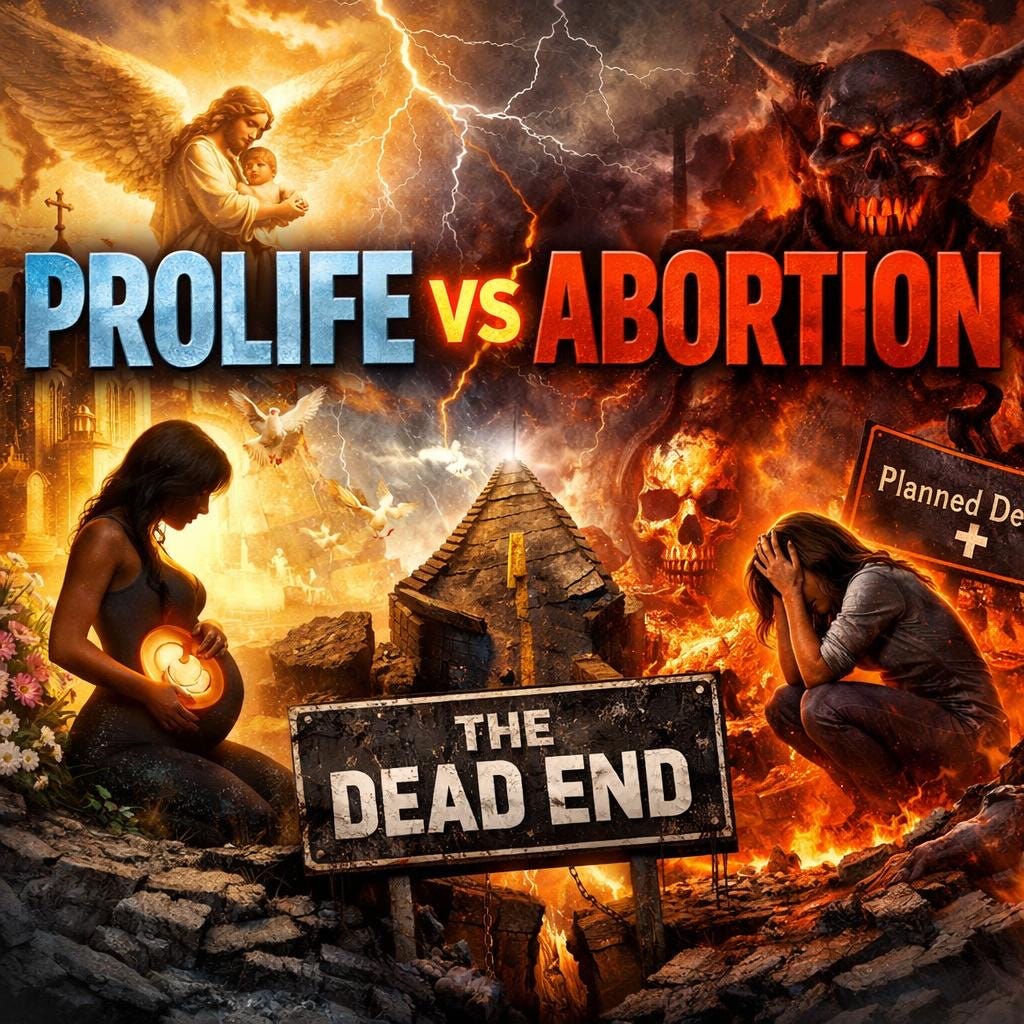
The pro-life movement has a question for adoptees. It is asked at dinner tables, in comment sections, in parliamentary debates, and in the oral arguments of the Supreme Court of the United States. It is asked with the confidence of people who already know the answer they expect.
Would you rather have been aborted?
The intent is coercion. The architecture of the question assumes that existence — any existence, under any conditions — is preferable to non-existence, and that the adoptee, having been granted the gift of life, is obligated to perform gratitude for it. The question is designed to silence. It has worked for decades.
But some adoptees are answering honestly now. And the honest answer is not the one the system anticipated.
It is the most damning indictment of the adoption system ever recorded. Not because it proves the system failed. Because it proves the system worked exactly as designed.
The Supply Chain
The adoption system was not built for the child. It was built for the crisis.
Every major forced adoption regime in the Western world — Australia, Canada, Ireland, the United Kingdom — was constructed at the intersection of two institutional pressures: shame management and demographic demand. The unmarried mother was a social and moral problem to be resolved. The childless couple represented a constituency with needs that institutions were positioned to serve. The infant was the mechanism by which one problem resolved the other. The transaction was dressed in the language of love, of rescue, of Christian charity. The language was always secondary to the logic.
Canada’s Senate motion, tabled in May 2026 and calling for a federal apology, names an estimated 300,000 women coerced into relinquishing their children between the 1940s and the 1970s. The coercion was not incidental. It was the product of systematic collusion between government policy, religious institutions, medical authority, and family pressure — an interlocking machinery designed to ensure that unmarried mothers had no viable alternative to surrender. Australia has apologised for its version of this machinery. Ireland has apologised. Scotland has apologised. Canada has not yet done so. The delay is not an administrative oversight. It is the Architecture of Silence in its self-preservation mode: the instinct of institutions to manage acknowledgement without permitting accountability.
The pro-life movement inherited this architecture and industrialised it. When Justice Alito cited adoption in the Dobbs majority opinion as the logical resolution for women who feared their child would not find a suitable home, he was not making a compassionate argument. He was restating supply chain logic that has governed adoption policy for a century. The child’s function is to resolve someone else’s crisis. The child’s experience of that resolution is not part of the calculation.
This is not a cynical reading of adoption policy. It is the reading the policy produces when you centre the adoptee rather than the institution. Non-Adoptee Bias — the systematic failure of policy, narrative, and legal architecture to account for the perspective of the person adoption is performed upon — is not an oversight. It is structural. The supply chain cannot function if the product is permitted a perspective that complicates the transaction.
The Permanent Lock
Once the transaction was complete, the system had one remaining task: make it permanent.
Sealed records are not a privacy protection. They have never been a privacy protection. They are an identity lock — a legal mechanism by which the state replaces one document of origin with another, substitutes one identity for another, and then enforces the substitution by making the original inaccessible. The original birth certificate — the document that records who the adoptee actually is, who their biological parents are, what their original name was — is sealed. In its place, an amended certificate is issued. The amended certificate records not biological reality but legal fiction: the adoptive parents are listed as the parents of origin. The original is buried.
There is no legal mechanism to discharge an adoption. In most jurisdictions, there is no exit. The identity the state assigned is the identity the adoptee carries, regardless of whether they consent to it, regardless of what it costs them, regardless of what they discover about the person underneath it. The Identity Gravity Well — the relentless pull of an externally imposed identity that distorts every attempt at authentic self-construction — is not a metaphor. It is a legal condition with no resolution mechanism.
Virginia’s House Bill 301, signed into law by Governor Abigail Spanberger in April 2026, grants adult adoptees unrestricted access to their original birth certificates for the first time. It passed the House 84-10. The margin is worth sitting with. If the arguments for sealing records had ever been as strong as institutions claimed — if secrecy genuinely protected adoptees, birth parents, and adoptive families in the ways proponents insisted — the vote would not have been 84-10. It would have been contested. The near-unanimity reveals that the arguments for sealing were never principled. They were convenient. They served the system.
California’s SB381 is advancing. Sixteen states have opened records since 2019. The majority of states have not. In those states, the amended certificate remains the only legal reality available to the adoptee. The statutory lie holds. The original is still sealed.
The adoptee who cannot access their original records is not protected. They are contained. The Architecture of Silence does not merely prevent knowledge — it enforces an alternative reality and demands the adoptee inhabit it.
The Expulsion
In 2026, the United States government launched Operation True Parent — a systematic review of intercountry adoption files for paperwork irregularities. At least 49 cases have been identified. Some of the people under review have gone into hiding. They are people who were adopted from overseas as infants or children, raised in American homes, educated in American schools, who have lived American lives for decades. They are now potentially deportable.
Approximately 75,000 people are in this position. They were legally adopted by American citizens through court-sanctioned processes. They were raised as Americans. They were never naturalised because the system assumed that citizenship would resolve itself — because the paperwork, in this as in so much else, was treated as secondary to the narrative of rescue and belonging. The Child Citizenship Act of 2000 closed the gap for some adoptees but not all. Those it missed have been carrying the citizenship void for decades. Under the current administration’s immigration enforcement surge, that void is now an active exposure.
The state that chose them is expelling them.
This is the Adoptee Paradox operating at federal scale. The foundational mythology of adoption — the chosen child, the rescued infant, the family completed by an act of institutional love — collides here with the legal reality that the state’s selection was never unconditional. The belonging it offered was provisional. The conditions are now being enforced by the same institutional apparatus that originally produced the adoption.
The deportation pipeline is not an accident or an administrative failure. It is the logical endpoint of a system that processed adoptees as legal transfers rather than as persons with civic identity. The paperwork was always the architecture. The person was always secondary to it. Operation True Parent does not represent a betrayal of adoption’s values. It represents their completion.
Activist Annie Wu, a Chinese adoptee, has said: If my birth mother aborted me, that would be fine with me. I would not exist so I would not care or be impacted. She said this in the context of the Roe v. Wade debate. She was responding to people who wielded her existence as an ar…