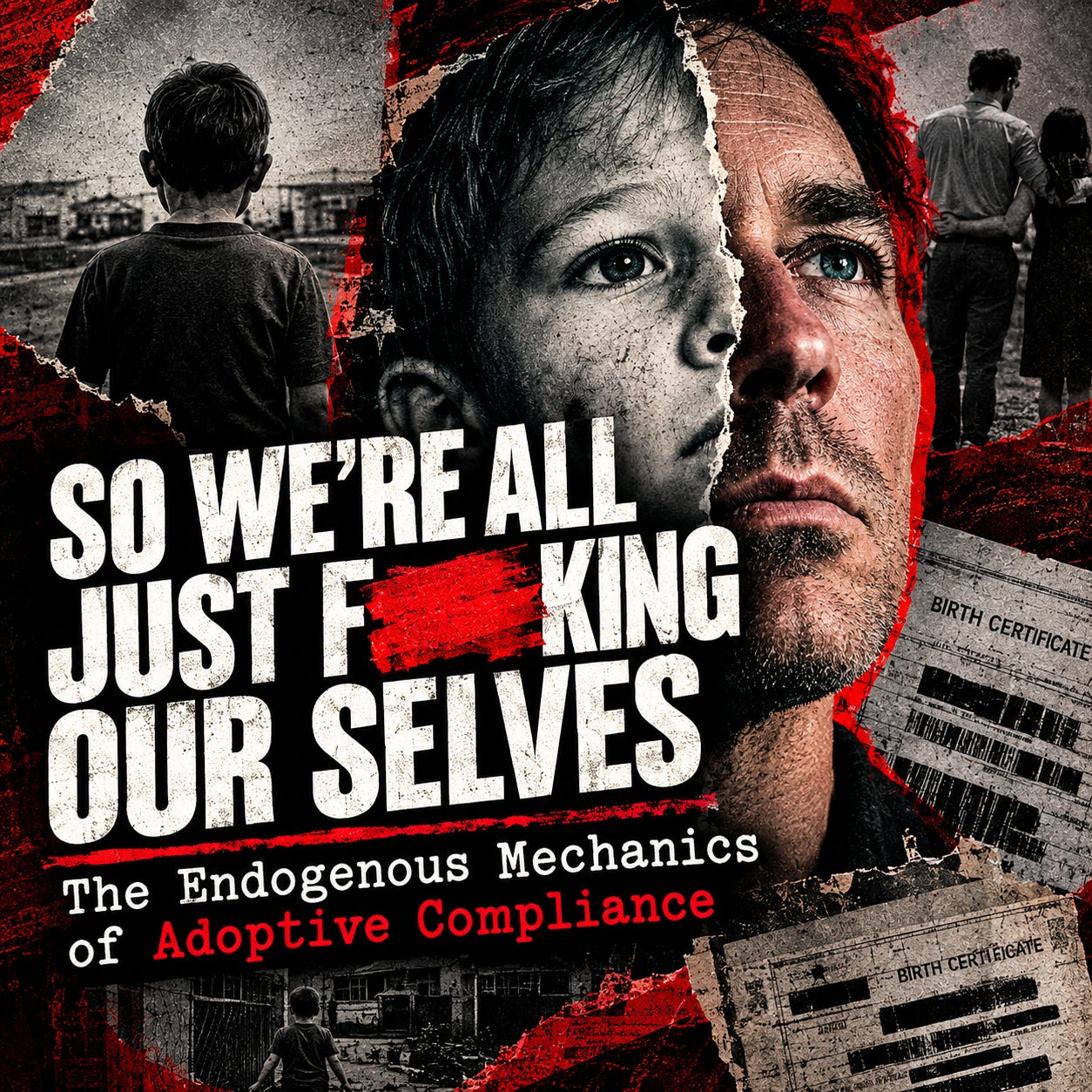
“The oppressed, instead of striving for liberation, tend themselves to become oppressors.“
There is a specific flavor of horror that arrives when you realize the prison guard is wearing your face.
It doesn’t arrive as a scream. It arrives as a slow, creeping nausea — the kind that settles in your chest when you catch yourself, mid-sentence, performing the very narrative that erased you. You are defending the system that stole your first language. You are dismissing your own grief as “attachment issues.” You are thanking your parents for “saving” you, even as you choke on the word.
In that moment, the architecture of compliance becomes visible. And the question that rises isn’t “why are they doing this to us?” It’s, with a sickening lurch: why am I doing this to myself?
The answer isn’t personal failure. It’s the genius of the apparatus. Family extraction doesn’t need a boot on every neck — it just needs the boot internalized as a cane you think you chose to carry. When the subject polices their own subjectivity, the state can retire its enforcers.
This is a report on how that happens. Four mechanisms, one collective self-harm, and — because I refuse to let this stop at the adoptee’s door — the mirror version that runs in every non-adoptee who’s ever loved one and called their own incuriosity kindness.
YouTube
The Internalized Savior
The first act of self-f*****g is believing the myth of your own unworthiness.
The rescue narrative — plucked from hell, placed in heaven — doesn’t just exist as something said about you. It gets whispered into your ear from before you can understand language, until the real triumph arrives: you start whispering it to yourself.
You learn to view your family of origin through the colonizer’s gaze — dysfunctional, incapable, a cautionary tale. You learn to view yourself as a project. A renovation. A salvage operation. Any curiosity about the past gets filed as ingratitude, until you’ve built your own internal censor that shuts the question down before it finishes forming.
When you look in the mirror, you don’t see a child who was stolen and sold. You see a problem that was fixed. And because you see yourself as a problem, you spend your life trying to be less problematic — smaller, quieter, more grateful, more forgetful.
The self-f**k: you become your own least-favorite relative. You perform the role of the child who asked to be rescued, even though you were an infant with no say in it at all. You gaslight yourself into believing that love looks like erasure.
The Debt Economy of the Self
The second layer is the ledger you run in your own head.
Debit: I was not wanted. Credit: I was chosen. Balance: I owe. I owe my entire existence. I owe my happiness. I owe my silence. I owe my compliance.
This isn’t a metaphor. Adoptees describe feeling like their own oxygen is borrowed — like they have to earn the right to exist every single day, and any complaint is rejecting the gift of their own life. The apparatus doesn’t do this arithmetic for you. It just hands you the categories, and you do the math yourself, endlessly, calculating exactly how much grief you’re allowed to feel before the debt goes unpayable.
That’s the deeper harm underneath the enforced gratitude — it doesn’t just deny you credibility from the outside. Once it’s internalized, you deny it to yourself. You hear your own voice crying out in pain and you answer it: you don’t have the right to that. You were saved.
The self-f**k: you become the loan shark of your own soul. You set the interest rate on your own suffering. You deny your own application for relief because your credit score — of gratitude — is too low.
The Erased Archive
The amended birth certificate is a legal fiction imposed from outside. Its internal corollary is a fractured self that can’t trust its own timeline, its own body, its own memory.
Without access to your original records, you’re forced to build an identity out of secondhand narratives — stories told by others, often self-serving, often half-true. When those stories collide with something visceral — a sense of not belonging, a phantom grief, a flash of a face you can’t name — you’re trained to distrust the feeling and trust the story. Over time you become an unreliable narrator of your own life. Not because you’re confused. Because you were systematically denied the raw data.
The self-f**k: you spend decades trying to feel what you’re told you should feel, instead of feeling what’s actually there. You pathologize your own alienation because it doesn’t match the official record. You become a detective chasing clues to a crime you’re told never happened — except it did, the evidence was sealed by the state, and somewhere along the way you internalized the sealing as your own shame instead of theirs.
The Diagnostic Mirror
The fourth mechanism goes endogenous the moment you reach for the DSM before you reach for the truth.
Adoptees get funneled into therapy at higher rates than the general population, and that’s not inherently bad — except the dominant frameworks (attachment theory, trauma-informed CBT) usually get deployed to manage your emotions rather than validate the systemic violence that produced them. You learn the language — attachment disorder, reactive attachment, complex trauma — and you don’t use it as a tool of liberation. You use it as a straitjacket you tighten yourself.
Grief over family separation becomes “complicated grief.” Rage at the adoption industry becomes “anger issues.” Disidentification with the adoptive family becomes “oppositional defiance.” A desire to find biological kin becomes “identity crisis.” Every one of those translations converts a structural truth into a personal defect — and you internalize the conversion so completely you show up to the therapist’s office pre-diagnosed: I know I have abandonment issues, doc. How do I fix them?
The question that never gets asked is why was I abandoned, or what system profited from my relocation. The question that always gets asked is what’s wrong with me that I can’t just be happy.
The self-f**k: you medicate the grief out of yourself. You reframe your righteous fury as a symptom to manage instead of a compass to follow. You become a patient when you should be a plaintiff. You treat the wound and ignore the knife — because looking at the knife means looking at the hand that held it, and that hand might belong to the parents who read you bedtime stories.
The Collective Self-Harm
No extraction apparatus survives without divide-and-conquer, and adoptees do plenty of that work for it, unpaid.
The Grateful Adoptee gets held up as the model — quiet, appreciative, never questioning, performing happiness on schedule. The Angry Adoptee gets derided as bitter, stuck, damaged. And this binary doesn’t just get imposed from outside — it gets enforced adoptee-to-adoptee. The Grateful Adoptee looks at the Angry Adoptee and feels threatened, because if the Angry Adoptee is right, the Grateful Adoptee has been living a lie. The Angry Adoptee looks at the Grateful Adoptee and feels betrayed, because the Grateful Adoptee is out here validating the system that hurt them both.
The self-f**k, collective version: we do the system’s work for it. We police each other’s grief. We measure each other’s compliance. We weaponize our own survival strategies against people who picked different ones. We tear each other apart so the system gets to stay comfortably intact.
We’re so desperate to prove we’re the “good ones” that we’ll throw every other adoptee under the bus to keep our seat at the table. The table is made of our own bones.
The Double F**k: Non-Adoptee Bias
Every mechanism catalogued so far indicts the adoptee’s own machinery. But the mirror in that opening image was never ours alone. There’s a second prison guard in the room, wearing their own face — and they’re not staff. They sincerely believe they’re the guest of honour.
Non-Adoptee Bias is their version of the same loop: the reflex that lets someone hold “I l…