This is a free preview of a paid episode. To hear more, visit thoughtlessdel.substack.com
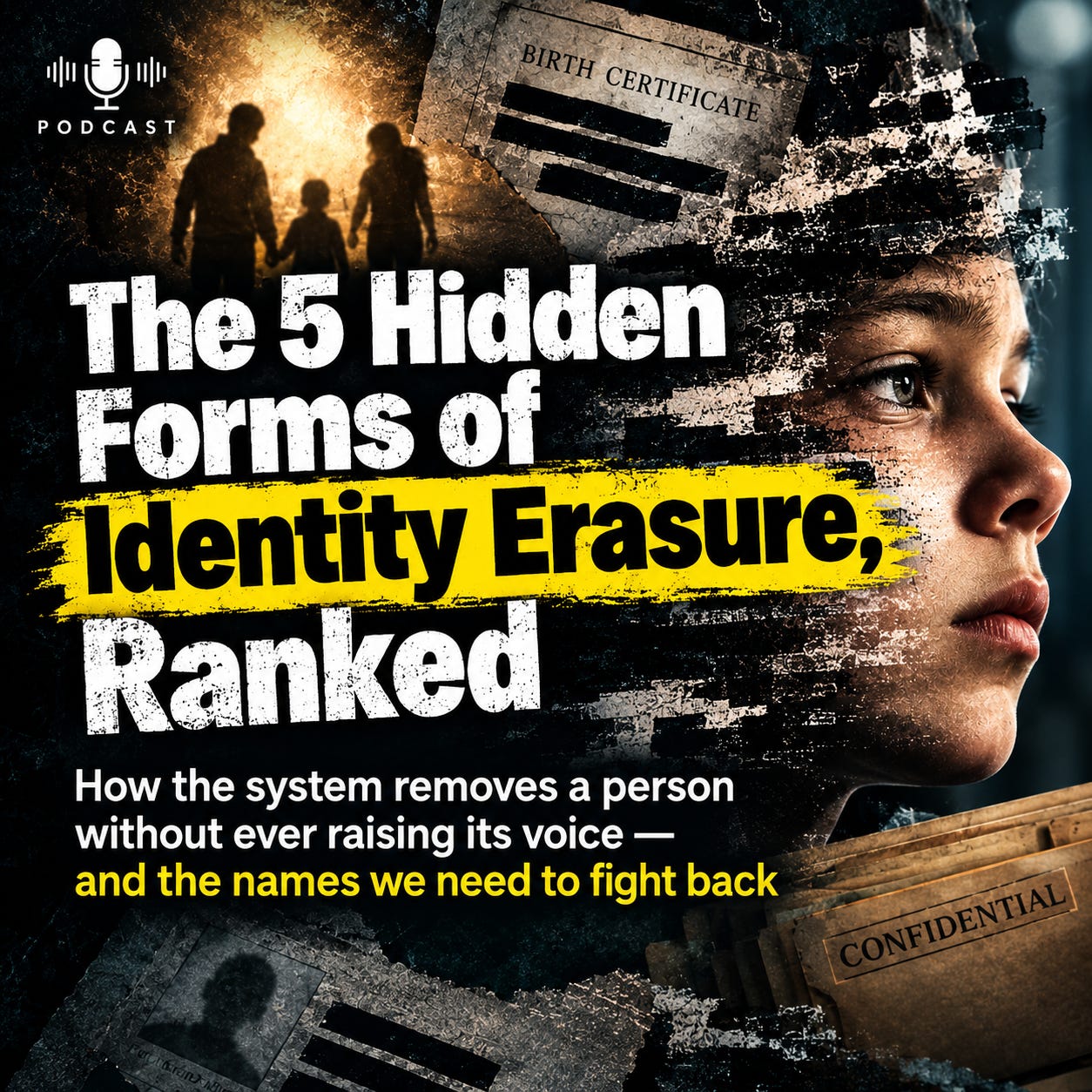
We have a word for a punch. We don’t have a word for the thing that slowly, politely, legally removes you from your own life — and that is exactly why it works.
The absence of language is not a coincidence. It is a design feature. The most effective machinery of erasure depends on your not being able to name what is happening to you. The moment you can name it, you can begin to contest it. Until then, you walk around carrying an absence you can feel but cannot articulate — and you are easy to tell that the problem is you.
This is an attempt to supply some names.
What follows is a taxonomy of five forms of identity erasure, ranked from most invisible to most complete. These are not metaphors. They are mechanisms. They operate in courtrooms, in family dinners, in the paperwork you were too young to read. They leave no wound you can point to — only a gap where you were supposed to be.
5 — THE SUBSTITUTION
The most invisible form begins long before anything is done to a record or a name. It begins with a story.
The Substitution is when the world quietly replaces your account of yourself with a more convenient one. Not a lie, precisely. More a casting change. Someone else’s version of you is written into the family narrative, and the original is edited out. It is told warmly. It is told at every gathering. It is told with love. That is the trap.
In adoption systems, the Substitution is typically the first movement. The child’s origin story is smoothed — the harder details softened, the discomforting facts omitted, the narrative reframed around the comfort of the adults in the room. It is not cruel. It is something worse than cruel: it is structural, and it is kind, and it repeats.
What the Fifth-Dimensional Split can tell us is this: every time a false story is told about who you are, the subsonic signal — your biological, embodied sense of self — goes a little further underground. The Substitution does not need malice. It only needs repetition. Once enough accumulates, the substitute story is the only story in the room, and the real one has no air.
4 — THE RENAMING
This one has a paper trail.
A name is not decoration. It is the first contract between a person and the world — the thing you are called when someone wants you, not a census entry. When a name is changed to fit a new family, a new country, a new legal category, something precise is severed: the link between your face and your origin. The sound your mother used for you goes silent. A stranger’s sound takes its place.
I want to be precise here. Renaming is not always violence. An adult who claims their own name is exercising power. That is a different act entirely. But when renaming is done to you — before you can speak, without your consent, to serve the administrative convenience of a system or the emotional comfort of a family — it is a severing.
They remove the word that held you and give you one that belongs to somewhere else. And you are expected to be grateful. Gratitude for the removal of your own name. That is the machine at its smoothest: the violence so thoroughly packaged as gift that the receiver apologises for not feeling more thankful.
3 — THE SEALING
Here the state enters the picture.
The sealed record. The birth certificate you cannot see. The file behind the counter you are legally barred from opening — the record of the exact moment you came into existence, held by an institution that has decided, on your behalf, that the truth is not your property.
The Architecture of Silence operates through this mechanism most nakedly. It takes one of the most fundamental questions a human being can carry — who am I, and where did I come from — and files it under administrative protocol. Your history is classified. The institution holding it will determine, on its own timeline, whether you are permitted to read it. Usually, you are not.
This is the form of erasure that breaks people quietly. You cannot rage at a filing cabinet. You cannot confront a redaction. There is no single person to hold responsible for the structural decision that your existence, before a certain date, does not belong to you. You feel the absence of yourself and are told, politely, that you have no cause of action.
The Sealing performs a second function: it makes the Substitution and the Renaming permanent. Without the record, there is no ground from which to compare the official version with the original. The substitute story has no counter-evidence in the room.
2 — THE GASLIGHTING
Not the pop-psychology version people reach for now. The institutional kind.
Institutional gaslighting is what happens when a family, or a system, tells you that what you remember did not occur. That you are too sensitive. That you misread it. That the thing you experienced — the coldness, the erasure, the administrative removal of your name and history — was actually love, and the problem is your inability to receive it correctly.
This is the most sophisticated form because it does not deny your reality. It relocates it. It reframes your accurate account of systematic removal as a psychological deficiency on your part. Once that reframing takes hold — once you begin to distrust the one source that was still telling you the truth, which is your own memory — the earlier forms of erasure become much easier to sustain.
The Gaslighting is not the most complete form. It is the lock that holds the others in place. Without it, a subject might eventually locate the sealed record, contest the substitute story, recover the original name. The Gaslighting closes those doors by making the subject the author of their own uncertainty. You cannot seek what you have been persuaded you are wrong to want.
1 — THE DISSOLUTION
The most complete erasure is not the most dramatic. It is the quietest.
The Dissolution is what remains when all four preceding mechanisms have done their full work — when a person has been so thoroughly substituted, renamed, sealed and gaslit that there is no longer an original to return to. Not because it was destroyed, but because it was never allowed to form. The person who might have been was interrupted so early, and so completely, that the self which exists is entirely constructed from the outside.
This is the Adoptee Paradox at its most precise. To be legally claimed — chosen, the institutions will say — and yet to have had the claiming itself be the instrument of erasure. The new family, the new name, the sealed file, the polished story of rescue: all of it held with warmth. And all of it the substance of the Dissolution.
You are held and removed at the same time. The claim is the erasure.
This is the one nobody names, because naming it implicates everyone standing around the moment. The parents who were told they were rescuing a child. The agency that processed the paperwork. The state that sealed the file. The cultural narrative that made gratitude the only acceptable response. To name the Dissolution is to implicate the entire architecture — and the architecture is very good at ensuring you remain too uncertain of your own account to try.
THE NAMING IS THE FIRST ACT OF RESISTANCE
Substitution. Renaming. Sealing. Gaslighting. Dissolution.
Five mechanisms of systematic identity removal — and most people carrying them have had the language for one, at most.
What the taxonomy makes visible is that these are not isolated wounds. They are a system. They reinforce one another. The Substitution provides the false narrative that the Renaming formalises; the Sealing makes both permanent; the Gaslighting ensures the subject cannot contest them; the Dissolution is the outcome when the system runs to completion without interruption.
Understanding the map is not the same as healing. But it is a precondition. You cannot contest a thing that has no name. The system depends on the absence of vocabulary — on the subject remaining unable to say, precisely, what was done to them.
The moment you can name it, you are no longer entirely inside it. You are, at least partly, outside it — looking at the mechanism from a position the mechanism does not control.
That is where agency begins. Not in recovery, not in reunion, not in the sealed file finally opened — though all of those matter. It begins here. In the taxonomy. In the naming.
The person who can say “I experienced the Dissolution, and here is what that meant for my sense of self” is already doing something the architecture was designed to prevent: treating their own experience as evidence. Acting as their own expert witness.
That is enough to start.
This Substack is reader-supported. To receive new posts and support my work, consider becoming a free or paid subscriber.
Reports and Resources Below -
Welcome to the core repository of research, frameworks, and policy analyses dedicated to exposing the structural mechanics of institutional identity erasure. For decades, systemic removal and the suppression of biological truth have been masked by administrative protocols, non-adoptee bias, and the “Architecture of Silence”. These resources provide the precise vocabulary and structural roadmaps needed to transition from psychological pathologization to systemic critique. By naming the mechanisms—from Substitution and Renaming to Sealing, Gaslighting, and Dissolution—these reports empower subjects to reclaim their status as expert witnesses to their own lives.
Short Description
Access foundational policy frameworks, clinical practice guides, and diagnostic taxonomies designed to deconstruct the systems that replace biological origin with administrative narrative.
* Clinical Practice Frameworks: Move beyond traditional bio-psycho-social models to evaluate structural harm, the “Fifth-Dimensional Split,” and the suppression of the subsonic signal.
* Policy Analyses & Taxonomies: Examine the five core mechanisms of identity erasure and understand how institutional sealing and non-adoptee bias manufacture ontological instability.
* Tools for Agency: Equip yourself with the precise terminology and structural mapping required to treat personal history as primary evidence and dismantle the architecture of silence.
Become a paid subscriber for full access to these comprehensive reports, study guides, and ongoing investigative resources.