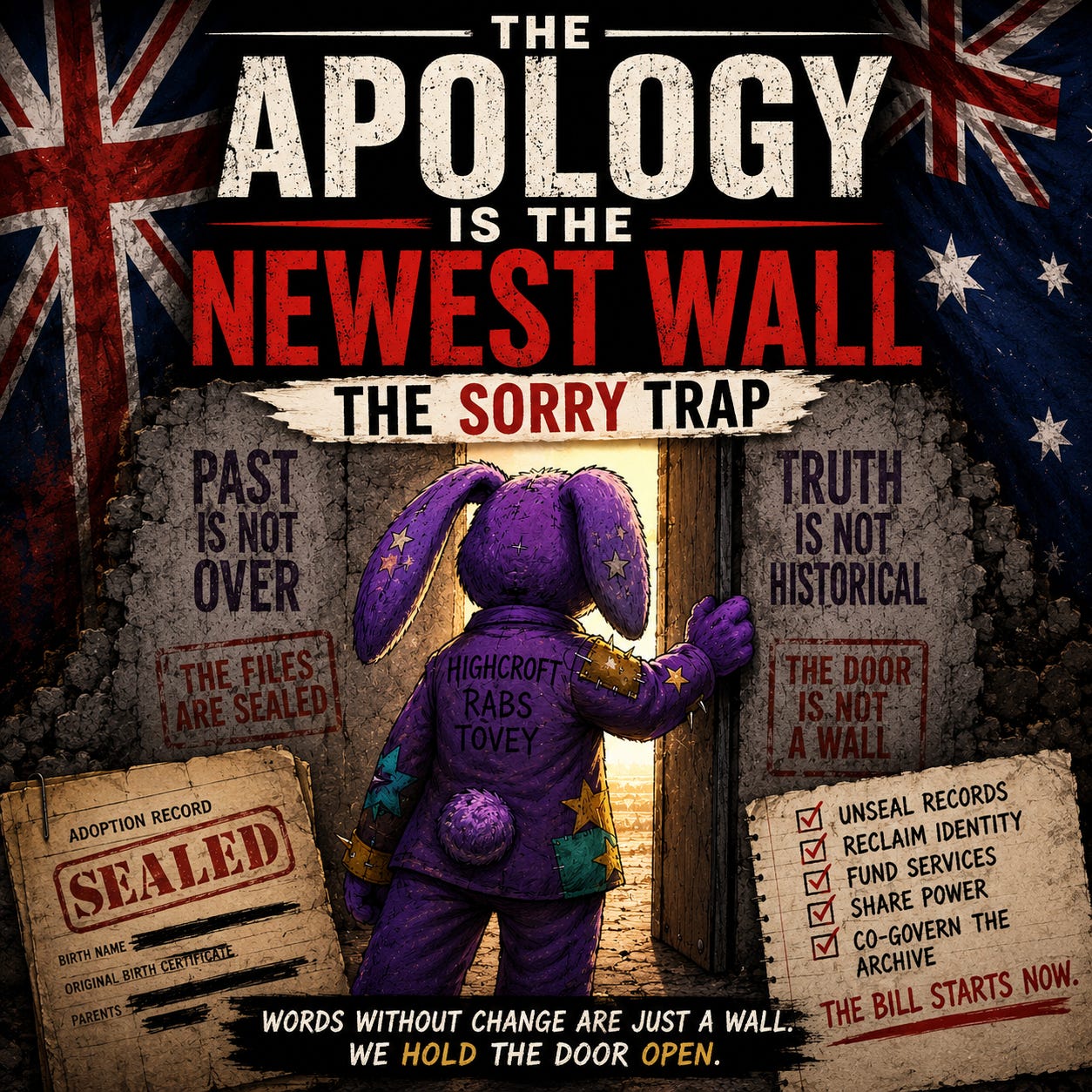
In memory of Highcroft Rabs Tovey.
When a country finally says sorry, something is supposed to end. The wrong is named, the file closes, the survivors are released into the rest of their lives. I want to tell you what actually begins.
This spring the United Kingdom moved closer to apologising for forced adoption than it ever has. The Prime Minister said his instinct was to apologise, and that there was a very strong case for it. A cross-party committee told the government to do it properly — an unqualified apology, written with the mothers and the adopted people, not at them. The Church of England began drafting its own sorrow for the mother-and-baby homes it ran. Between 1949 and 1976, an estimated 185,000 babies were taken from unmarried mothers in England and Wales. In 1968 alone, English courts signed more than sixteen thousand adoption orders. The apology, when it comes, will be aimed at a system that once ran at full industrial capacity.
I am not going to tell you the apology does not matter. It matters. Survivors have carried this for sixty years, and to be believed out loud, by a state, is not nothing. I have felt the pull of that wish myself — the longing for an institution to say the true sentence at last.
But I am Australian. And I have seen this film.
In 2013 my country issued its national apology for forced adoption. The Prime Minister stood up and said the words. People wept; I was one of them. And then more than a decade passed, and the survivors did the accounting. The words had been real. The repair had not arrived. In most states the records stayed sealed. The support services stayed thin, underfunded, and quietly wound down. A new category of grief opened up, and it had a name we did not expect to need: after the apology.
After the apology is a strange country to live in. The official story says your chapter is closed; your body says it is not. You are expected to be lighter now, and you are not lighter, and the distance between those two facts becomes a new thing to carry — set down on top of the original thing, which has not moved at all.
That is what nobody tells you about the sorry. An apology is an external event. It happens in a room, in a parliament, in a press release. It addresses the part of you that lives in public — the part that has spent a lifetime being told its own displacement was a kindness. Call that the adaptive self: the version of you assembled, over years, to be legible to other people.
It does not reach the other part. Underneath the adaptive self there is a lower signal — a steady subsonic hum that has been running since before you had language for it. It is the part of you that knows it began somewhere else: in a body, in a room, under a name the record no longer admits exists. I feel it as a pressure beneath the sternum, the particular quiet of a question that has never once been allowed its answer. An apology cannot touch that frequency. It was never built to. You can be acknowledged in full daylight by the highest office in the land and walk back out of the building with the sealed file still sealed, the original birth certificate still out of reach, the first name still legally unreachable. The public wound gets dressed. The private one is left exactly where it was.
Here is the word the apology depends on, and you will hear it in every official account: historical. Historical forced adoption. Historic wrongs.
Watch what that word does. It picks the harm up and sets it down in a sealed past — finished, survived, over. It writes the apology’s last line before the apology is even drafted: we are sorry for what happened. Not for what is happening.
Highcroft Rabs Tovey would have put it differently. Tovey was an adopted man and an advocate; he led Adoptee Watch UK. Notice the name first — three of them, carried by one person. Tovey, the birth name the record tried to write over. Rabs, the purple rabbit he wrote and survived through. Highcroft. A name is meant to be the most ordinary thing a person owns; for someone the system has processed it becomes a thing you assemble, and defend, and carry in pieces. For Tovey the name was the wound and the resistance in the same breath.
He spent two decades documenting what the official frame leaves out. Through Adoptee Watch UK and the Forced Adoption and Care Order Survey he ran from 2002 to 2024, his work followed the State’s removal of children out of the past tense and into this one. Because the forced adoption Britain is preparing to apologise for is not a discrete postwar scandal that began in 1949 and ended in 1976. The logic underneath it — that a child is better taken than a poor or unmarried mother supported — did not die. It changed its paperwork. It became the care order being signed somewhere in Britain this week.
Tovey did not live to hear the apology. He died earlier this year, before the State could bring itself to say a single word of it aloud. This is what the clock does. It is not a metaphor, and it does not wait. For the people this apology is supposedly for, it is already running out. It ran out for him.
The word “historical” is doing that sealing. If the wrong is “historic,” then the care order signed this week becomes a separate, unrelated matter — different department, different era, nothing here to be sorry for. It is not separate. It is the same machine with the signage replaced. To date the harm is to exempt the present from it.
This publication has a name for the machinery that does this work: the Architecture of Silence. Its hard tools are obvious once you have seen them — the sealed adoption file, the amended birth certificate that names people who were never in the room, the legal route to reclaim your birth identity that exists on paper and is barred in practice by cost and a bar set almost too high for any human to clear.
The apology is the architecture’s softest tool. It is the one that does not look like a tool at all. It produces the visible appearance of reckoning — the bowed head, the co-written paragraph, the front page — while every hard mechanism keeps running underneath it, untouched. The file stays shut. The certificate remains false. The reversion stays barred. An apology that is not bolted to the unsealing of records is not the end of the silence. It is the silence in its most advanced form: a silence that has finally learned how to speak.
So what do you do with that, if you are one of the people the apology is supposedly for?
You do not refuse it. Refusing the apology hands the institution the easy story — that survivors can never be satisfied, that the wound must be in them rather than in the system. That is the cynical turn, and it is a trap, and it is also exhausting in a way that helps no one.
You do something harder. You accept the apology and refuse the closure. You take the words, and you treat them not as an ending but as a door — a door the institution would much prefer to let swing shut, and that you now wedge open with the whole weight of your body. Because a door held open is the only version of an apology that leads anywhere at all.
And then you name the bill, because an apology is the start of a bill, not the payment of one. The bill is specific, and it is not abstract. Original birth records released to every adopted adult as a right, not a favour granted at an institution’s discretion. A funded, low-barrier legal route to reclaim a birth identity — the exact change Tovey spent years campaigning for, so that a name like “Tovey” is simply a thing a person is allowed to have again. Reunion and reckoning services resourced properly and permanently, not announced warmly and defunded quietly two budgets later. Co-governance of what happens next — survivors with their hands on the archive itself, not survivors consulted on the wording of their own sorrow. And the mothers are elderly now. Whatever is owed to them is owed against a clock — the same clock that ran out for Tovey.
This is the post-tragic position, and it is the one this…