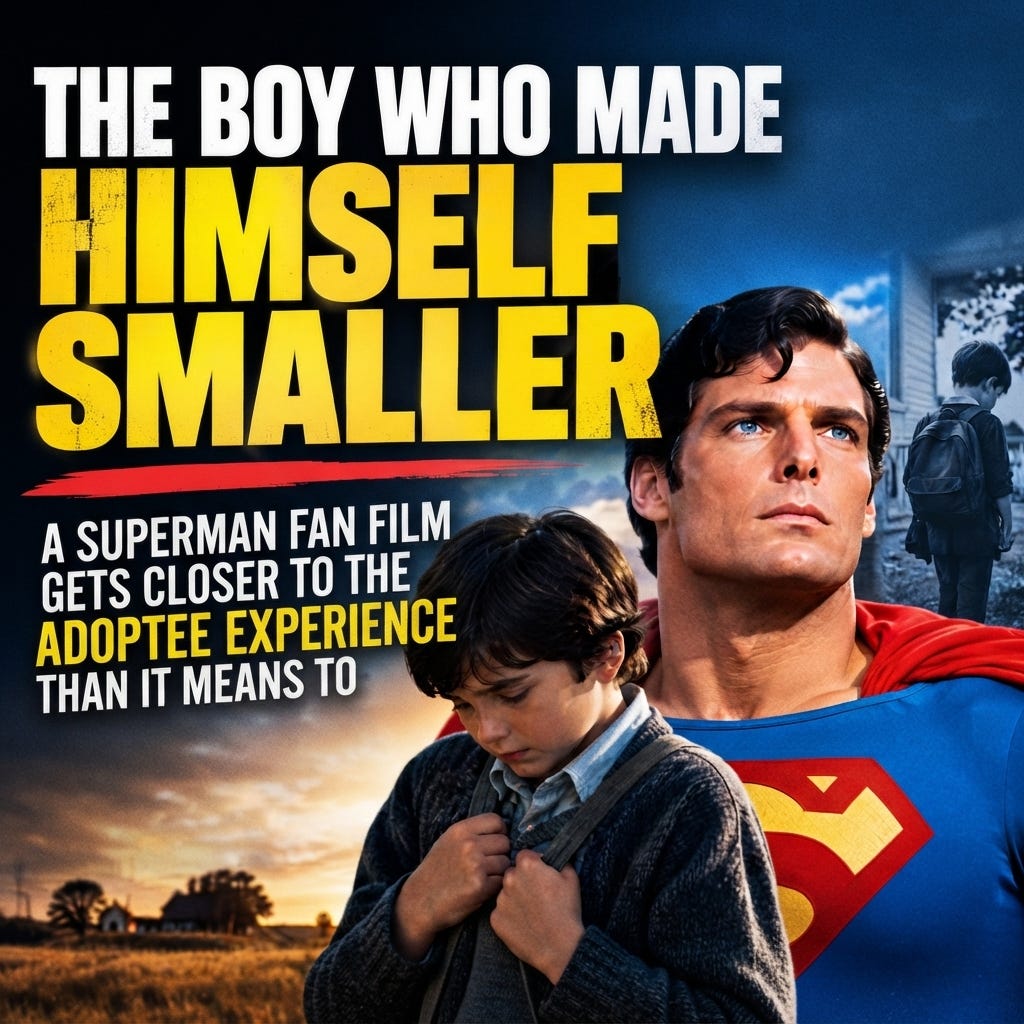
There’s a fan film doing the rounds called The Return of Superman — a Christopher Reeve tribute made by SWFX, twelve minutes of Clark Kent coming home to Martha after years away “searching for answers about who he is and where he came from.” It’s earnest, well-shot, clearly made with love for the 1978 original. It is also, without meaning to be, one of the more accurate depictions of adoptee psychology I’ve seen on a screen this year.
Not because of the spaceship. Because of one line.
Martha tells Clark she remembers something he used to do as a kid: “You’d make yourself smaller. Head down, shoulders in. Always trying not to take up quite so much room.” Clark’s answer is the whole thesis of the film, delivered like a throwaway: “I was trying not to stand out.”
The film treats this as an origin story beat — cute foreshadowing for the glasses, the slouch, the “mild-mannered” disguise he’s about to build. Watch it from inside adoption instead of from inside comic-book mythology, and the same line reads as something closer to a clinical observation. Making yourself smaller isn’t a superpower learning to hide. It’s a child managing a household’s tolerance for how much of him is allowed to exist.
“He knew who you were”
The emotional peak of the film is Martha telling Clark that his late father Jonathan “never needed an answer. He knew who you were.” It’s meant to land as unconditional love — the family that took him in didn’t need the alien backstory to accept him fully.
It’s a good scene. It’s also the line that every forced-adoption survivor I know would read completely differently, because the sentence only works if you already believe the family could know. Ours mostly didn’t ask. Sealed files, falsified or absent records, birth certificates rewritten to erase one set of parents and install another — the legal architecture of closed adoption in Australia was built specifically so nobody would have to know, and so nobody would go looking. Clark gets to grow up in a version of the story where curiosity is safe, where the not-knowing is temporary and resolves in a hug on a porch. Most of us grew up in the version where curiosity was treated as disloyalty, and where the “answers” — when we found them at all — came from us tearing through the record decades later, alone, against the system’s design, not from the parents’ garden.
Martha didn’t need to be told who Clark was. She raised him. She watched him. That’s real, and it’s rare, and it’s exactly the thing forced adoption is engineered to prevent on both sides of the equation: the birth mother who’s told to forget and move on, and the adoptee who’s told the file is closed for their own good.
The disguise as survival skill
The film’s most telling moment isn’t the reveal, it’s the method. Clark doesn’t invent “mild-mannered reporter” Clark Kent from nothing — Martha reaches back into an actual childhood behaviour, something he was already doing to survive being different in a small town, and repurposes it into a costume. The disguise works because it was never fake. He really did learn to hunch, to minimise, to fold the parts of himself that didn’t fit the room away before anyone could ask about them.
That’s not a superhero’s clever trick. That’s what a lot of adoptees do by age seven. You learn which parts of your face, your history, your questions are welcome at the dinner table, and you build a smaller, more portable version of yourself to bring downstairs. The difference is Clark gets to unfold again on request — Martha literally coaches him through it, tender and amused, in a kitchen that has never lied to him about where he came from. Most of us don’t get the coaching, and a lot of us don’t get to unfold at all. The smallness isn’t a phase you graduate out of into a disguise you control. For a lot of adoptees, it’s just the shape you’re stuck being.
What the film gets right anyway
I don’t say any of this to take a shot at the filmmakers — The Return of Superman isn’t trying to be about adoption, and it doesn’t need to be. But origin stories about a child raised by people who aren’t his biological parents, who has to reconcile a hidden history with the life he was given, were never going to be adoption-neutral territory. Superman’s whole mythology runs directly through the adoptee experience whether the writers intend it or not: the sealed origin, the found family, the question of which self is the “real” one, the fantasy that somewhere out there someone always secretly knew and always secretly approved.
It’s a good fantasy. It’s worth noticing how much of it is fantasy — and how much weight gets quietly loaded onto a twelve-minute fan film the moment you watch it as someone who actually lived the search instead of someone watching a hero find his.
YouTube
The Video has since been Removed by Warner Bros
This Substack is reader-supported. To receive new posts and support my work, consider becoming a free or paid subscriber.
Thoughtless Delineation is Shane Bouel’s forensic investigative publication on adoptee rights, identity erasure, and institutional accountability in adoption systems.
Resources