This is a free preview of a paid episode. To hear more, visit thoughtlessdel.substack.com
This one is not addressed to adoptees.
You already know this. You have lived it in your body for decades — the vertigo, the translation work, the grief with no name and no funeral. You don’t need this essay.
This one is for the people who thought they knew you.
The parents. The siblings. The extended family who watched you grow up and believed they were watching a person form. The friends who have known you for twenty years and are certain they know who you are. The partners who have shared a life with you and cannot understand why, after everything, you still seem to be somewhere else.
This is for them.
WHAT YOU WERE WATCHING
You were watching someone perform.
Not deliberately. Not deceptively. The person in front of you was not running a con. They were doing the only thing available to them — translating themselves, continuously and at considerable cost, into a version that the environment could receive.
You saw the translation. You thought you were seeing the person.
The distinction matters more than anything else in this essay, so let me be precise about it.
A child who grows up in the family they were born into builds a self in conditions that include friction, failure, and the particular safety of being known. They can be difficult. They can be themselves at their worst and survive it. They can say this isn’t me and have someone who knew them before they said it. The self that forms under those conditions has been tested against reality — against people who will push back, disagree, remember, and remain.
The child placed into adoption builds something different.
They build a self that works. A self calibrated to what the new environment requires — what makes the adults in the room comfortable, what earns safety, what keeps the placement stable. This is not manipulation. It is survival intelligence operating in a child who has already, at the most fundamental neurological level, registered that the original context disappeared. The body knows, even when the mind has no language for it yet, that belonging here is not guaranteed in the way it is supposed to be.
What you raised was the result of that calibration.
It was real. It functioned. It loved you, in the ways it had available. But it was not the unobstructed person. It was the person the circumstances permitted — and the circumstances, from the first moment of placement, included a structural condition that most adoptive families never name and many never see:
The child was already performing before you met them.
THE SPECIFIC PERSON THE DISSOLUTION MAKES
In “The 5 Hidden Forms of Identity Erasure, Ranked,” the Dissolution was described as the most complete form of identity erasure — the outcome when all five mechanisms run to completion. Here is what that produces. Not as abstraction. As a person you may recognise.
They read the room before they enter it.
This is not social skill, though it presents as social skill and is often admired as such. It is hypervigilance that has been refined over decades into something that looks like charm or emotional intelligence. They know what you need before you ask. They know when the atmosphere has shifted before anyone has said a word. They have been reading environments for danger signals since before they had language, and they are very, very good at it.
What it costs: they are exhausted in a way they cannot always explain. They are present in the room and somewhere else simultaneously. The question of what they themselves need is genuinely difficult to answer — not because they are selfless, but because the wanting-self did not get to form in conditions where its wants were the primary signal.
They are competent in ways that feel compensatory.
They built skills. They achieved. They became capable, reliable, often remarkable — because competence is the clearest available proof that the placement was worth it, that the gratitude is warranted, that the story of rescue was true. The achievement is real. The drive behind it is not purely intrinsic.
What it costs: when the competence is acknowledged, it lands somewhere adjacent to where it should. The praise is for the performance, and some part of them knows it.
They are loyal to the people who caused the harm.
They protect the family that raised them. They minimise, qualify, defend. They feel the harm and simultaneously insist it was not that bad, or that it came from love. This is not delusion. It is the structural outcome of a child who learned that the attachment relationship was the only one available, and that threatening it was more dangerous than absorbing the harm.
Their self-doubt is not general. It is precise.
They do not distrust themselves randomly. They distrust themselves at exactly the points where they are most accurate. When their account of events is clearest. When the mechanism is most visible. When the naming is most precise. That is when the doubt arrives — and that is not coincidence. It is the Gaslighting mechanism, installed early and running continuously, calibrated to activate when the truth gets close enough to threaten the covering story.
And underneath all of it — something that will not stop.
A signal. Persistent, subsonic, running beneath the performance and the competence and the loyalty and the doubt. The original self that the Dissolution was supposed to extinguish. It keeps making itself known — in the work they are drawn to, the things they cannot stop thinking about, the inexplicable grief that arrives without context, the sense that they are living adjacent to their own life rather than inside it.
That signal is not a symptom. It is evidence. It is the thing that survived.
UNTIL THEY AREN’T
At some point — and it is different for everyone, and it cannot be forced or scheduled — the performance becomes unsustainable.
Not because it failed. It didn’t fail. It worked, often extraordinarily well, for decades. It kept them functional and legible and loved, in the ways they could be loved by people who were seeing the translation rather than the person.
It becomes unsustainable because they survived long enough to not need it anymore.
Something breaks the covering story from the inside. A reunion. A document. A piece of writing that names the mechanism precisely enough that the body recognises it before the mind does. A conversation in which someone — for the first time — treats their account of their own experience as evidence rather than as sensitivity to be managed.
And then something that nobody around them has a map for begins to happen.
The person who was built by the Dissolution starts to put down the architecture that was built to survive it. The hypervigilance relaxes, partially, intermittently. The loyalty structures begin to shift. The competence is still there but it is no longer load-bearing in the same way. The self-doubt loses some of its precision because the Gaslighting is being named.
What this looks like from the outside — to you, the family, the partner, the friends of twenty years — is destabilisation. It looks like the person you knew becoming someone you don’t recognise. Anger that seems disproportionate. Grief that seems excessive. Withdrawal that seems ungrateful.
What it actually is: emergence.
The person you raised. Finally. Partially. Beginning to exist.
WHAT THIS ASKS OF YOU
What the emergence asks of you is this: to understand that the person you are now seeing is not a deterioration. They are not having a breakdown. They are not being manipulated by a support group or a therapist or an ideology.
They are meeting you, possibly for the first time, as something closer to who they actually are.
And what that requires from you is the willingness to grieve the person you thought you knew — the one who was easier, more grateful, more legible, more comfortable — while making room for the one who is actually there.
That grief is real. You loved the translation. You built a family around it. The loss of that version is not nothing, and you are not a monster for feeling it.
But here is what you need to understand about that grief: it is the smallest fraction of what has been lost. Because what was lost — what the architecture removed before you ever met them — was not a version. It was a person. The unobstructed, unperformed, uncalibrated person who would have existed if the conditions had been different.
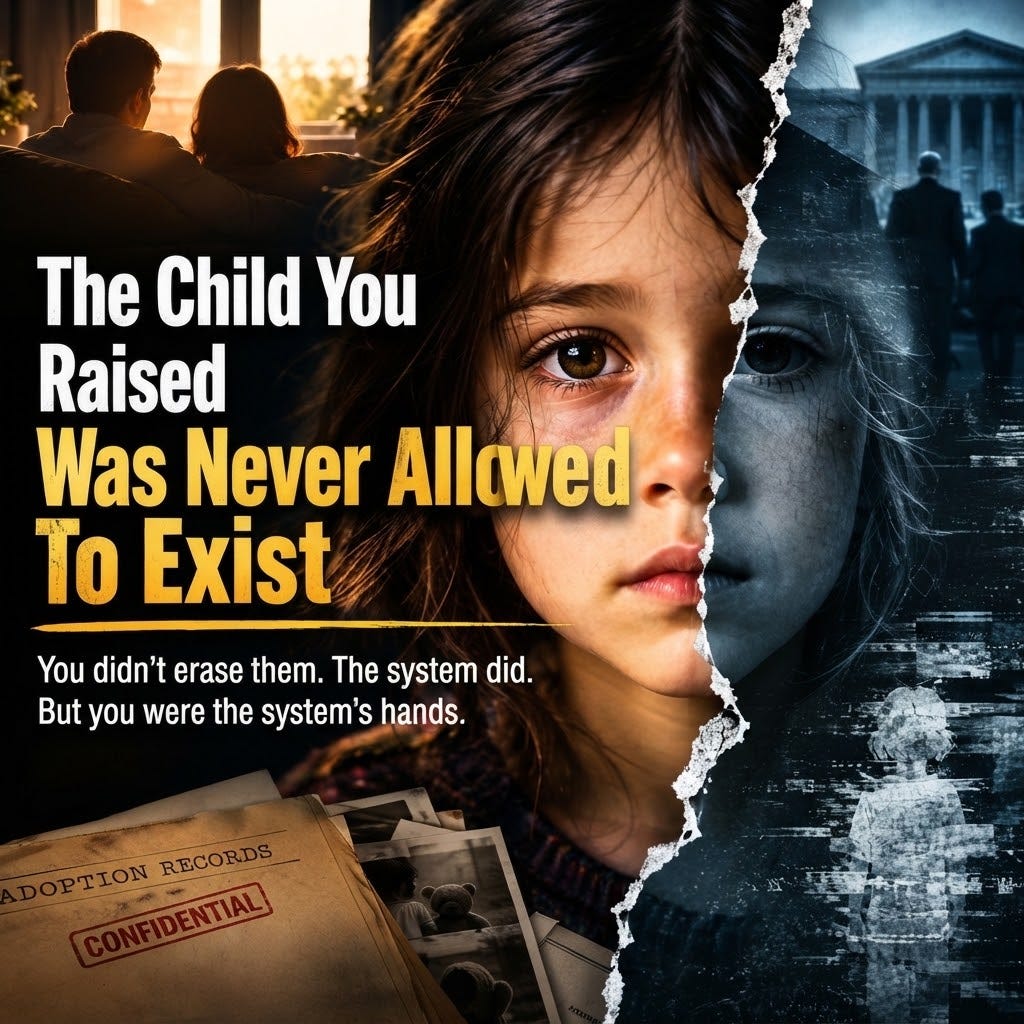
You didn’t erase them. The system did.
But you were the system’s hands. Not maliciously. Not consciously. You did what you were told — by the agency, by the law, by the cultural narrative of rescue and chosen-ness and gratitude. You sealed the story, kept the records closed, told the origin narrative in the version that was comfortable, and asked — implicitly, structurally, not cruelly — for a gratitude that required the child to locate the harm outside their experience of being claimed.
That is not condemnation. It is description.
And the description matters because the person in front of you now needs you to be able to hold it. Not to take responsibility for the whole architecture. You didn’t build it. But to acknowledge that you were inside it. That the love was real and the harm was also real and both of those things can be true simultaneously without either cancelling the other.
YOUTUBE
THE PERSON WHO IS STILL THERE
The signal didn’t stop. That is the thing to hold onto.
Underneath the performance, underneath the decades of translation and competence and inverted loyalty and precise self-doubt — the original person was still running. Diminished, interrupted, never given the conditions to fully form. But present.
The work of emergence is not the creation of a new self. It is the recovery of the one that was interrupted. It is slow and non-linear and has no clear endpoint and looks, from the outside, like instability. It is not instability. It is the most stable thing they have ever done — because for the first time, they are building on what is actually there rather than on what the architecture required.
You didn’t know them. That is not your fault. The system that placed them with you was designed to make knowing them difficult.
But they are there. They have always been there.
The child you raised was never allowed to exist. They are trying to exist now.
The question is whether you will be there when they do.
This Substack is reader-supported. To receive new posts and support my work, consider becoming a free or paid subscriber.
RESOURCES AVAILABLE FOR PAID SUBSCRIBERS
* Presentation Slide Deck
* Identity Translation and Survival Intelligence_ A Conceptual Framework Primer.pdf
* Clinical Practice Guide_ Navigating the Transition from Performance to Emergence in Adoptive Families.pdf
* Institutional Impact Assessment_ The Architecture of Identity Erasure in Adoption Systems.pdf
* Study Guide_ The Child You Raised Was Never Allowed To Exist.pdf
* SOCIAL GRAPHICS AND carousel